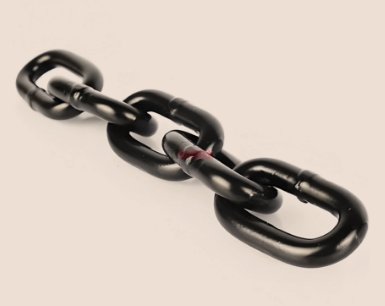
Anchor Chains: Types, Materials, Standards, and Applications in Marine Industry
Anchor chains are vital parts of a ship's anchoring system. They link the anchor to the vessel and ensure it holds securely in different sea and weather conditions. For shipowners, shipyards, and marine equipment suppliers, choosing the right anchor chain is crucial for safety, durability, and meeting regulations. This article covers the main types, materials, standards, and applications of anchor chains used in the global marine industry.
History of the Anchor Chain
1. A late 19th century-Early 20th Century:Progress in the steel industry allowed for the mechanization of anchor chain production. The British Royal Navy Standardized on stockless anchors with uniform anchor chains in 1903. The nature of the material used changed to high strength steel and heat treatment and surface anti-rust treatment was popularized.
2. Mid-20th Century:Anchor chain types(e.g. plate chains, round-link chains) were diversified, after the mechanized manufacture of chains on automated assembly lines was introduced. New materials and processes, for example the application of alloy steel and lead-free anti-corrosion to that required by bulk carriers, warships, and marine engineering.
3. 21st Century: Anchor chains develop towards refinement and high-end, high strength steel and corrosion resistance alloy are widely used, stud-link chains forming the mainstream. At the same time, dynamic positioning systems have partly displaced anchor chains in deep-sea applications, but anchor chains are still the principal mooring equipment for ships and offshore platforms, with production clusters in China, Japan and South Korea among other nations.
What is an Anchor Chain?
An anchor chain is a marine hardware component that connects an anchor to a boat, ship, offshore platform or mooring system. It is important to have the right thickness and weight of the chain to make anchoring safe and stable, and it is this characteristic that makes for a comfortable anchoring in any sea condition. Anchor chains are considered a must-have in the world of marine supply as they are frequently employed in commercial ships, offshore rigs, harbors, and marine engineering works.
Anchor chains have the following advantages in comparison to anchor ropes:
1. High strength and abrasion resistance
2. Good performance under severe marine environment condition
3. Longer life and higher safety margins
Main types of Anchor Chain
1. Stud Link Anchor Chain Stud link anchor chains 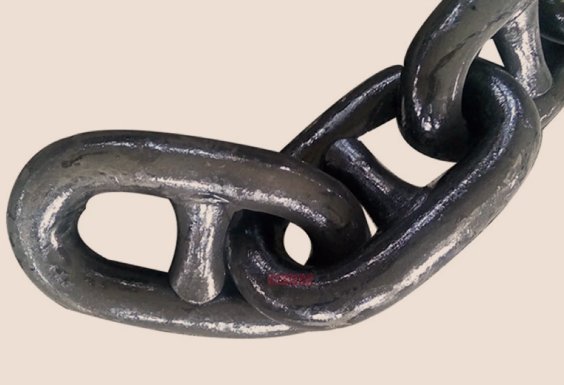
Contain a solid piece known as a stud through the middle of each link.
Advantages:
Better strength and load distribution
Lower deformation and twisting
Improved wear resistance
Applications:
Commercial vessels
Cargo ships
Tankers
Offshore platforms
In modern marine and most other applications, stud link chains prevail.
Studless anchor chains do not have a center stud.
Advantages:
Lighter weight
Easier handling and storage
Applications:
Smaller vessels
Special offshore applications
Mooring systems
Although studless chains have a lighter weight, they could be more subject to deformation when carrying heavy loads than the stud link chains do.
Materials Used for Anchor Chains
Anchor chains are usually made from high quality carbon steel or alloy steel to provide strength and good resistance to corrosion.
Common materials include:
CM490 (for U2 standard anchor chain)
CM690 (for U3 standard anchor chain)
All anchor chains undergo strict heat treatment and mechanical testing to meet international standards.
Anchor Chain Grades and Strength Levels
Anchor chains are classified by grade, which indicates their strength level.
Common grades include:
Grade U2 – Standard strength
Grade U3 – High strength
Higher grades provide greater breaking load and are suitable for large vessels and offshore installations.
International Standards for Anchor Chains
Including the following classification approvals :
CCS/ABS/DNV/BV/LR/NK
Third-party inspection and certification ensure quality, safety, and global acceptance.
Manufacturing Process of Anchor Chains
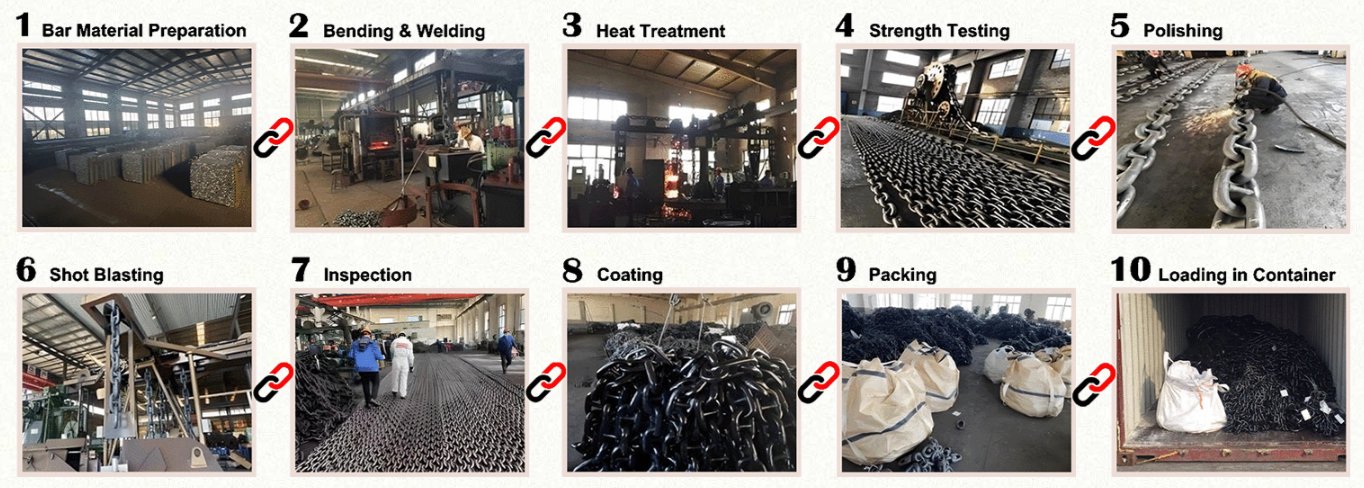
Applications of Anchor Chains
Anchor chains are widely used in:
Merchant vessels
Fishing boats
Tugboats
Offshore oil & gas platforms
Floating docks and mooring systems
Different vessel sizes and operating conditions require different chain sizes and grades.
How to Choose Anchor Chain?
When selecting an anchor chain, consider:
1. Vessel type and size
2. Anchor weight and windlass specifications
3. Required chain grade and diameter
4. Operating sea conditions
5. Applicable classification standards
Professional suppliers can provide technical support to ensure the correct selection.
Conclusion
Anchor chains are essential to vessel safety and stability on the water. Selection of appropriate type, grade and standard of anchor chain for good anchoring performance and long life of operation.
As a professional marine hardware manufacturer, we can offer you high quality anchor chain with worldwide certificates, customized size and dependable global delivery service to meet various marine requirements.
Leave A Message
Subscription email
4-1/401,No.26 Jingde Rd.,Qingdao Shandong,P.R.China
Copyright © 2025 QINGDAO RICHMAX IMPORT & EXPORT CO.,LTD All Rights Reserved.
 Powered by HiCheng


 English
 Español
 Français
 Árabe
Árabe
 Русский
 Português
 日本語
日本語
 한국어
한국어
 Dansk
Dansk
 Nederlands
 Italiano
 Türkçe
 Deutsch
 Prancis
 ไทย
ไทย
 Tiếng Việt
 हिंदी
हिंदी
 বাংলা
বাংলা
 中文
中文