Structure
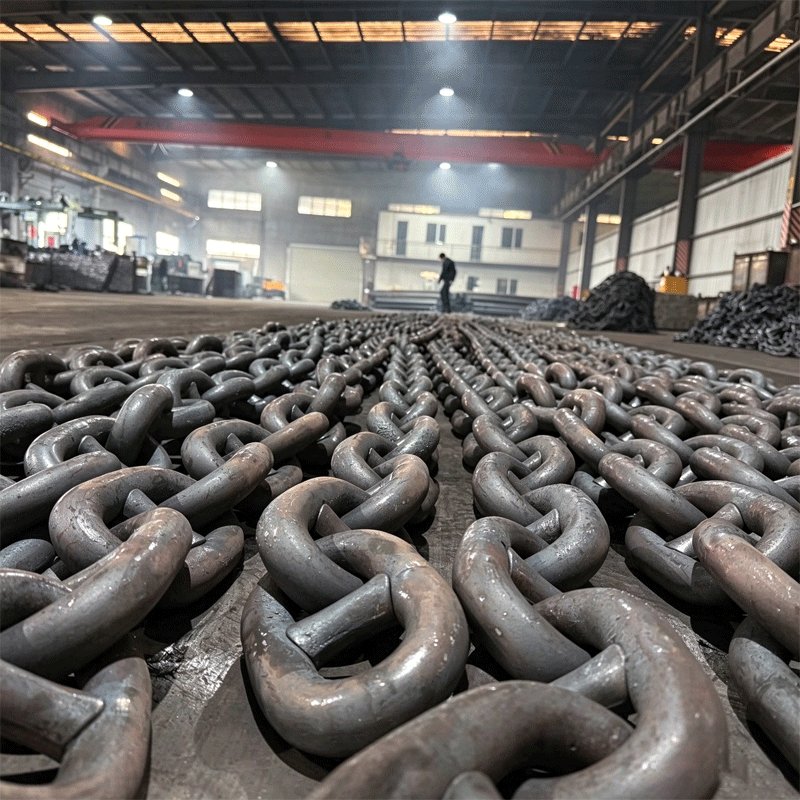
A Stud Link Anchor Chain consists of interconnected steel links, each fitted with a transverse stud across the inside of the link. It is commonly used in ship anchoring systems to transfer tensile loads between the anchor and the vessel.
The chain structure is designed to maintain link stability under tension while allowing adjacent links to articulate during deployment and recovery. Its mechanical performance depends on link geometry, material properties, weld quality and the dimensional compatibility of the complete anchoring system.
1. Chain Link
Main Load-Bearing Component
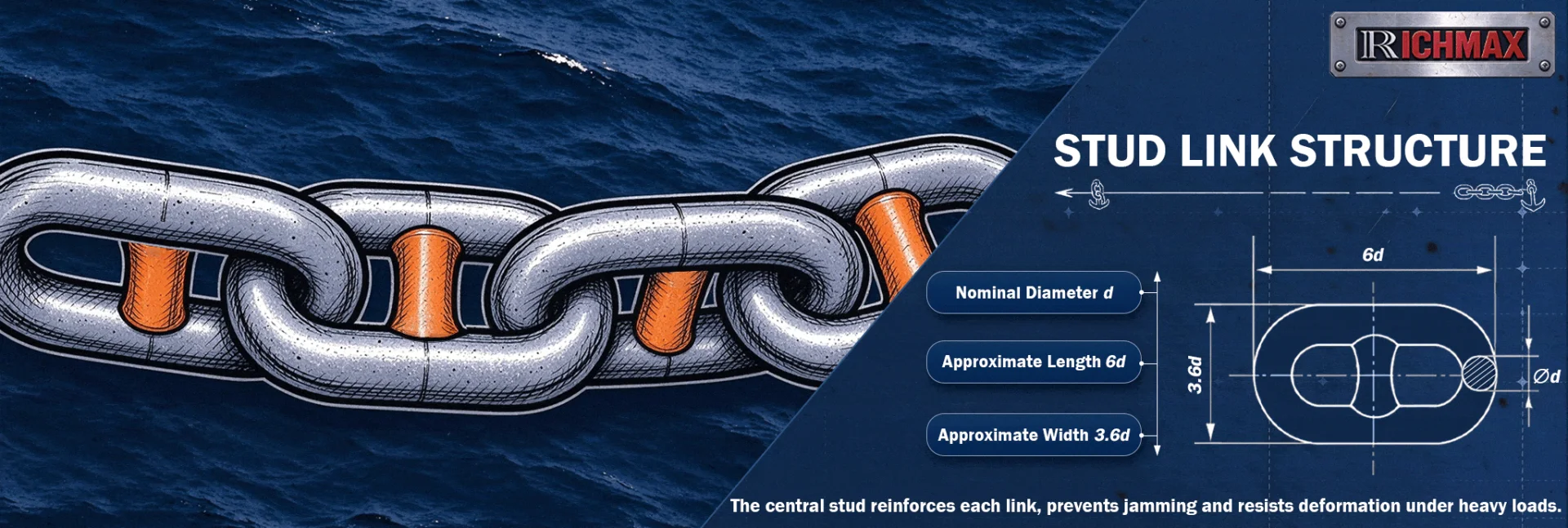
The chain link is the primary load-bearing component of a Stud Link Anchor Chain. Under tension, the load is transferred through the contact areas between adjacent links, placing the curved link body under tensile stress and localized contact pressure.
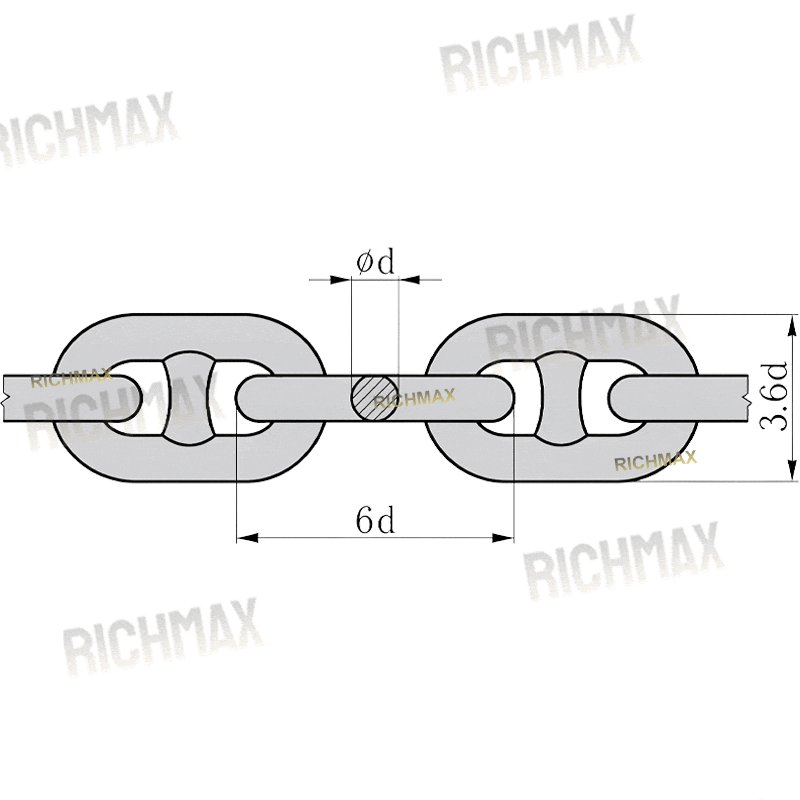
The main dimensions include:
These dimensions determine the chain's articulation, dimensional consistency and compatibility with the windlass gypsy and connecting components.
Nominal diameter alone is insufficient for confirming compatibility. The actual link dimensions and applicable manufacturing standard must also be considered.
2. Stud
Transverse Stud and Its Function
The stud is positioned across the internal opening of each link. It helps maintain the link's shape under tensile loading and limits excessive deformation.
The stud also contributes to the dimensional stability of the link during repeated loading and handling. Its position, dimensions and attachment method must comply with the applicable manufacturing specification.
The main tensile load is carried through the link body and the contact areas between adjacent links. The stud supports link stability rather than acting as an independently rated load-bearing component.
3. Load Transfer and Structural Performance
Tensile Loading and Contact Stress
When the anchor chain is under tension, the load passes through successive links via their contact areas. The distribution of stress depends on link geometry, contact position, material properties and loading direction.
Under normal axial loading, the chain is designed to withstand the specified loads for its chain grade.
Side loading, twisting or improper alignment can introduce additional local stresses and affect the chain's structural condition.
Dynamic Loading and Wear
During vessel movement, anchoring and recovery, the chain may experience repeated changes in tension.
These loading cycles can contribute to fatigue damage, while contact between adjacent links causes gradual wear. In seawater, corrosion may further reduce the effective cross-sectional area of the link.
The chain's service condition therefore depends on its loading history, material properties, manufacturing quality and maintenance.
4. Connecting Components
| Main Connecting Components |
| Anchor shackles | Joining shackles | Kenter shackle |
| End link | Enlarged links | Swivel forerunner |
These components must be compatible with the chain's dimensions, mechanical grade and connection requirements. Improper matching may cause interference, unfavorable load transfer or installation difficulties.
5. Material and Manufacturing
Stud Link Anchor Chains are manufactured from steel grades specified for the required chain grade and applicable standard.
The manufacturing process typically involves link forming, welding, stud fitting and, where required, heat treatment.
Key manufacturing controls include:
Material identification and traceability
Link dimensions and forming accuracy
Welding quality and process control
Stud position and attachment
Heat treatment where specified
Mechanical testing and dimensional inspection
These controls help ensure that the chain meets the specified mechanical properties, dimensional tolerances and inspection requirements.
6. Structural Failure Modes
The main damage mechanisms affecting Stud Link Anchor Chains include:
Wear and Cross-Section Reduction: Repeated contact between links gradually removes material from bearing surfaces, reducing the effective load-bearing section.
Corrosion: Seawater exposure may cause general or localized corrosion, affecting the link body, stud and welded areas.
Fatigue Cracking: Repeated loading may contribute to cracks in areas subject to stress concentration, particularly where surface defects or unfavorable contact conditions exist.
Link Deformation: Excessive loading or improper handling may cause permanent deformation, affecting link articulation and dimensional compatibility.
Stud Damage: A loose, displaced or damaged stud may affect link stability and should be assessed against the applicable inspection criteria.
Weld Defects: Weld discontinuities may compromise structural integrity and must be evaluated according to the relevant manufacturing and inspection requirements.
7. Stud Link vs Studless Anchor Chain
The main structural difference is the presence of a transverse stud inside each link.
| Structural Aspect | Stud Link Chain | Studless Chain |
| Link structure | Transverse stud fitted inside each link | No transverse stud |
| Link stability | Stud helps maintain link geometry | Stability depends on link geometry and material |
| Internal opening | Divided by the stud | Unobstructed |
| Manufacturing | Requires control of link forming, welding and stud fitting | Requires control of link forming, welding and geometry |
| System compatibility | Must match the specified windlass and connecting hardware | Must match the specified windlass and connecting hardware |
The two chain types are not automatically interchangeable. Link geometry, mechanical properties, connection dimensions and windlass compatibility must be verified before replacement.
8. Classification and Manufacturing Standards
The applicable requirements depend on the chain grade, manufacturing standard, vessel design and classification requirements.
The specification may cover:
Material grade and mechanical properties
Link dimensions and tolerances
Welding and heat treatment
Proof load and breaking load
Testing, inspection and marking
Traceability and certification
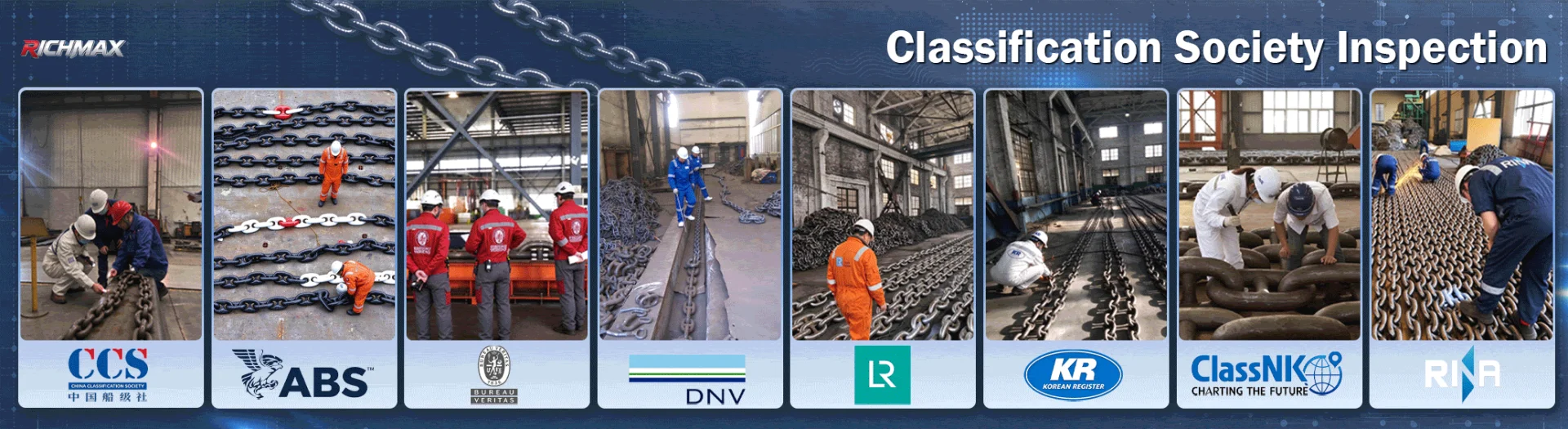
For classification-controlled projects, the applicable rules and certification scope should be confirmed before production. Classification societies may include DNV, ABS, Lloyd's Register, Bureau Veritas and ClassNK, depending on the project requirements.
9. Compatibility with the Anchoring System
A Stud Link Anchor Chain must be compatible with the vessel's complete anchoring arrangement.
Windlass: The chain dimensions and link geometry must match the windlass gypsy or wildcat to ensure proper engagement during deployment and recovery.
Chain Stopper: The stopper must accommodate the specified chain dimensions and function according to the vessel's anchoring arrangement.
Anchor and Connecting Hardware: The chain end connections, shackles and anchor connection must match in dimensions, mechanical properties and installation configuration.
Before procurement, buyers should confirm the chain diameter, grade, length, applicable standard, link dimensions, connecting components, windlass compatibility and certification requirements.
The final specification should follow the vessel's approved anchoring arrangement and the applicable project requirements.
Material
Material Advantages
1. Raw Material and Steel Grade
Stud Link Anchor Chain is manufactured from steel specifically selected for marine chain production. The steel must meet the chemical composition and mechanical property requirements of the specified chain grade and applicable manufacturing standard.
AM2 and AM3 are commonly used grades for marine stud link anchor chains. They differ in their required mechanical properties and intended load-bearing capacity.
AM2 steel is used for anchor chains requiring a defined level of tensile strength, ductility and toughness. Its mechanical properties are established through material selection and controlled manufacturing processes.
AM3 steel is designed for higher mechanical strength than AM2. It is used in anchor chain systems requiring a higher specified strength level, subject to the applicable standard and classification requirements.
The selection between AM2 and AM3 should be based on the vessel's approved anchoring arrangement, chain diameter, design loads and classification requirements.
2. Chemical Composition Control
The chemical composition of chain steel affects its strength, toughness, hardenability and response to heat treatment.
Elements such as carbon, manganese and alloying elements are controlled within the limits specified for the relevant steel grade.
Carbon content influences strength and hardenability, while manganese and other alloying elements contribute to the steel's mechanical properties and heat-treatment response.
Chemical composition must be controlled within the specified range. Excessive or insufficient alloying elements may affect the balance between strength, ductility and toughness.
Material verification should be based on the applicable steel specification and material test documentation.
3. Mechanical Properties
Anchor chain steel must provide sufficient strength and toughness to withstand the tensile loads generated during anchoring operations.
The main mechanical properties include:
Yield Strength: Determines the stress level at which permanent deformation begins.
Tensile Strength: Indicates the maximum tensile stress the material can withstand before fracture.
Elongation: Reflects the material's ability to deform plastically before fracture.
Reduction of Area: Indicates the degree of local deformation before fracture.
Impact Toughness: Reflects the material's ability to absorb energy under impact loading at a specified temperature.
AM2 and AM3 have different specified mechanical property requirements. Higher strength does not automatically mean better performance under every operating condition.
The required balance between strength, ductility and toughness is essential for anchor chains exposed to repeated loading and changing marine conditions.
4. Heat Treatment and Mechanical Performance
Heat treatment is a critical manufacturing process for achieving the required mechanical properties of stud link anchor chains.
Depending on the chain grade and manufacturing procedure, heat treatment may involve normalizing, quenching and tempering, or other approved processes.
These processes modify the steel's microstructure and help establish the required combination of strength, toughness and ductility.
For AM2 and AM3 chains, the heat-treatment procedure must be compatible with the specified steel grade and manufacturing requirements.
Temperature, holding time and cooling conditions must be controlled to ensure consistent properties throughout the chain links.
Proper heat treatment helps reduce undesirable variations in mechanical properties and supports the chain's ability to withstand working loads.
5. Corrosion Resistance in Seawater
Conventional AM2 and AM3 anchor chain steels are carbon or low-alloy steels. They are not inherently resistant to seawater corrosion in the same way as stainless steel.
Their corrosion protection generally depends on surface treatment, protective coatings where applicable, lubrication and maintenance.
In seawater, the steel surface is exposed to chloride ions, dissolved oxygen and other environmental factors that promote corrosion.
Protective measures can slow corrosion, but they do not eliminate the risk of material loss during long-term service.
The corrosion performance of an anchor chain therefore depends on both its material characteristics and the conditions in which it is used.
6. Material Testing and Classification Certification
Material inspection and testing are carried out according to the applicable manufacturing standard, purchase specification and classification requirements.
Depending on the order, verification may include:
Chemical composition analysis
Tensile testing
Impact testing
Hardness testing, where specified
Material certificate verification
Heat-treatment record review
Steel heat number and material traceability
Classification society inspection and certification, where required
For classified anchor chains, the required inspection and certification procedures should be agreed upon before production.
Material certificates and test reports provide evidence of compliance with specified requirements. They do not, by themselves, guarantee the chain's performance under every operating condition.
Material Precautions
1. Trade-Offs Between Strength and Toughness
Higher tensile strength does not necessarily translate into better resistance to all forms of damage.
As steel strength increases, the material's sensitivity to certain manufacturing defects, stress concentrations and unsuitable heat-treatment conditions may also increase.
For anchor chains, strength must be considered together with ductility, impact toughness and resistance to repeated loading.
AM3 is specified for a higher strength level than AM2, but this does not mean that AM3 is automatically suitable for every anchoring system.
The material grade must match the chain design, equipment requirements and operating conditions.
2. Common Material Defects in Inferior Anchor Chains
Anchor chains manufactured from inadequately controlled steel may contain defects that affect their mechanical properties and service life.
Potential material-related problems include:
Uncontrolled Chemical Composition: Deviations from the specified composition may result in inconsistent strength, toughness or heat-treatment response.
Non-Metallic Inclusions: Excessive inclusions may act as local stress concentration points and contribute to crack initiation under repeated loading.
Segregation: Chemical inhomogeneity within the steel may lead to variations in microstructure and mechanical properties.
Internal Defects: Porosity, shrinkage cavities or other internal discontinuities may reduce the effective load-bearing section.
Insufficient Toughness: Steel that meets a strength requirement but lacks adequate toughness may be more susceptible to brittle fracture under unfavorable conditions.
These defects cannot always be identified through visual inspection alone.
Material testing, manufacturing process control and appropriate nondestructive examination are required according to the applicable technical specification.
3. Risks Associated with Improper Heat Treatment
Improper heat treatment may prevent the steel from achieving its specified mechanical properties.
Insufficient heating or unsuitable cooling conditions may result in an inconsistent microstructure or inadequate strength.
Excessive heating, inappropriate cooling rates or incorrect tempering conditions may affect toughness, hardness and residual stress.
Potential consequences include:
Non-uniform mechanical properties between chain links
Excessive hardness or insufficient toughness
Increased susceptibility to cracking
Reduced resistance to repeated loading
Inconsistent performance during service
Heat-treatment control should therefore include process records and verification of the final mechanical properties.
The acceptance criteria must follow the applicable chain grade and manufacturing specification.
4. Corrosion Fatigue in Seawater
Anchor chains are exposed to repeated tensile loading during vessel movement, changes in environmental conditions and anchoring operations.
When cyclic loading occurs in a corrosive seawater environment, corrosion fatigue may develop.
Corrosion can create surface pits and localized defects. These features act as stress concentration points and may initiate cracks under repeated loading.
Once a crack forms, continued cyclic loading may cause it to grow, even when the applied stress remains below the material's nominal tensile strength.
The combined effects of corrosion and cyclic loading can reduce the chain's fatigue life.
Areas exposed to wear, coating damage, contact between links and localized stress concentrations require particular attention during inspection.
5. Material Degradation During Service
The mechanical properties of properly manufactured steel do not necessarily decline simply because the chain has been in service for a certain period.
However, the chain's overall load-bearing condition may deteriorate through corrosion, wear, deformation, cracking and other forms of damage.
Common degradation mechanisms include:
Corrosion: Reduces the effective cross-sectional area of the steel.
Wear: Gradually removes material from contact surfaces between links.
Pitting: Creates localized surface cavities that may initiate cracks.
Fatigue: Allows cracks to develop and grow under repeated loading.
Permanent Deformation: May indicate that the chain has experienced loads beyond its intended elastic range.
The actual condition of a chain depends on its operating environment, loading history, maintenance and inspection results.
Service life should not be determined solely by the original material grade or manufacturing date.
6. Application Limits of AM2 and AM3 Steel
AM2 and AM3 are standardized anchor chain grades with different mechanical property requirements.
AM2 is suitable for anchoring systems designed around its specified strength and mechanical properties.
AM3 is intended for systems requiring a higher specified strength level, subject to the applicable chain standard and classification approval.
Neither grade should be selected solely on the basis of nominal tensile strength.
The following factors should be considered:
Vessel type and approved anchoring arrangement
Chain diameter and required proof and breaking loads
Windlass and chain stopper compatibility
Classification society requirements
Operating water depth and environmental conditions
Expected loading cycles and maintenance arrangements
AM3 should not be treated as a direct replacement for AM2 without confirming system compatibility and applicable approval requirements.
The final selection must comply with the vessel's approved design and the relevant chain manufacturing standard.
How to Use Stud Link Anchor Chain?
Stud Link Anchor Chain is used to connect the anchor to the vessel's anchoring system and transmit loads during anchoring and mooring operations.
Correct use involves selecting a chain that matches the vessel's requirements, installing the connecting components properly, controlling chain movement during anchor deployment and retrieval, and carrying out regular inspection and maintenance.
The chain should be operated according to the vessel's approved anchoring procedures, equipment specifications and applicable classification requirements.
1. Chain Selection and Compatibility
The chain should be selected according to the vessel's anchoring arrangement, operating conditions and specified mechanical requirements.
Chain diameter and grade should be determined according to the vessel's design requirements, anchoring equipment and applicable standards.
Common marine anchor chain grades include AM2 and AM3 under applicable marine chain specifications. The required grade should be confirmed against the vessel's approved documentation.
Selection should consider:
Vessel type and displacement
Operating water depth
Expected environmental loads
Anchor type and weight
Chain diameter and grade
Required chain length
Windlass and chain stopper compatibility
A chain with an insufficient grade or diameter may not meet the required load capacity.
The chain length should be determined according to the vessel's anchoring arrangement and operating conditions.
The chain should be compatible with the anchor and connecting components, including:
Anchor, Anchor shackle, Kenter joining shackle, Swivel, End links
The dimensions and load ratings of these components should correspond to the specified chain and anchoring system.
2. Installation and Assembly
Stud Link Anchor Chain should be assembled according to the approved arrangement and the manufacturer's installation instructions.
Kenter joining shackles are commonly used to connect individual chain lengths or shots.
The shackle should match the chain diameter, grade and connection dimensions.
Before assembly, check the following:
Connecting components are compatible with the chain.
Pins and locking arrangements are correctly installed.
Connecting surfaces are free from visible damage.
The assembled connection allows the chain to articulate correctly.
Incorrect assembly may cause interference, uneven loading or damage to the connecting components.
Where a swivel is specified, it should be installed in the direction and position required by the approved anchoring arrangement and component manufacturer's instructions.
The connection should allow the intended movement without interference with adjacent links or fittings.
Incorrect installation may affect the intended swivel function and introduce unwanted torsion into the chain assembly.
Chain marking is used to identify individual shots and indicate the amount of chain deployed.
Marking rings or other approved identification methods should be installed according to the vessel's chain-marking arrangement.
The markings should remain identifiable during operation and maintenance.
The chain should pass correctly through the hawse pipe, chain pipe, windlass chain wheel and chain stopper.
Before operation, confirm that:
The chain wheel matches the chain dimensions and profile.
The chain runs freely through the chain path.
The chain stopper engages correctly.
The chain does not rub excessively against surrounding structures.
The chain can enter the chain locker without obstruction.
Incorrect alignment may cause abnormal wear, chain jamming or damage to the equipment.
3. Anchor Deployment
Anchor deployment should follow the vessel's approved anchoring procedure and the operating instructions for the windlass and associated equipment.
Before releasing the anchor, check the condition of the chain, connecting components and chain-handling equipment.
The inspection should include:
Chain condition and visible deformation
Connecting shackle pins and locking arrangements
Windlass and chain stopper condition
Chain markings
Chain path and chain locker arrangement
Communication between the personnel involved in the operation
Any identified defect should be assessed before the anchoring operation proceeds.
The chain should be released at a controlled speed according to the vessel's operating procedure.
The release speed should account for water depth, vessel movement, anchor descent and the operating limits of the windlass and chain-handling equipment.
Sudden acceleration or uncontrolled chain release may create impact loads on the chain and associated equipment.
The amount of chain deployed should be determined according to water depth, seabed conditions, vessel characteristics, weather and the approved anchoring procedure.
Chain scope is generally considered in relation to the vertical distance between the anchor handling point and the seabed, but the appropriate scope depends on the complete anchoring arrangement.
A fixed water-depth multiple should not be applied to every anchoring situation.
Confirming Anchor Holding
After the required chain has been deployed, the vessel's personnel should confirm that the anchor has engaged the seabed and that the anchoring arrangement is holding as intended.
Confirmation should follow the vessel's approved procedure and take account of vessel movement, chain behavior and environmental conditions.
The chain should not be subjected to sudden loading before the anchor's holding condition has been assessed.
4. Anchor Retrieval
Anchor retrieval should be carried out according to the vessel's operating procedures and the windlass manufacturer's instructions.
The chain should be recovered at a controlled speed appropriate to the vessel's equipment and operating conditions.
The windlass should not be subjected to loads exceeding its specified operating limits.
Where the anchor is heavily loaded, the vessel's approved procedure should be followed to reduce the load before recovery.
During retrieval, the chain should remain correctly engaged with the windlass chain wheel.
The chain stopper should be operated according to its intended function and the vessel's procedures.
Personnel should monitor the chain's movement and check for abnormal vibration, slipping, jamming or interference.
As the anchor approaches the hawse pipe, its movement should be controlled to prevent impact with the hull or surrounding structures.
The anchor should be secured in its designated stowed position according to the vessel's approved procedure.
The chain should be properly arranged in the chain locker to prevent excessive tangling or obstruction during subsequent operations.
5. Storage and Maintenance
Proper storage and maintenance help control corrosion, wear and deterioration of the chain and its connecting components.
The chain should be stored in the designated chain locker according to the vessel's arrangement.
The chain should be allowed to run and pile naturally without obstruction.
The chain locker should be checked for conditions that may interfere with chain movement or contribute to excessive corrosion.
Where required by the vessel's maintenance procedure, the chain may be rinsed with fresh water to remove accumulated salt and deposits.
Cleaning methods should be suitable for the chain's material and surface protection system.
The chain and connecting components should be inspected for corrosion and surface coating damage.
Where protective coatings are specified, damaged areas should be assessed and treated according to the approved maintenance procedure.
Lubrication should be applied only where appropriate for the component design and manufacturer's instructions.
Chain markings should be checked periodically to ensure that shot identification and chain-length indications remain readable.
Damaged or missing markings should be restored according to the vessel's marking arrangement.
6. Periodic Inspection
Stud Link Anchor Chain should be inspected at intervals specified by the vessel's maintenance plan, applicable classification requirements and relevant regulations.
Inspection frequency depends on the chain's service conditions, operating history and observed condition.
Dimensional inspection may include:
Chain link diameter
Link length and width
Stud condition and position
Connecting shackle dimensions
Areas showing significant wear or deformation
Measurements should be compared with the applicable original dimensions and acceptance criteria.
Visual inspection should cover the chain links, studs, connecting components and accessible weld areas where applicable.
The inspection should identify:
Cracks
Excessive wear
Corrosion
Link deformation
Loose or displaced studs
Damaged connecting components
Abnormal surface damage
Chain wear should be assessed by measuring the relevant cross-sectional dimensions at locations identified by the inspection procedure.
Measured values should be compared with the applicable wear limits.
Chains that exceed the permitted wear limits should be assessed for repair, replacement or withdrawal from service according to the applicable requirements.
NDT may be required when specified by the inspection plan, classification society or applicable standard.
The method and inspection scope should be determined according to the component, suspected defect and governing requirements.
Inspection Records
Inspection records should include the inspection date, chain identification, measured dimensions, observed defects and assessment results.
Any repair, replacement or withdrawal from service should be documented according to the vessel's maintenance and inspection procedures.
7. Common Operating Errors and Risks
Incorrect selection, assembly or operation may affect the chain's mechanical performance and the reliability of the complete anchoring system.
Using a chain grade or diameter that does not meet the vessel's requirements may result in insufficient load capacity.
Chain selection should be based on the approved anchoring arrangement rather than nominal diameter alone.
Incorrectly installed joining shackles, swivels or other connecting components may interfere with chain articulation and introduce abnormal loading.
All connecting components should be assembled according to the approved arrangement and manufacturer's instructions.
High-speed chain release, sudden stopping or abrupt loading may generate impact forces on the chain and associated equipment.
Chain movement should be controlled according to the vessel's operating procedure.
Severe weather, strong currents and other environmental conditions may increase the loads acting on the anchoring system.
The vessel's operating limits and approved procedures should be followed when assessing whether the anchoring arrangement remains suitable for the prevailing conditions.
Failure to inspect wear, corrosion and component condition may allow deterioration to remain undetected.
Inspection and maintenance should be carried out according to the vessel's maintenance plan and applicable requirements.
The following conditions require prompt assessment against the applicable acceptance criteria:
Missing or displaced studs
Cracks in chain links or connecting components
Excessive cross-sectional wear
Permanent deformation
Damaged or insecure connecting components
Other defects affecting the chain's structural integrity
A chain with defects that may affect its load-bearing capacity should not be returned to service until its condition has been assessed and the required corrective action completed.
8. Operational Safety
Stud Link Anchor Chain should be operated by trained personnel in accordance with the vessel's approved procedures.
Personnel should remain clear of hazardous chain movement areas and follow the vessel's communication and equipment-control procedures during anchoring and retrieval.
The chain, anchor, connecting components and chain-handling equipment should be treated as one integrated system. The operating condition of each component affects the overall anchoring arrangement.
Application
Stud Link Anchor Chain is used in marine anchoring systems to connect the anchor to the vessel's anchoring equipment.
Its application depends on the vessel type, anchoring arrangement, chain grade, nominal diameter and operating conditions.
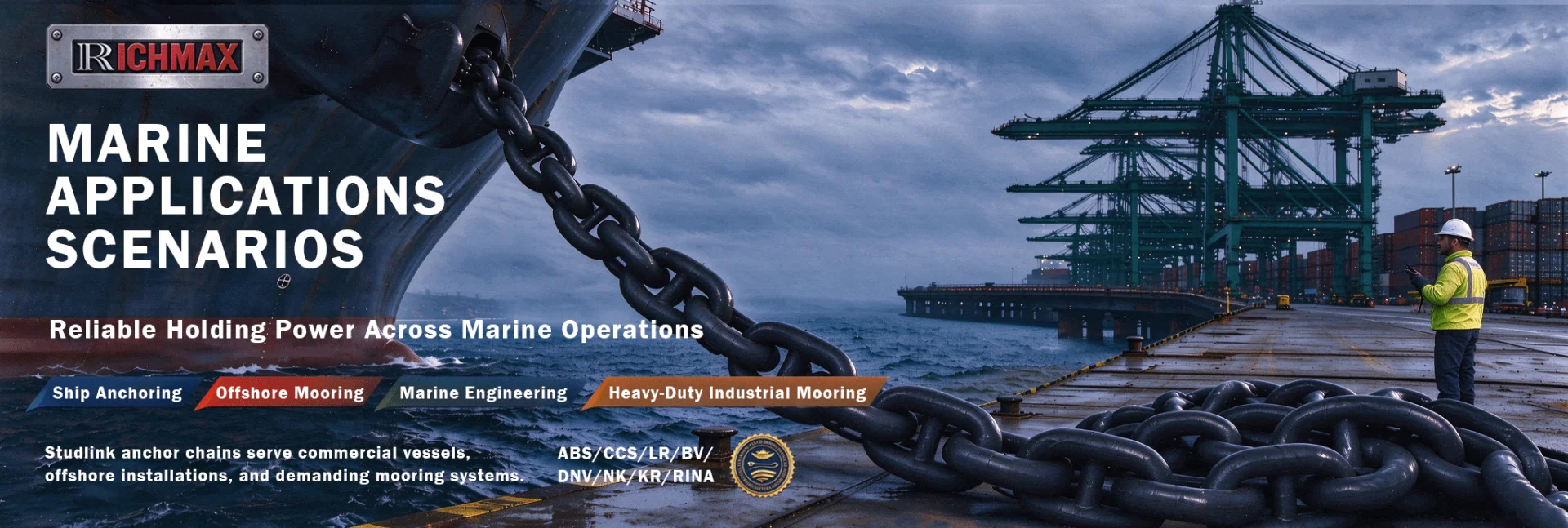
Commercial Vessels
Used in the anchoring systems of bulk carriers, container ships, general cargo vessels and other commercial vessels.
The chain connects the anchor to the vessel's windlass and chain stopper. Its dimensions and grade are specified according to the vessel's anchoring system.
Tankers
Used in the anchoring systems of oil tankers, chemical tankers and other tank vessels.
Chain selection should consider the vessel's approved specifications, equipment compatibility and operating environment. Additional corrosion protection may be required for specific service conditions.
Offshore Vessels
Used on offshore support vessels, construction vessels and other marine engineering vessels equipped with conventional anchoring systems.
For offshore applications involving repeated loading or prolonged exposure to environmental forces, chain strength, fatigue requirements and connection details should be checked against the project specifications.
Work Boats and Service Vessels
Used in the anchoring systems of work boats, harbor service vessels and other working vessels.
The chain diameter, grade and length should correspond to the vessel's displacement, operating water depth and anchoring equipment.
Yachts and Recreational Vessels
Used on larger yachts and recreational vessels where the anchoring system is designed for Stud Link Anchor Chain.
Chain dimensions should match the anchor, windlass and chain storage arrangement.
For smaller vessels with light anchoring requirements, other chain types may be considered according to the system design.
Applications by Operating Environment
Coastal and Nearshore Anchorage
Used for anchoring commercial vessels, work boats and service vessels in coastal and nearshore waters.
Chain length and grade are determined by water depth, seabed conditions, vessel characteristics and expected loads.
Offshore and Deep-Water Operations
Used in anchoring systems where the chain specification meets the requirements of the offshore installation.
Selection should account for water depth, suspended chain weight, environmental loads and the configuration of the anchoring system.
Permanent offshore mooring systems require chain specifications based on the project's engineering requirements.
Temporary Mooring
Used in temporary anchoring arrangements for marine construction, floating equipment and other marine operations.
The chain specification depends on the required load capacity, connection arrangement and duration of use.
Exposed Waters
Used in anchoring systems exposed to wind, waves and currents.
Changes in chain tension should be considered when selecting the chain grade and evaluating fatigue requirements.
The chain must meet the specified mechanical properties and operating limits.
Applications by Functional Purpose
Main Anchor Chain
Used to connect the vessel's main anchor to the anchoring equipment.
The chain transfers tensile loads during anchor deployment, retrieval and anchoring operations.
Chain diameter, grade and length are specified according to the vessel's approved anchoring arrangement.
Spare and Replacement Anchor Chain
Used as a spare or replacement for an existing anchor chain.
Replacement specifications should include:
Nominal diameter and chain grade.
Link dimensions and chain length.
End connections and connecting components.
Applicable manufacturing standard.
Required inspection and certification.
The replacement chain should be compatible with the existing windlass, chain stopper and anchor connection.
Floating Structures and Mooring Systems
Used in certain mooring arrangements for floating structures and marine equipment.
The chain specification depends on the mooring design, expected loads, water depth and connection details.
For permanent offshore installations, selection should follow the approved mooring system design.
Port and Harbor Anchorage
Used in anchoring systems for vessels operating in ports and harbor areas.
For temporary anchoring of marine equipment, chain selection should follow the system's load requirements and applicable operating specifications.
Structural Characteristics in Marine Applications
Link Deformation Resistance
The transverse stud helps maintain the shape of individual chain links under tensile loading.
The chain's resistance to deformation depends on its grade, dimensions, manufacturing quality and loading conditions.
Link Alignment
The stud helps maintain the geometry of individual links and reduces the tendency of links to become distorted during handling.
Chain twisting may still occur due to installation conditions, anchor rotation and the configuration of the anchoring system.
Repeated Loading
Marine anchoring systems may experience changes in chain tension during vessel movement and anchoring operations.
For applications involving frequent load cycles, fatigue requirements should be considered according to the applicable technical specifications.
Equipment Compatibility
Stud Link Anchor Chain is used with compatible anchors, windlasses, chain stoppers and connecting components.
Nominal diameter, link dimensions and chain grade should match the requirements of the anchoring system.
Application Limitations
Light-Duty Mooring
For light-duty mooring in sheltered waters, Stud Link Anchor Chain may not be necessary.
Other chain types may be considered if they meet the required load capacity, equipment compatibility and applicable technical requirements.
Corrosive Environments
In highly corrosive environments, material selection and corrosion protection should be evaluated according to the operating conditions.
Additional surface treatment or a different material specification may be required.
Load Limits
The chain must not be subjected to loads exceeding its specified limits.
Allowable working load and breaking force are different parameters and should not be used interchangeably.
Abrasive Contact
Continuous friction against abrasive surfaces, sharp edges or rough seabed materials can accelerate chain wear.
Applications involving repeated abrasive contact require regular inspection of link dimensions and surface condition.
Lifting and Hoisting
Stud Link Anchor Chain intended for marine anchoring should not be used for lifting or hoisting unless it is specifically designed and approved for that purpose.
Marine anchor chains and lifting chains have different application requirements.
Sea Ice and Rocky Seabeds
Sea ice and rocky seabeds may cause increased wear, impact loading and localized damage.
Inspection frequency should be adjusted according to the operating environment and observed chain condition.
Classification and Compliance
Stud Link Anchor Chain used on classed vessels should meet the applicable classification society requirements and the vessel's approved specifications.
Depending on the project, requirements may include:
Chain grade and nominal diameter.
Mechanical properties and breaking force.
Manufacturing standards and dimensional tolerances.
Material traceability and inspection records.
Proof testing and other specified tests.
Classification society inspection and certification, where required.
For offshore installations and specialized mooring systems, additional project-specific requirements may apply.
The chain specification should be confirmed against the vessel's design documents and applicable technical requirements before procurement.
How to Choose Stud Link Anchor Chain?
The selection of Stud Link Anchor Chain depends on the vessel's anchoring arrangement, chain specification, operating conditions and applicable requirements.
For a new vessel, the chain specification is normally taken from the approved anchoring system or equipment specification.
For a replacement order, the original chain specification, existing dimensions and connection arrangement should be checked before ordering.
1. Operating Conditions
The operating condition is one of the factors used to determine the anchoring system requirements.
The following information should be considered:
Vessel type and displacement
Platform weight, where applicable
Anchoring water depth
Wind, wave and current conditions
Coastal or offshore operation
Frequency and duration of anchoring
Seasonal exposure to strong winds and heavy weather
For offshore or exposed-water applications, environmental loads are normally included in the anchoring system calculation.
Chain diameter and grade should be selected from the resulting system requirements rather than from vessel size alone.
2. Chain Diameter
Nominal chain diameter is normally specified together with the chain grade and applicable standard.
The buyer should confirm:
Nominal diameter
Applicable standard
Link dimensions
Required chain grade
Required breaking load or proof load
For replacement chains, the existing chain diameter should be checked against the original specification or drawing.
A change in chain diameter may also affect the windlass chain wheel, chain stopper and other chain-handling components.
3. Chain Grade
Common stud link anchor chain grades include U2 and U3, depending on the applicable standard and project specification.
The selected grade should be checked against the required mechanical properties.
| Relevant information |
| Chain grade | Proof load | Breaking load | Tensile strength |
| Elongation | Reduction of area | Heat treatment requirement |
|
The grade should not be selected separately from the anchoring system specification.
For replacement orders, the grade of the existing chain should be confirmed before quotation.
4. Chain Length and Shot Arrangement
The required chain length depends on the vessel's anchoring arrangement.
The order specification should state:
Total chain length
Number of shots
Length of each shot
Joining arrangement
End-link arrangement
Where the vessel uses standard chain shots, the shot length and connecting components should be confirmed from the vessel's existing arrangement.
The total length should be based on the approved anchoring arrangement and operating requirements.
5. Link Dimensions
The nominal diameter alone does not define the complete chain specification.
The buyer should also check the main link dimensions, including:
Inside length
Inside width
Outside width
Link pitch
Stud dimensions
Overall link dimensions
These dimensions affect the fit between the chain and the windlass chain wheel, chain stopper and connecting components.
For replacement chains, existing chain dimensions should be measured where drawings or original specifications are not available.
6. Stud Link Structure
Stud Link Anchor Chain has a transverse stud fitted inside each chain link.
The stud supports the link structure and helps maintain the shape of the link when the chain is under load.
The stud dimensions and position are part of the chain specification.
For replacement work, the chain type should be confirmed before ordering. Stud link chain and studless chain have different link dimensions and should not be treated as interchangeable products.
7. Material
The steel material should meet the requirements of the specified chain grade and applicable manufacturing standard.
Depending on the project, the material requirements may include:
Chemical composition
Yield strength
Tensile strength
Elongation
Reduction of area
Impact properties, where specified
Heat treatment requirements
Material traceability may also be required.
For classed vessels or projects with specific documentation requirements, the material certificate and heat number should be traceable to the manufactured chain.
8. Surface Treatment and Corrosion
The required surface treatment depends on the operating environment and purchase specification.
Common requirements may include black-painted or other specified protective coatings.
Hot-dip galvanizing may be specified for some applications, but it should be confirmed against the applicable chain standard and manufacturing requirements before ordering.
For seawater service, the buyer should consider:
Saltwater exposure
Immersion time
Atmospheric exposure
Local corrosion conditions
Inspection and maintenance arrangements
The coating should not be specified separately from the intended service conditions.
9. Anchor and Equipment Matching
The chain is part of the complete anchoring system.
The following components should be checked together:
Anchor
Anchor shackle
Stud link chain
Joining shackle
Chain stopper
Windlass
Chain wheel
Chain pipe
Chain locker
The anchor weight and chain grade should correspond to the anchoring system specification.
The windlass chain wheel must match the chain link dimensions. The chain stopper and connecting components must also be suitable for the specified chain size and load.
For replacement projects, the existing equipment should be checked before changing the chain specification.
10. Certification Requirements
Certification requirements depend on the vessel, project and applicable regulations.
For classed vessels, the required classification society should be identified before production.
Depending on the project, this may include:
Classification Societies Certificate |
| CCS | ABS | BV | DNV |
| LR | NK | KR | RINA |
The buyer should state whether classification approval, third-party inspection or specific product certificates are required.
The certificate requirement should be confirmed at the quotation stage rather than after production.
11. Inspection and Testing
Inspection requirements should be stated in the purchase specification.
Depending on the chain grade and applicable standard, inspection may include:
The required inspection documents should also be identified.
For third-party inspection, the inspection agency, inspection stage and witness or hold points should be agreed before production.
12. Service and Maintenance
The service condition has a direct effect on chain wear and corrosion.
During operation, attention may be required for:
Link wear
Stud condition
Deformation
Corrosion
Local damage
Connection components
For an existing chain, replacement should be based on inspection results and the applicable maintenance requirements.
The expected service period can also be considered when comparing different material, coating and inspection requirements.
13. Common Selection Mistakes
Choosing Only by Price
Price should not be used as the only basis for selecting anchor chain.
A chain with a smaller diameter or lower grade may have a lower purchase price but may not meet the required anchoring system specification.
The chain grade, diameter, breaking load and certification should be checked first.
Mixing Stud Link and Studless Chain
Stud link and studless chains have different link structures and dimensions.
They are not interchangeable simply because the nominal diameter is the same.
The chain type should be confirmed from the original specification or equipment drawing.
Ignoring Corrosion Conditions
A coating suitable for a particular environment may not be sufficient for continuous seawater exposure or other corrosive conditions.
The surface treatment should be specified according to the actual service environment and maintenance arrangement.
Ordering Without Required Certification
If a project requires classification certification, the required certificate should be specified before production.
A standard commercial inspection report may not replace a classification certificate required by the project.
Checking the Chain but Not the Equipment
The chain should not be checked as an individual component only.
The windlass chain wheel, chain stopper, shackles and anchor connection should also be checked for dimensional and load compatibility.
Using Vessel Size as the Only Selection Basis
Vessel size does not provide enough information to determine the complete chain specification.
Water depth, environmental loads, anchoring arrangement, anchor weight, chain grade and applicable design requirements also need to be considered.
14. Information Required for Quotation
For a Stud Link Anchor Chain quotation, the following information should preferably be provided:
Chain diameter
Chain grade
Applicable standard
Total length
Number of shots
Shot length
Link dimensions, if available
Stud dimensions, if specified
End-link arrangement
Connecting shackle requirements
Anchor information
Windlass or chain wheel information
Surface treatment
Classification society requirements
Inspection requirements
Certificate requirements
Delivery requirements
For replacement orders, photographs, existing chain dimensions, original drawings or previous purchase specifications can also be provided.
Where the original specification is available, it should be used as the primary reference for replacement.
How To Choose A Reliable Marine Anchor Chain Supplier?
Supplier Evaluation for Stud Link Anchor Chain
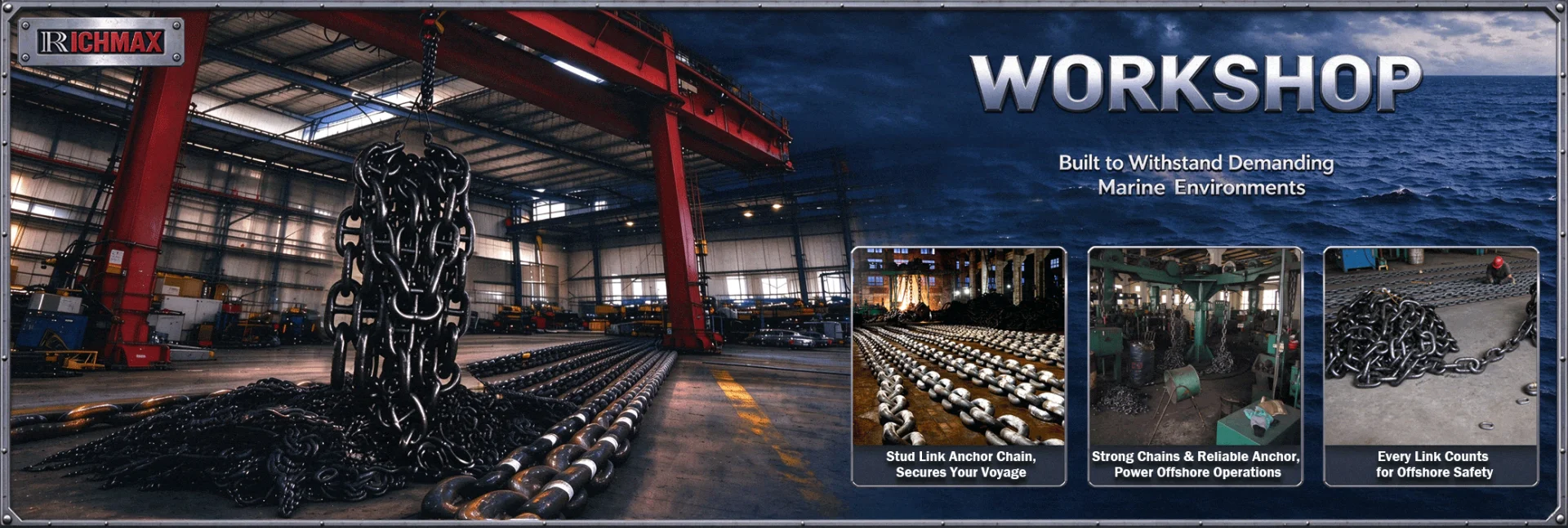
When selecting a Stud Link Anchor Chain supplier, the buyer should verify the supplier's actual manufacturing, inspection and documentation capabilities rather than relying only on product specifications or quoted price.
For Richmax, supplier evaluation is handled around the same points that normally need to be confirmed before a marine anchor chain order is placed: technical specification, production control, inspection, traceability and export documentation.
1. Classification and Certification
For marine anchor chain used on classed vessels, the buyer should first confirm whether the supplier and the production facility meet the required classification requirements.
Depending on the project, this may involve CCS, DNV, LR, ABS, BV, NK or another specified classification society.
The buyer should check:
Validity and scope of the manufacturer's approval
Applicable chain grade and product type
Approved manufacturing location
Product certification requirements
Material certificates and mechanical test reports
Classification inspection and attendance requirements
Richmax can review the customer's required classification, chain grade and documentation requirements before quotation and coordinate the relevant production and inspection arrangements with the manufacturing facility.
The certificate requirements should be confirmed before production rather than added after the chain has been completed.
2. Manufacturing Capability
The buyer should establish whether the supplier actually controls the main manufacturing processes.
For Stud Link Anchor Chain, relevant processes may include:
Steel material preparation
Link forming and forging
Stud fitting
Welding where specified
Heat treatment
Calibration
Proof load testing
Breaking load testing
Final inspection
The buyer should clarify which processes are carried out at the manufacturing facility and which, if any, are subcontracted.
For Richmax, the export team works with the relevant production facilities to confirm the manufacturing route, production capacity, inspection requirements and delivery schedule before an order is finalized.
For larger orders, production planning should be based on the actual quantity, chain diameter, grade, inspection requirements and required delivery date rather than only providing a fixed lead time.
Factory inspection or third-party inspection can also be coordinated when required by the purchase specification.
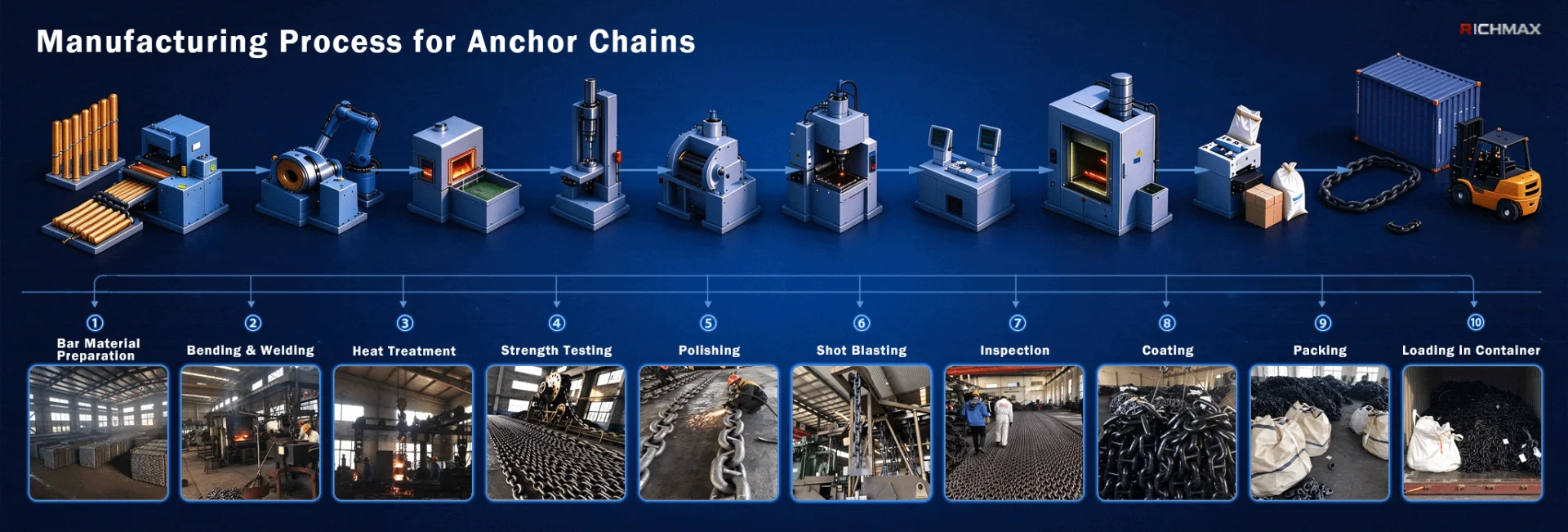
3. Material and Production Quality Control
The buyer should check how the supplier controls the chain from raw material to finished product.
Important points include:
Incoming steel inspection
Material identification and heat number control
Chemical composition and mechanical properties
Forging and forming control
Heat treatment records
Dimensional inspection
Proof load testing
Breaking load testing where required
Non-destructive testing according to the applicable specification
Final inspection records
Richmax's role is not limited to forwarding a quotation. The technical requirements received from the customer can be reviewed against the production and inspection requirements before the order is confirmed.
Where inspection documents are required, the required records should be identified in advance so that material certificates, test reports and inspection records correspond to the actual order.
4. Traceability of the Finished Chain
Traceability is particularly important when the chain is supplied with classification or project documentation.
The buyer should confirm whether the supplier can trace the finished chain back to:
Steel heat number
Raw material certificate
Production batch
Heat treatment batch
Test records
Inspection records
Final certificate
For Richmax orders, traceability requirements can be included in the technical confirmation and purchase documentation.
The required identification method should be clarified before production, especially for large orders containing multiple chain sizes, grades or production batches.
This makes it easier to match the finished chain with the relevant inspection and certification records during delivery and later use.
5. Experience with Marine Projects
Previous marine supply experience should be checked based on the type of product and application rather than simply the number of years the company has been trading.
Relevant experience may include supply to:
Shipyards
Shipowners
Offshore engineering projects
Marine contractors
Offshore platforms
Mooring systems
Marine equipment distributors
Richmax focuses on export supply for marine hardware and related industrial products. Its customer base includes shipyards, marine service companies, offshore engineering contractors, distributors and other industrial buyers.
This background is useful when a project involves more than the chain itself, such as connecting shackles, swivels, anchors or other components in the anchoring and mooring system.
Project information should still be evaluated according to the actual product specification, inspection requirements and documentation available for the particular order.
6. Technical Communication
Before placing an order, the buyer should check whether the supplier can correctly review the technical requirements.
For Stud Link Anchor Chain, this may involve confirming:
Nominal chain diameter
Chain grade
Applicable standard
Link dimensions
Stud dimensions
Proof load
Breaking load
End connection requirements
Connecting shackle dimensions
Classification requirements
Required certificates
Richmax can review customer drawings, specifications, inquiry sheets and existing chain information before preparing the quotation.
For replacement orders, particular attention should be given to the relationship between the chain and the existing windlass, chain stopper, connecting shackles and other components.
Nominal diameter alone does not establish complete compatibility.
If the customer's specification contains unclear or conflicting parameters, these points should be identified and clarified before production rather than left for the factory to interpret after the order is placed.
7. Export Documentation and After-Sales Support
For international orders, the supplier should also be able to handle the documentation required for shipment and customs clearance.
Depending on the destination and contract, documents may include:
Commercial Invoice
Packing List
Certificate of Origin
FORM A, FORM E or other applicable certificates
Material certificates
Test certificates
Classification certificates
Inspection reports
Shipping documents
Richmax has an established export process for overseas orders and can coordinate commercial documents, technical documents and inspection records with the customer and production facility.
The purchase contract should also clearly define delivery terms, warranty period, inspection arrangements and responsibility for non-conforming products.
If a quality issue occurs, the supplier should be able to collect the relevant production and inspection information, communicate with the manufacturing side and coordinate the follow-up process with the customer.
Red Flags When Evaluating An Anchor Chain Supplier
Some supplier characteristics should be treated as points requiring further verification before an order is placed.
1. Unclear Classification Approval
The supplier cannot provide a valid factory approval certificate, provides certificates that cannot be verified, or cannot clearly explain the certificate's scope.
Another warning sign is providing only a previous product certificate when the current order requires factory or production approval.
Richmax can review the customer's classification requirements before quotation and confirm which certificates and inspection arrangements are required for the specific order.
2. No Clear Manufacturing Control
The supplier cannot explain where forging, heat treatment, calibration and load testing are carried out.
If major production processes are outsourced, the buyer should understand who controls the subcontracted process and how the records are incorporated into the final quality documentation.
For Richmax orders, the manufacturing source and production requirements can be clarified during the technical confirmation stage instead of relying only on the trading company's product description.
3. Price Without a Clear Technical Basis
A quotation that is substantially lower than other comparable offers should be checked against the same technical specification.
The buyer should compare:
Chain grade
Steel specification
Heat treatment requirements
Proof load
Breaking load
Inspection scope
Classification requirements
Certificate requirements
Delivery terms
Richmax quotations can be prepared according to the customer's specified chain grade, standard, inspection requirements and documentation requirements, allowing the price to be compared against the same technical basis.
A lower price is not necessarily a quality problem, but the technical differences behind the price should be identified before comparing quotations.
4. Limited Inspection or Traceability
The supplier refuses agreed third-party inspection, cannot provide material traceability, or cannot connect test records with the supplied chain.
For classed or project-specific orders, these issues should be resolved before production rather than after the chain has been completed.
Richmax can coordinate the agreed inspection requirements with the production facility and customer, including document collection and third-party inspection where required.
5. Limited Marine Supply Records
If the supplier cannot clearly describe previous marine anchor chain projects or the applicable standards and inspection procedures, the buyer should verify its actual experience with this type of product.
Richmax's business covers marine hardware and related products for overseas industrial customers. This provides experience in handling marine product specifications, export documentation, customer drawings and project-related technical communication.
The actual qualification of a particular chain order should still be assessed from its product specification, manufacturing source and inspection documentation.
6. Unclear Delivery and Warranty Responsibilities
The supplier gives a delivery date without explaining the production schedule, or the quotation and contract do not clearly define inspection, acceptance, warranty and non-conformity procedures.
Richmax can confirm the main commercial and technical requirements before order confirmation, including quantity, specification, inspection, documentation and expected delivery schedule.
Where production involves multiple processes, the delivery schedule should be checked against the actual manufacturing and inspection arrangement.
7. Weak Technical Review
The supplier focuses mainly on price and nominal diameter but cannot review chain grade, proof load, breaking load, connecting components or classification requirements.
For replacement orders in particular, the complete anchoring arrangement should be checked rather than selecting the chain by diameter alone.
Richmax can assist with the technical information exchange between the buyer and manufacturing facility, including specification clarification, dimensional confirmation and documentation requirements.
FAQ
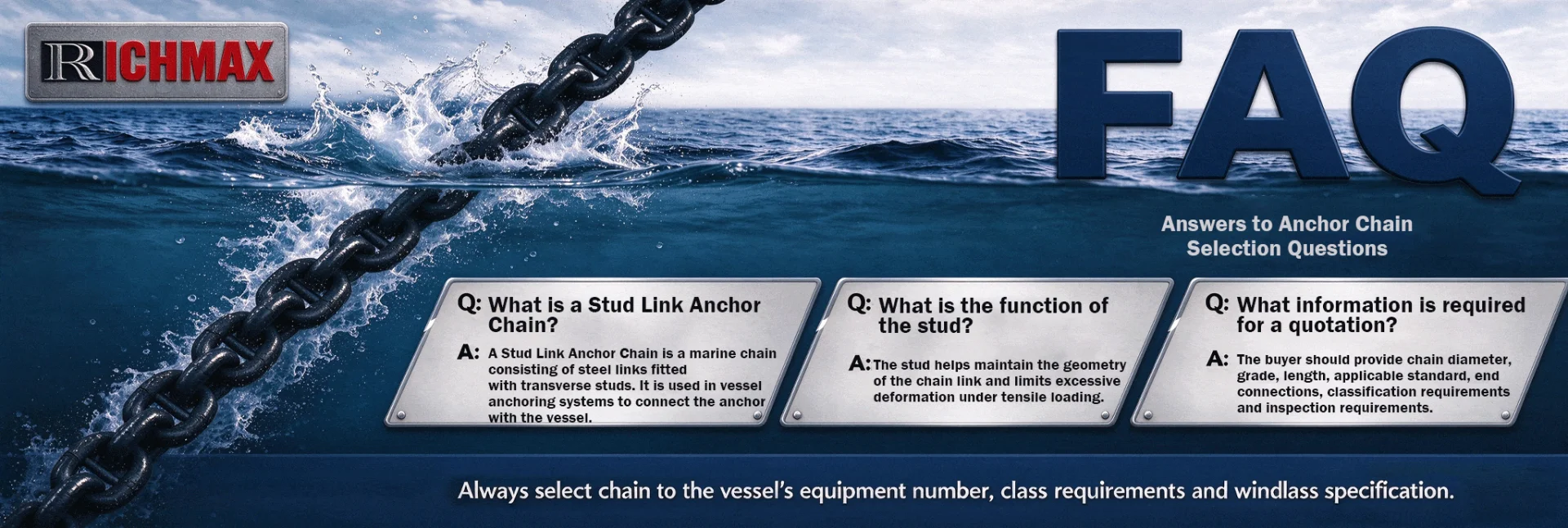
1. What is a Stud Link Anchor Chain?
A Stud Link Anchor Chain is a marine chain consisting of steel links fitted with transverse studs. It is used in vessel anchoring systems to connect the anchor with the vessel.
2. What is the function of the stud?
The stud helps maintain the geometry of the chain link and limits excessive deformation under tensile loading.
3. What information is required for a quotation?
The buyer should provide chain diameter, grade, length, applicable standard, end connections, classification requirements and inspection requirements.
4. Can Stud Link Anchor Chain be supplied in different grades?
Yes. The available grades depend on the manufacturing specification and applicable requirements. The required grade should be confirmed before production.
5. Can the chain be supplied with shackles?
Yes. Connecting components can be included according to the specified anchoring arrangement.
6. What certificates can be provided?
Certificates and inspection documents depend on the applicable standard, classification requirements and purchase specification.
7. What is the difference between Stud Link and Studless Anchor Chain?
Stud Link Anchor Chain has a transverse stud inside each link, while Studless Anchor Chain does not. The two types have different dimensional and structural characteristics and should be selected according to the anchoring system's requirements.

 English
 Español
 Français
 Árabe
 Русский
 Português
 日本語
 한국어
 Dansk
 Nederlands
 Italiano
 Türkçe
 Deutsch
 Prancis
 ไทย
 Tiếng Việt
 हिंदी
 বাংলা
 中文