Structure
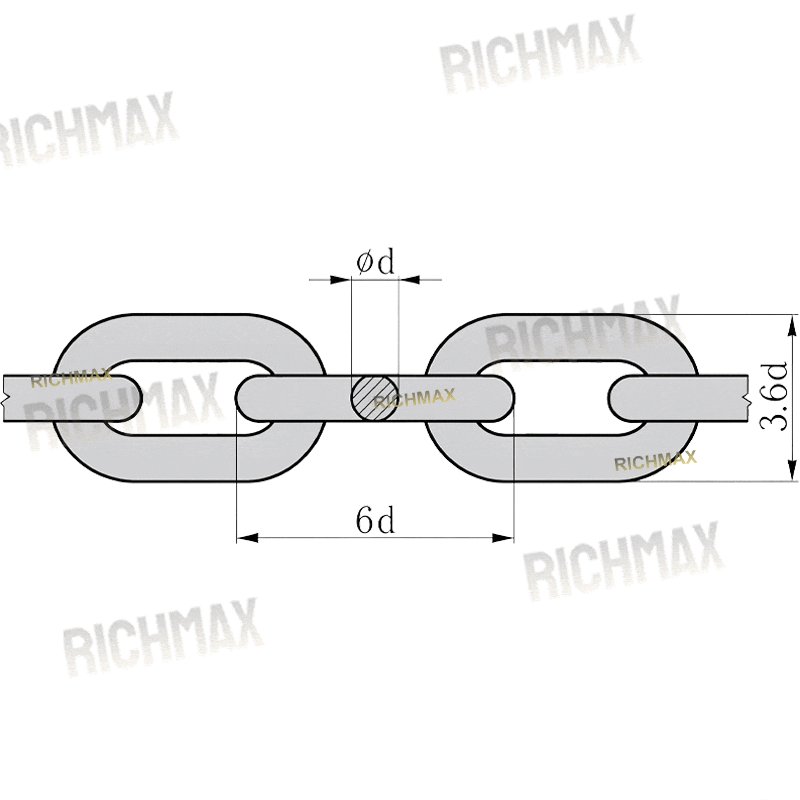
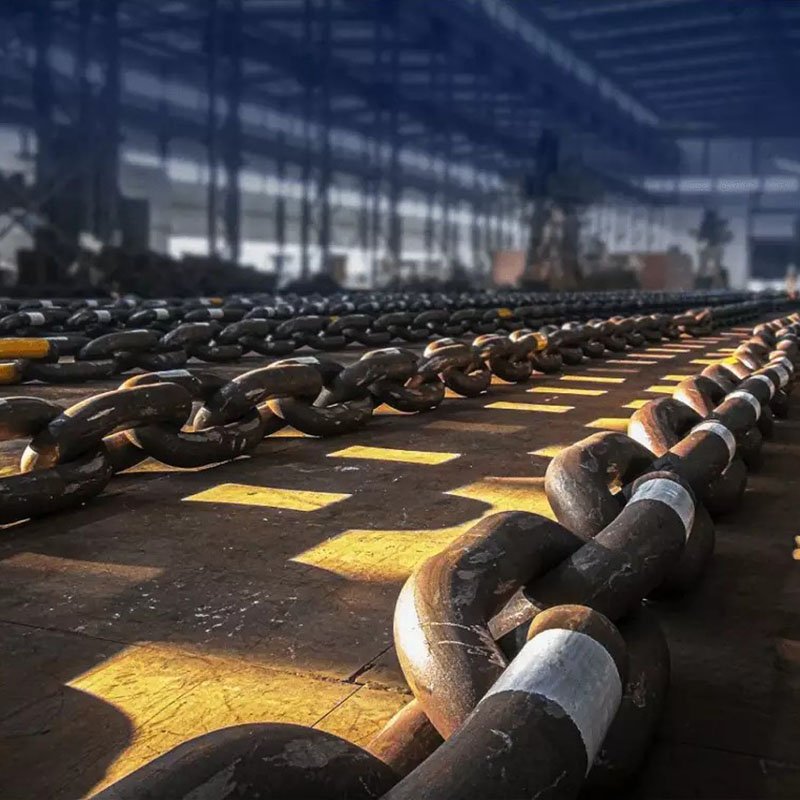
Studless Link Anchor Chain is constructed from interconnected steel links without transverse studs. The link design provides a continuous load-bearing profile while allowing adjacent links to move relative to each other during chain deployment, recovery and handling.
The chain structure is determined by the link dimensions, cross-sectional geometry, contact surfaces and connection arrangement. These features influence how the chain articulates, passes through chain-handling equipment and connects with other components in the anchoring system.
1. Studless Chain Link Design
The common link is the main structural component of Studless Link Anchor Chain.
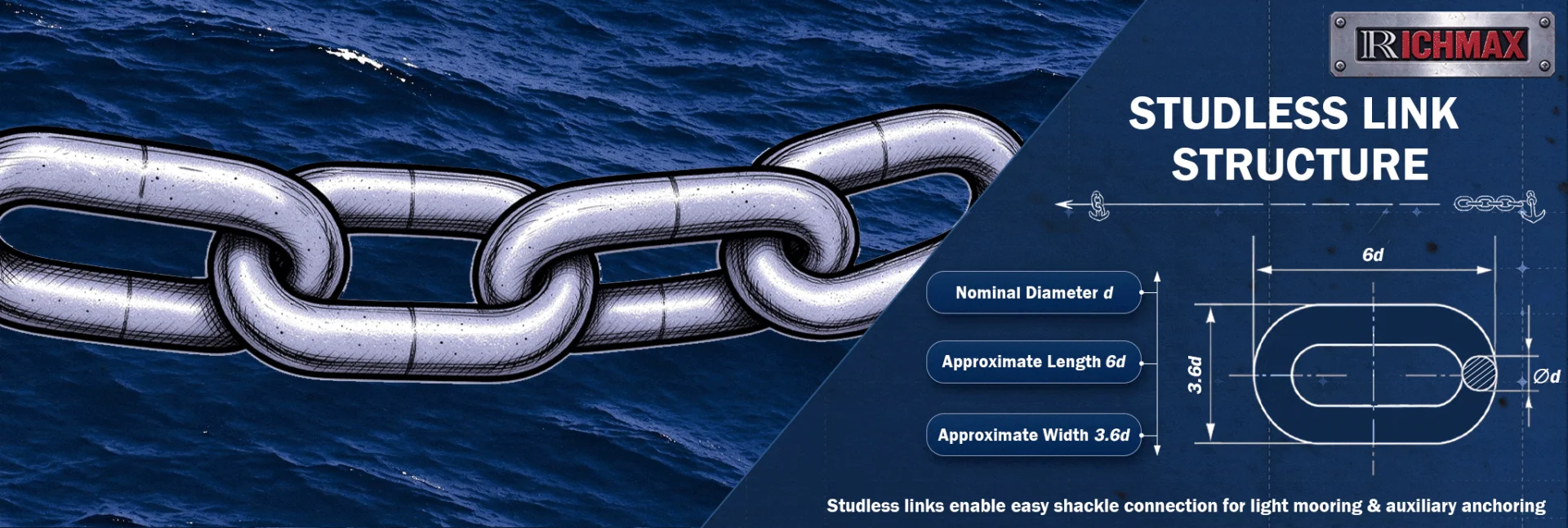
Each link is formed without a transverse stud, leaving the internal opening clear for the adjacent link to pass through and articulate. The continuous link profile provides the structural connection between successive chain links.
The link design is based on the specified nominal diameter, steel cross-section, internal opening and dimensional tolerances.
Depending on the manufacturing specification, the chain link may be produced through a controlled forming and welding process, followed by the required heat treatment and inspection.
The link dimensions and manufacturing requirements determine the finished geometry and mechanical properties of the chain.
2. Link Dimensions and Chain Handling
The dimensions of each chain link are selected according to the required chain size and the configuration of the anchoring equipment.
Important dimensions include:
These dimensions determine the available clearance between adjacent links and influence the chain's movement during deployment and recovery.
For vessel anchoring systems, the chain dimensions should correspond to the chain wheel, chain stopper, chain pipe and other handling components.
A correctly specified link geometry allows the chain to pass through the intended equipment while maintaining the required articulation between links.
3. Link Contact and Articulation
Studless Link Anchor Chain is designed to allow movement between adjacent links.
During chain deployment and recovery, the links change their relative positions as the chain passes through the chain-handling equipment or follows the movement of the anchor.
The contact areas between links are influenced by the link curvature, cross-sectional profile and dimensional tolerances.
The internal and external radii of the links are therefore important manufacturing parameters. A controlled link profile helps maintain consistent contact geometry and reduces irregular contact caused by dimensional variation.
The finished chain should be checked against the applicable drawings and dimensional requirements to verify that the links maintain the specified geometry throughout the chain length.
4. Continuous Link Structure
The absence of a transverse stud gives Studless Link Anchor Chain a relatively simple link configuration.
Each link forms a continuous steel loop, with the connecting geometry established by the link profile and the specified manufacturing process.
The structural integrity of the link depends on the steel grade, cross-sectional dimensions, forming accuracy, weld quality where applicable, and heat treatment.
For welded chain links, the manufacturing process should control the joining area and maintain the required mechanical properties after heat treatment.
For forged or other manufacturing configurations, the applicable production and inspection requirements should be defined by the chain specification.
The finished link must meet the specified dimensional, mechanical and inspection requirements regardless of the manufacturing method.
5. Chain Flexibility and Movement
The articulation of Studless Link Anchor Chain is determined by the geometry of the individual links and their contact with adjacent links.
As the chain moves, each link can change its orientation within the available clearance. This allows the chain to follow the movement of the anchor and the path established by the vessel's anchoring equipment.
The resulting flexibility is a structural characteristic of the interconnected link design rather than a separate component.
For practical installation, the chain dimensions, connecting components and handling equipment should be considered together to confirm that the chain can move through the intended arrangement.
The required chain configuration should be verified against the vessel's anchoring system and operating conditions.
6. End Links and Connection Arrangement
End links provide the connection between the chain and other components of the anchoring system.
Depending on the specified arrangement, the chain may include enlarged end links, anchor shackles, joining shackles, swivel assemblies or other connecting components.
The dimensions of these components must correspond to the chain size and the required connection geometry.
For replacement chains, the existing end-link configuration should be checked before production. This includes the connection opening, link dimensions, shackle arrangement and required chain length.
Where a new anchoring system is being designed, the connection arrangement should be established according to the approved system drawings and equipment requirements.
7. Chain Configuration and Installation
Studless Link Anchor Chain can be supplied in continuous lengths or individual sections according to the purchase specification.
The required configuration depends on the vessel's anchoring arrangement, chain length, connection requirements and handling equipment.
For replacement projects, the existing chain arrangement provides a useful reference, but the actual dimensions and connection details should be verified before manufacturing.
For new installations, the chain length, end connections and associated components should be specified together to ensure compatibility with the complete anchoring system.
The final chain configuration should follow the approved drawings, applicable chain specification and agreed purchase requirements.
Technical note: Studless Link Anchor Chain should not automatically be described as having lower strength, lower service life or limited suitability for offshore mooring. These characteristics depend on the chain grade, dimensions, manufacturing process, mechanical properties, applicable standard and actual loading conditions. For offshore applications, the chain specification and certification requirements should be established by the project or system designer.
Material
The material of Studless Link Anchor Chain is selected according to the specified chain grade, manufacturing standard and service requirements. Steel quality, heat treatment and material consistency directly affect the chain's tensile properties, toughness and resistance to repeated loading.
For marine and offshore applications, the material specification should be established before production. The selected steel must meet the mechanical properties and inspection requirements defined for the intended anchoring or mooring system.
Steel Quality and Material Selection
Studless Link Anchor Chain can be manufactured using steel specified for marine chain applications, including applicable R3, R4 or R4S grades where required by the order.
Steel quality is controlled through the specified chemical composition and material acceptance criteria. Sulfur and phosphorus content, steel cleanliness and internal material consistency are important considerations when evaluating the suitability of the steel for chain manufacturing.
The material specification may cover:
Steel grade and applicable manufacturing standard
Chemical composition and impurity limits
Yield strength and tensile strength
Elongation and reduction of area
Impact toughness where specified
Material certification and heat-number identification
The selected steel grade should correspond to the required chain strength and operating conditions rather than being determined by nominal chain diameter alone.
Heat Treatment and Mechanical Properties
Heat treatment is an important part of Studless Link Anchor Chain manufacturing.
Depending on the specified steel grade and production procedure, the chain links may undergo controlled quenching and tempering to obtain the required combination of strength, toughness and ductility.
The heat-treatment process should provide consistent mechanical properties throughout the specified production batch.
Relevant controls include:
Heating temperature and holding time
Quenching conditions
Tempering temperature and duration
Cooling procedure
Batch identification and process records
Mechanical testing after heat treatment
The final properties should be verified against the applicable chain specification.
A properly controlled heat-treatment process helps the material maintain its required mechanical performance under tensile loading and repeated service loads. Actual fatigue performance, however, also depends on chain geometry, manufacturing quality, operating conditions and inspection history.
Continuous Link Section and Material Consistency
Studless Link Anchor Chain is manufactured without a transverse stud inside the link.
The link is formed from a continuous steel section, with its final geometry and mechanical properties determined by the specified material and manufacturing process.
Unlike stud link chain, the studless link does not contain a separate transverse stud or its associated stud-fitting arrangement.
This difference simplifies the link's internal configuration and eliminates the need to inspect a transverse stud connection.
The absence of a stud does not eliminate the need for material and dimensional inspection. The link body remains subject to forming, welding where applicable, heat treatment and other manufacturing requirements specified for the chain.
Material consistency should be assessed through the applicable production controls and mechanical test results.
Material Protection and Surface Finish
Studless Link Anchor Chain can be supplied with different surface finishes according to the operating environment and purchase specification.
Available finishes may include:
Hot-dip galvanizing provides a zinc coating that helps protect the steel surface from corrosion in marine environments.
The coating should be applied according to the specified process, with attention to surface preparation, coating coverage, thickness and adhesion requirements.
Black paint provides a surface coating according to the agreed paint system. Its performance depends on the coating specification, surface preparation and application quality.
Uncoated chain may be specified where the project requires a bare steel surface or where subsequent treatment will be carried out separately.
The appropriate finish should be selected according to the chain's exposure conditions, maintenance requirements and project specification.
Material Inspection and Traceability
Material inspection verifies that the steel used for Studless Link Anchor Chain conforms to the specified grade and manufacturing requirements.
Depending on the order and applicable classification requirements, inspection may include:
Review of material certificates
Verification of steel grade and heat number
Chemical composition testing
Mechanical property testing
Hardness testing where specified
Heat-treatment record review
Material identification and production traceability
Spectral analysis may be used for material identification or chemical composition verification where required by the inspection plan.
For orders requiring classification approval, material certificates and inspection records should correspond to the applicable chain grade, production batch and certification scope.
CCS, ABS, BV or other classification-related documentation may be provided when applicable to the order and agreed certification requirements.
The inspection scope should be confirmed before production to ensure that the material, testing and documentation requirements are consistent with the purchase specification.
How To Use?
Stud Link Anchor Chain: Operating and Maintenance Guidelines
Stud Link Anchor Chain should be used according to the vessel's anchoring arrangement, chain specification and operating procedure. Before operation, the chain condition, connection components and compatibility with the anchoring equipment should be checked.
Proper handling helps maintain the chain's working condition, reduce unnecessary impact loads and prevent damage caused by improper deployment, twisting or seabed contact.
1. Pre-Operation Inspection
Before deploying the anchor chain, check whether the chain specification and condition meet the requirements of the anchoring system.
The inspection should include:
Chain grade, nominal diameter and applicable product specification
Material and inspection certificates, where required
Chain links for visible cracks, deformation or abnormal wear
Surface condition, including damaged coating and corrosion
Connecting shackles and other accessories
Compatibility between the chain, anchor and chain-handling equipment
The specified chain grade and mechanical properties should correspond to the design requirements of the anchoring system.
The required proof load and breaking load should be verified against the applicable chain specification and equipment requirements. The chain should not be selected solely according to its nominal diameter or appearance.
2. Controlled Chain Deployment
During anchor deployment, the chain should be released in a controlled manner according to the vessel's anchoring procedure.
Sudden braking, excessive acceleration and uncontrolled chain release should be avoided. These operations can generate impact loads that are different from the normal tensile loads experienced during anchoring.
The chain should be allowed to run freely through the chain-handling equipment without unnecessary twisting or interference.
For Studless Anchor Chain, particular attention should be given to chain alignment because the links do not have transverse studs to help maintain their orientation.
If twisting or abnormal link positioning is observed, the condition should be corrected before continuing the operation.
3. Chain Position During Anchoring
After the anchor reaches the seabed, the chain arrangement should follow the vessel's approved anchoring procedure.
The deployed chain length and resulting chain geometry depend on water depth, vessel characteristics, environmental conditions and seabed conditions.
The chain should not be treated as a straight, continuously suspended connection between the anchor and vessel.
Where the anchoring arrangement requires part of the chain to rest on the seabed, the deployed length should provide the required chain geometry and load distribution.
The chain line should be maintained within the operating limits specified for the anchoring system.
The actual chain configuration should be assessed according to the vessel's anchoring arrangement rather than a fixed chain length or angle applied to every operating condition.
4. Chain Condition During Operation
During anchoring operations, the chain should be monitored for abnormal movement, twisting, excessive tension and contact with surrounding structures.
When wind, current or wave conditions change, the chain loading may also change.
The operating crew should observe the chain condition and follow the vessel's established procedures when the load or environmental conditions approach the permitted operating limits.
The chain should not be subjected to sustained loads exceeding its specified working requirements.
Where the chain passes over or contacts the seabed, the seabed characteristics should also be considered.
Sharp rocks, irregular surfaces and abrasive materials can cause local wear or damage to the chain links.
For operations involving abrasive or uneven seabeds, the anchoring arrangement should be evaluated before use.
5. Anchor Chain Retrieval
During anchor retrieval, the chain should be recovered at a controlled speed according to the vessel's operating procedure.
The chain should pass through the chain-handling equipment without excessive impact, compression or interference between links.
Abnormal twisting, overlapping links or uneven chain movement should be corrected before the chain is fully recovered.
The chain should not be forced through the equipment when link alignment or movement is restricted.
After retrieval, the chain should be arranged properly in the chain locker to avoid unnecessary entanglement and difficulties during the next deployment.
6. Cleaning and Storage
After marine operation, the chain should be inspected and cleaned according to its material and surface treatment requirements.
Seawater, mud and accumulated deposits should be removed where necessary.
The chain should be allowed to drain and should be stored in a condition suitable for the intended storage environment.
For galvanized chain, damaged coating and exposed steel areas should be checked during maintenance.
Where corrosion protection is required, the maintenance method should be compatible with the chain material, coating system and applicable inspection requirements.
Storage arrangements should prevent unnecessary mechanical damage, deformation and contact with sharp objects.
7. Matching the Anchoring System
Stud Link Anchor Chain should be used with an anchor and chain-handling equipment suitable for the specified chain dimensions and operating requirements.
Before installation or replacement, verify the compatibility of the following components:
Marine anchor
Anchor chain
Connecting shackles
Windlass and gypsy wheel
Chain stopper
Chain pipe and hawse pipe
Chain locker
The chain grade, dimensions and connecting components should be consistent with the approved anchoring arrangement.
Different chain grades or chain types should not be combined without confirming their compatibility and suitability for the intended load conditions.
For replacement projects, the existing chain specification, equipment profile and connection arrangement should be checked before ordering a new chain.
8. Common Operating Mistakes to Avoid
Using a chain beyond its specified load requirements
A chain with an unsuitable grade or insufficient mechanical properties should not be used for deep-water anchoring or demanding mooring conditions simply because its dimensions appear suitable.
Applying excessive impact during deployment or retrieval
Sudden braking, uncontrolled release and forced chain movement can generate additional loads and damage chain links.
Ignoring chain twisting
Twisted links can interfere with normal chain movement and create abnormal loading conditions. Chain alignment should be checked whenever irregular movement is observed.
Leaving the chain without appropriate maintenance
Prolonged exposure to seawater, deposits and unsuitable storage conditions can contribute to corrosion and surface deterioration.
Combining incompatible chain types or grades
Stud Link Anchor Chain, Studless Anchor Chain and other chain types should not be connected or mixed without confirming dimensional, mechanical and system compatibility.
Allowing continuous abrasive contact
Repeated contact with sharp rocks or abrasive seabed materials can reduce the effective link section through wear.
Where seabed contact is part of the anchoring operation, the potential for abrasion should be considered in the anchoring arrangement and inspection plan.
9. Routine Condition Monitoring
The condition of Stud Link Anchor Chain should be checked at intervals established by the vessel's maintenance and inspection requirements.
Inspection should focus on areas where mechanical damage, corrosion or wear is more likely to occur.
Relevant inspection items include:
Link dimensions and visible deformation
Localized wear and reduction in link section
Cracks or other visible surface defects
Corrosion and coating deterioration
Chain connections and accessories
Abnormal link alignment
Condition of chain-handling equipment
If a chain link shows suspected damage or abnormal deformation, the chain should be evaluated according to the applicable inspection procedure before further use.
Inspection and maintenance records should be retained where required by the vessel's maintenance system, project specification or applicable classification requirements.
Application
Studless Link Anchor Chain is used in marine anchoring, offshore mooring and positioning systems. Its application depends on the chain design, specified grade, seabed conditions and compatibility with the chain-handling equipment.
Application:
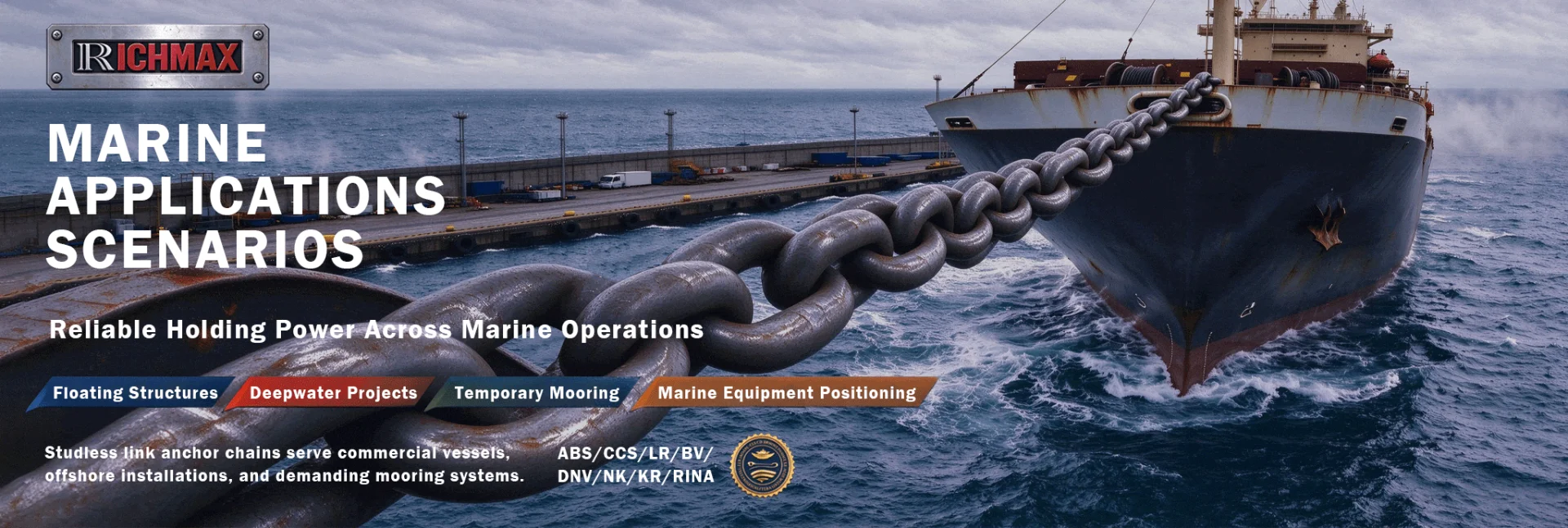
Offshore Floating Structures
Used in mooring systems for FPSOs, floating wind turbines, semi-submersible platforms and other floating offshore structures.
For permanent mooring projects, chain selection should consider the design loads, mooring configuration, water depth, seabed conditions and specified chain grade.
Deepwater and Ultra-Deepwater Projects
Used in offshore projects where chain handling involves large winches, chain guides and other dedicated equipment.
The studless link design provides an unobstructed link profile, which may help reduce interference during chain passage. Its suitability depends on the chain dimensions, equipment design and operating conditions.
Temporary Mooring for Offshore Vessels
Used in temporary anchoring and positioning systems for offshore construction vessels, crane vessels, pipelay vessels and other marine working vessels.
Chain specifications should be selected according to the vessel's anchoring arrangement, operating loads, required chain length and project conditions.
Buoy and Marine Equipment Positioning
Used in anchoring and positioning systems for port buoys, navigation buoys, dredging equipment, floating barriers and temporary marine structures.
The required chain length, grade, connection arrangement and seabed holding conditions should be confirmed according to the installation design.
Soft Seabed Mooring
Suitable for selected mooring applications on sand, mud and soft clay seabeds, where the chain forms part of an engineered anchoring or mooring system.
Chain selection should consider seabed interaction, expected loads, movement of the floating structure and the required service life.
Chain Handling Systems
Used in systems where smooth chain passage and compatibility with the handling equipment are important.
The absence of a transverse stud provides a different link profile from stud link chain. Compatibility with the windlass, chain guide, stopper and storage arrangement should be checked before installation.
Low-Impact Chain Handling
Used in selected systems where controlled chain movement, reduced link interference and stable chain handling are required.
Actual noise, impact and wear performance depend on the equipment configuration, chain condition, operating speed and applied loads. These factors should be evaluated during system design rather than determined by chain type alone.
Mooring System Replacement
Used for replacement or renewal of existing studless anchor or mooring chains during vessel maintenance, offshore equipment refurbishment and project upgrades.
Replacement specifications should include chain diameter, grade, length, link dimensions, end connections and compatibility with the existing chain-handling equipment.
How to Select Studless Link Anchor Chain?
Studless Link Anchor Chain should be selected according to the required load capacity, operating conditions, chain handling equipment and installation arrangement.
For replacement or new installation, the selection should be based on the approved anchoring or mooring system specification rather than nominal chain diameter alone.
1. Match Chain Strength to the Required Load
The chain should have sufficient strength for the loads specified in the anchoring or mooring system design.
Selection should consider:
Required chain grade and nominal diameter
Specified proof load and minimum breaking load
Static and dynamic loading conditions
Applicable design factors and classification requirements
The required chain strength should be determined from the system specification.
A higher chain grade should not be selected solely to increase strength without checking the compatibility of the connecting components and chain-handling equipment.
2. Consider the Operating Environment
The operating environment affects chain wear, corrosion and service life.
For offshore installations, selection should consider water depth, seabed conditions, wave and current loading, and the intended service period.
For conventional vessel anchoring, the required chain specification should correspond to the vessel's approved anchoring arrangement and operating conditions.
Seabed conditions should also be considered.
Rocky, abrasive or uneven seabeds may increase local wear and damage to chain links. Where these conditions are expected, the chain configuration, inspection requirements and maintenance arrangements should be reviewed before selection.
3. Verify Chain Wheel and Handling Equipment
Studless Link Anchor Chain should be compatible with the chain wheel and associated chain-handling equipment.
Before ordering, confirm:
Chain wheel pocket dimensions
Link profile and dimensional tolerances
Chain wheel and guide arrangement
Chain stopper compatibility
Available clearance through the chain pipe and hawse pipe
For replacement projects, the existing chain wheel should be checked against the proposed chain dimensions.
A dimensional mismatch may cause poor seating, abnormal wear or irregular chain movement during operation.
4. Confirm Material and Manufacturing Requirements
Material requirements should correspond to the specified chain grade, manufacturing standard and service conditions.
The buyer should confirm the required material properties and manufacturing controls before production.
Depending on the applicable specification, these may include:
Chemical composition
Mechanical properties
Heat treatment requirements
Material identification and traceability
Welding and manufacturing requirements
For offshore mooring applications, the chain specification should be reviewed against the project design and applicable classification requirements.
Material selection should not be based on chain diameter or product name alone.
5. Select the Appropriate Surface Protection
Surface protection should be selected according to the operating environment, corrosion exposure and maintenance requirements.
Hot-dip galvanizing may be specified for applications requiring a zinc coating for corrosion protection.
Paint or other coating systems may be used where required by the project specification.
The buyer should confirm the coating type, surface preparation, coating thickness and inspection requirements before production.
For submerged service or offshore mooring applications, the coating system should be assessed against the actual exposure conditions and project requirements.
6. Determine the Chain Configuration
The chain configuration should correspond to the installation arrangement and maintenance requirements.
The buyer should confirm whether the chain is supplied as a continuous length or divided into sections.
Where required, the configuration may include:
Connecting shackles
Enlarged end links
Swivel assemblies
Anchor connection components
Defined section lengths
For segmented chain arrangements, the connection positions and component dimensions should be confirmed before production.
The configuration should also allow the chain to be inspected, handled and replaced according to the installation requirements.
7. Define Inspection and Documentation Requirements
Inspection requirements should be agreed before manufacturing begins.
The required inspection scope depends on the chain specification, applicable standard, classification requirements and purchase order.
Documents may include:
Material certificates
Manufacturing and heat-treatment records
Dimensional inspection records
Proof load test reports
Mechanical test results
NDT reports, where specified
Classification inspection and certification, where required
The buyer should confirm the required certificate type, inspection stage and acceptance criteria before placing the order.
Selection Considerations
Studless Link Anchor Chain selection should consider the complete installation rather than the chain alone.
The chain, connecting components, chain wheel, handling equipment and operating conditions should be reviewed together.
For replacement projects, existing equipment dimensions and the original chain specification should be checked before confirming the new chain.
For new installations, the chain specification should follow the approved system design and applicable technical requirements.
A complete purchase specification helps avoid dimensional incompatibility, incorrect chain configuration and inspection requirements that are not defined before production.
How To Choose A Reliable Supplier?
How to Evaluate a Studless Link Anchor Chain Supplier
When purchasing Studless Link Anchor Chain, buyers should look beyond the quoted price and confirm how the supplier manages manufacturing, inspection, documentation and delivery.
For shipbuilding, marine engineering and offshore projects, the supplier should understand the technical requirements of the chain and be able to coordinate the manufacturing process with the buyer's specification.
Richmax works with qualified manufacturing resources and provides support for product selection, factory coordination, inspection arrangements and export documentation.
Our Workshop:
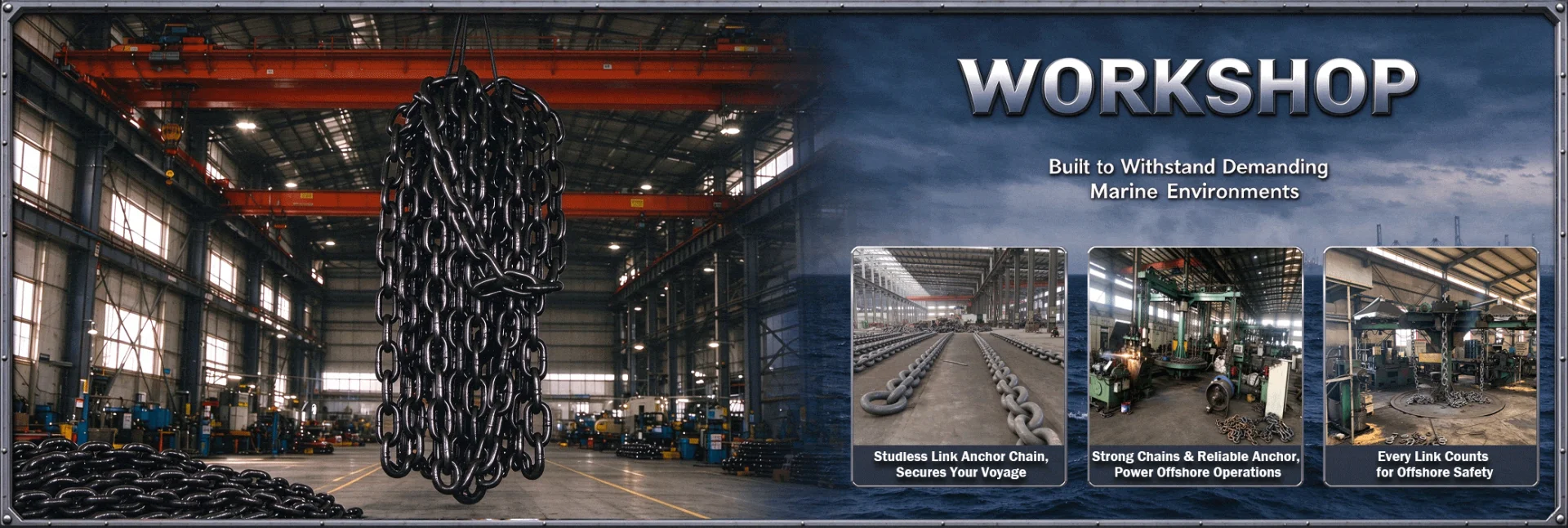
1. Factory Qualification and Product Approval
The buyer should confirm whether the manufacturing facility is approved for the required anchor chain type, grade and applicable classification requirements.
For Studless Link Anchor Chain, factory qualification should be checked against the actual product specification rather than based on a general statement that the factory produces marine chains.
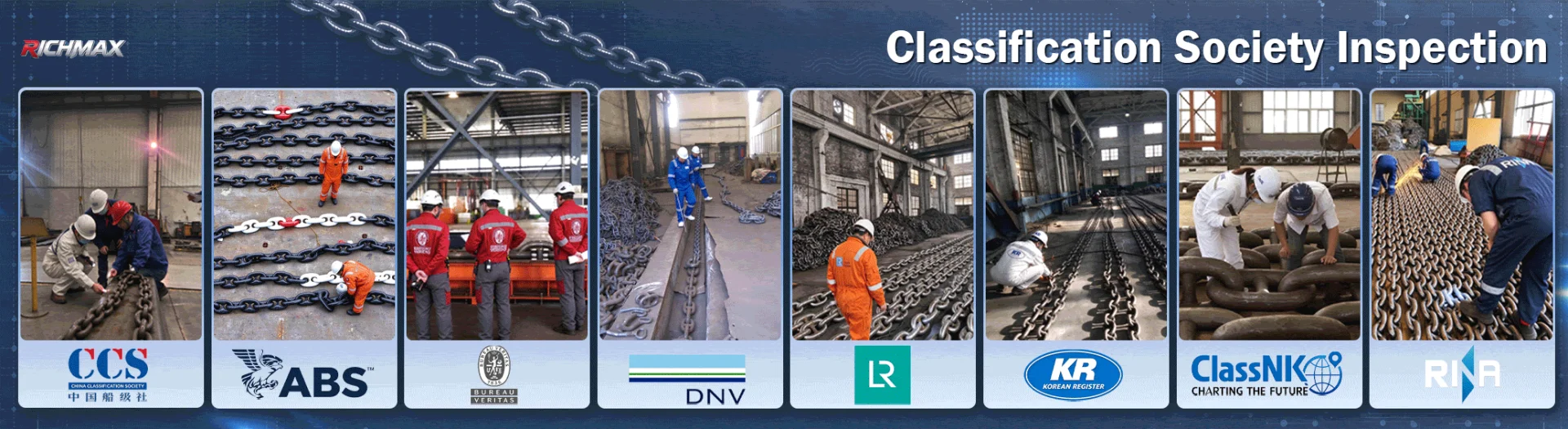
Richmax can coordinate with manufacturing partners to verify applicable CCS, ABS, BV or LR factory approval documents, including the approved product scope and validity.
For orders requiring U1, U2 or U3 chain, the applicable grade, manufacturing standard and certification requirements should be confirmed before quotation and production.
Factory approval documents should correspond to the actual manufacturing facility responsible for the order.
2. Production Control and Inspection Coordination
A reliable supplier should be able to explain how production is monitored and how inspection requirements are communicated to the factory.
For Studless Link Anchor Chain, production follow-up may cover:
Material preparation and heat-number identification
Link forming and welding, where applicable
Heat treatment and dimensional calibration
Chain assembly and connecting components
Surface treatment and final inspection
Richmax can coordinate production follow-up, third-party inspection and surveyor attendance according to the agreed inspection scope.
Inspection arrangements should be confirmed before production, including the required inspection stages, testing procedures and acceptance criteria.
Where witness testing or independent inspection is required, the supplier should coordinate the schedule with the factory and the appointed inspection party.
3. Material Traceability and Certificate Verification
Material traceability is an important part of anchor chain procurement.
The buyer should confirm whether material identification, production batch records and test results can be linked to the supplied chain.
Richmax coordinates the verification of relevant heat numbers, batch identification and inspection records against the order requirements.
For orders requiring classification certification or material documentation, the corresponding records should be checked against the actual production batch and supplied chain.
The documentation scope may include:
Material certificates
Heat-number and batch records
Mechanical test results
Proof load and breaking load test records, where required
Classification inspection records and certificates, where applicable
The required documents should be agreed before production to avoid discrepancies during final inspection or delivery.
4. Technical Understanding and Equipment Compatibility
The supplier should understand the difference between Studless Link Anchor Chain and Stud Link Anchor Chain.
These chain types have different link geometries and should not be substituted without checking the vessel's approved anchoring arrangement.
For replacement orders, the buyer should provide the available chain specifications, equipment details or existing chain dimensions.
Richmax can assist with checking:
Chain type and specified grade
Nominal diameter and link dimensions
Chain length and connecting arrangement
Windlass and chain wheel compatibility
Required joining shackles, end connections and swivel assemblies
For U1, U2 and U3 chain requirements, the applicable grade and technical specification should be confirmed from the purchase documents and relevant manufacturing standard.
Selection should be based on the actual equipment and service requirements rather than nominal diameter alone.
5. Project Documentation and Delivery Preparation
For marine and offshore orders, documentation requirements should be established before production.
The supplier should understand which records are required for inspection, shipment, customs clearance and project acceptance.
Richmax can coordinate the preparation and checking of the agreed export and technical documents, including:
Product specifications and approved drawings
Material certificates
Inspection and test reports
Classification documents, where required
Packing lists and commercial invoices
Shipping and customs documentation
For project orders, chain marking, identification, sectional delivery and accessory matching can be coordinated according to the buyer's requirements.
Where connecting shackles, joining links or swivel assemblies are included, their specifications should be checked against the chain arrangement before shipment.
6. Production Schedule and Delivery Risk Control
A reliable supplier should provide a realistic production schedule and communicate changes that may affect delivery.
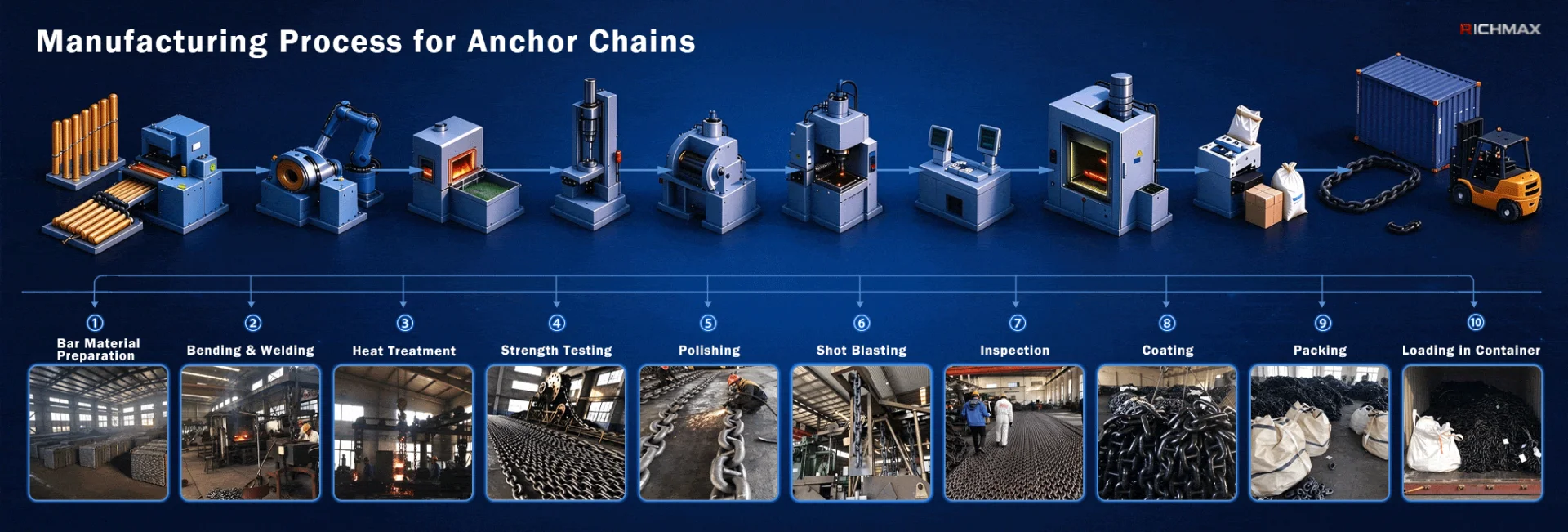
Anchor chain production involves several stages, including material preparation, forming, heat treatment, calibration, testing and final inspection.
Richmax coordinates with manufacturing partners to follow the agreed production schedule and communicate relevant progress to the buyer.
If dimensional deviations, surface treatment issues or test results do not meet the agreed requirements, the supplier should coordinate corrective action with the factory before shipment.
Production delays, inspection arrangements and documentation requirements should be discussed early, particularly for replacement orders and project deliveries with fixed installation schedules.
Our Manufacturing Process:
7. Technical Support and After-Sales Coordination
The supplier should be able to support the buyer when technical questions arise during quotation, production or delivery.
Richmax can assist with reviewing chain specifications, confirming the required grade, checking equipment compatibility and coordinating technical questions with the manufacturing facility.
For project orders, the technical review should consider the intended application, approved anchoring arrangement, chain dimensions and applicable inspection requirements.
The supplier should also establish a clear process for handling quality issues, document discrepancies and delivery claims.
Where a problem requires factory investigation, Richmax coordinates communication between the buyer and the responsible manufacturing partner and follows up on the agreed corrective actions.
The objective is to maintain clear responsibility for communication, inspection follow-up and resolution throughout the order process.
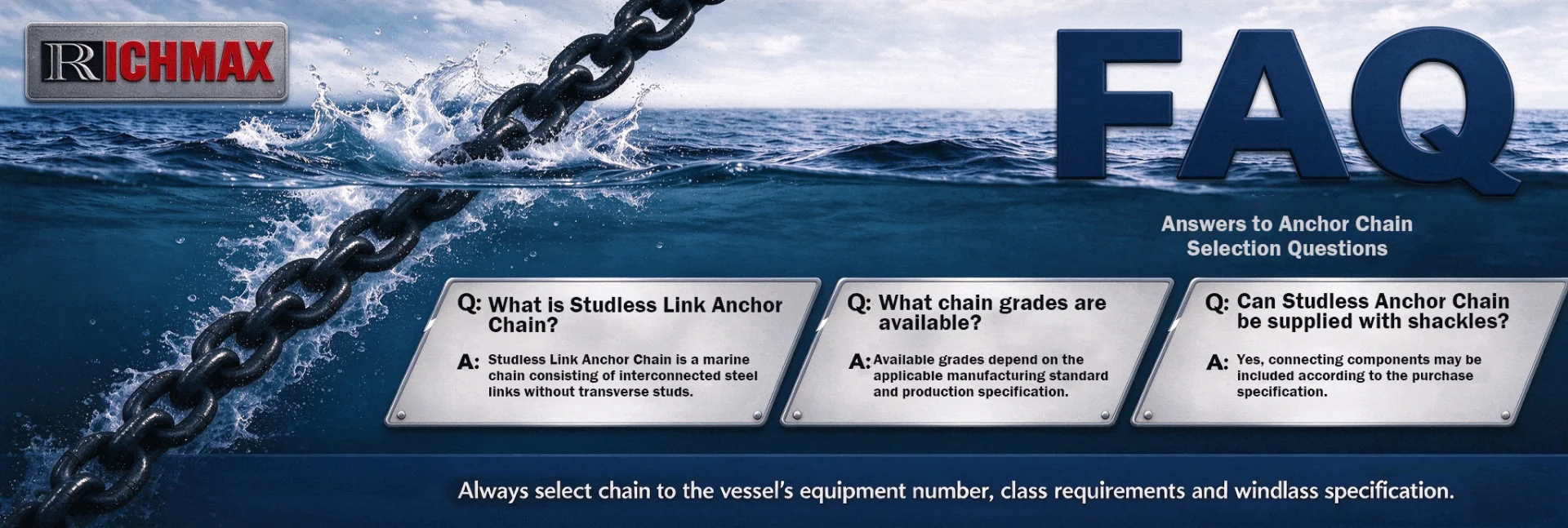
FAQ
1. What is Studless Link Anchor Chain?
Studless Link Anchor Chain is a marine chain consisting of interconnected steel links without transverse studs.
It is used in anchoring systems where the chain type, dimensions and mechanical properties are specified according to the vessel's requirements.
2. What is the difference between Studless and Stud Link Anchor Chain?
Stud Link Anchor Chain contains a transverse stud inside each link.
Studless Link Anchor Chain does not contain this transverse stud.
The two chain types have different link geometries and dimensional characteristics. Selection should follow the vessel's anchoring arrangement and equipment requirements.
3. What chain grades are available?
Available grades depend on the applicable manufacturing standard and production specification.
The required grade should be identified in the purchase specification and verified against the vessel's technical requirements.
4. Can Studless Anchor Chain be supplied with shackles?
Yes, connecting components may be included according to the purchase specification.
The required shackle type, dimensions and connection arrangement should be confirmed before production.
5. Can the chain be used for replacement projects?
Yes, provided the supplied chain matches the required chain type, grade, dimensions and connection arrangement.
For replacement orders, existing chain measurements and equipment specifications should be checked before ordering.
6. What certificates can be provided?
The available documentation depends on the applicable standard, classification requirements and purchase specification.
Material certificates, mechanical test reports, inspection records and classification documents may be required.
7. Is Studless Anchor Chain suitable for offshore mooring?
Suitability depends on the chain design, grade, specified mechanical properties and project requirements.
The product name alone does not establish suitability for offshore mooring applications.
The chain should be selected according to the approved system design and applicable technical specification.

 English
 Español
 Français
 Árabe
 Русский
 Português
 日本語
 한국어
 Dansk
 Nederlands
 Italiano
 Türkçe
 Deutsch
 Prancis
 ไทย
 Tiếng Việt
 हिंदी
 বাংলা
 中文