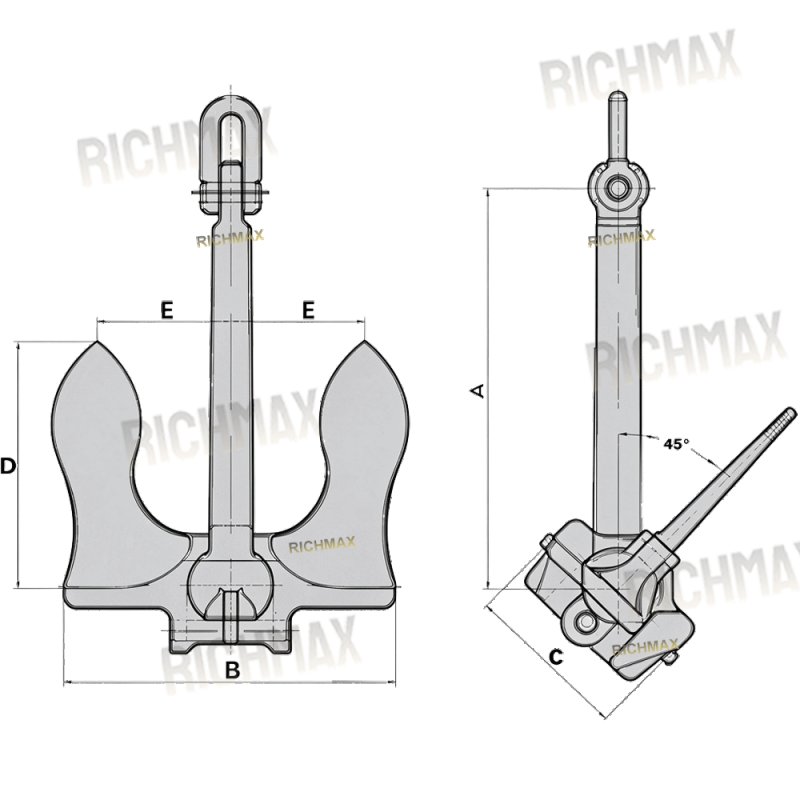
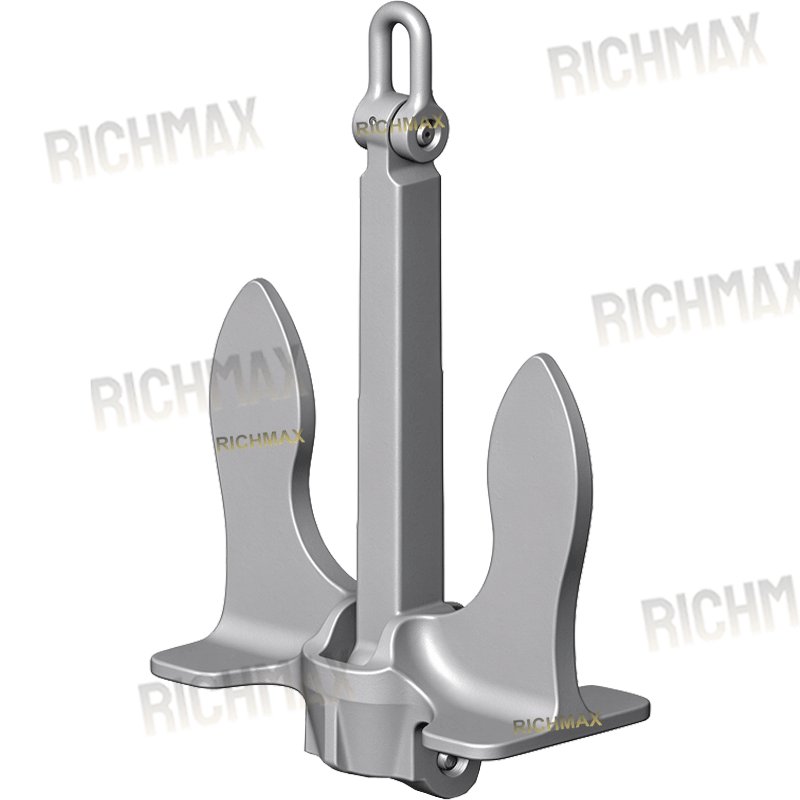
Structure
Baldt Anchor is a stockless anchor with a hinged fluke arrangement. Its main structural components include the shank, crown, flukes, hinge pins and chain connection. The crown and fluke assembly are designed to maintain the required anchor position during deployment, seabed engagement and recovery.
Depending on the design and manufacturing specification, the anchor body may use an integrated cast structure with a separate shank and movable flukes. The exact construction, material, dimensions and assembly details should be confirmed against the approved drawing and applicable classification requirements.
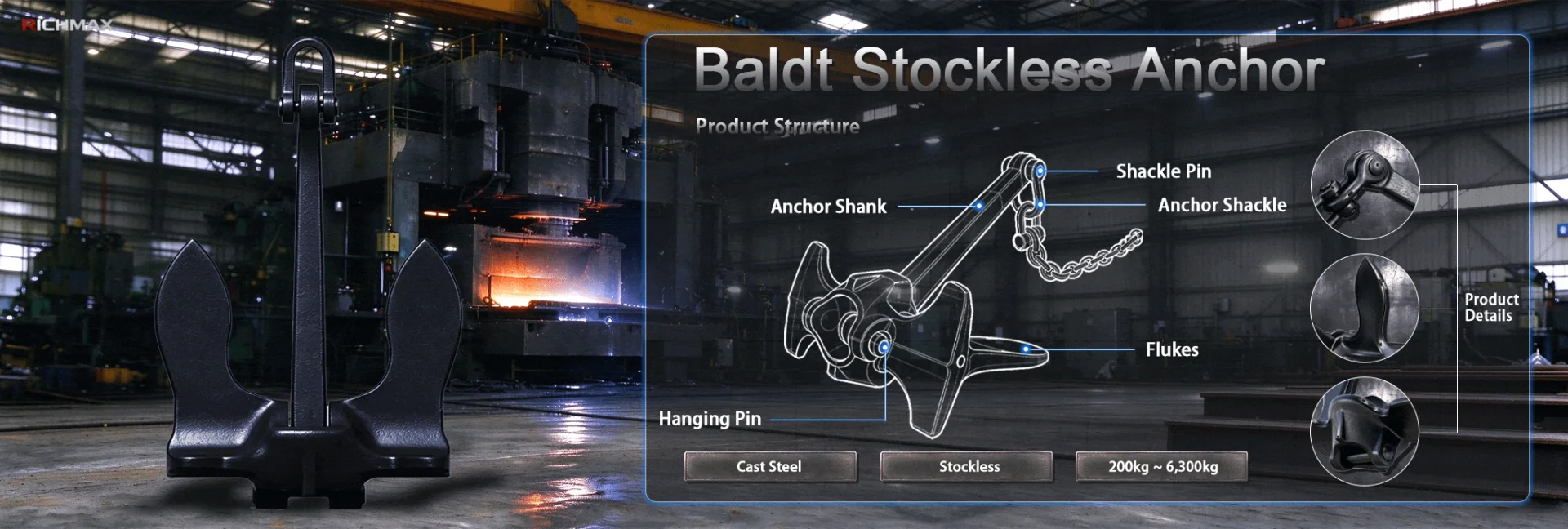
1. Main Anchor Body
The main anchor body forms the structural foundation of the anchor. It connects the shank and fluke assembly and provides the geometry required for the anchor to rest in the intended position before setting.
The crown profile, body proportions and weight distribution affect the anchor's resting position and the orientation of the flukes when they contact the seabed.
For a replacement anchor, the overall dimensions and structural configuration should be checked against the original drawing. Nominal anchor weight alone is not sufficient to confirm dimensional interchangeability.
2. Shank
The shank is the main longitudinal member connecting the anchor to the anchor chain. During deployment and holding, it transfers the chain load to the anchor body and fluke assembly.
Shank design considerations include:
Overall length and cross-sectional dimensions
Material grade and specified mechanical properties
Connection geometry at the crown or hinge assembly
Pin-hole dimensions and local wall thickness, where applicable
Alignment with the chain connection and anchor body
The shank connection is subject to tensile loading and changes in load direction during anchor setting and recovery. Dimensional accuracy and the condition of the connection area are therefore important for assembly and service.
3. Crown and Weight Distribution
The crown connects the main body with the flukes and influences how the anchor rests on the seabed. Its profile and mass distribution are part of the overall anchor geometry.
The crown configuration must correspond to the intended fluke movement and working position. Incorrect dimensions or weight distribution may affect the anchor's resting orientation and the initial contact between the flukes and seabed.
Depending on the design, the crown may incorporate additional material or a shaped profile to maintain the specified balance. Such features should be verified against the approved drawing rather than assumed to be identical across all Baldt Anchor models.
4. Flukes
The Baldt Anchor has two flukes arranged around the central body. The flukes engage with the seabed when the anchor is pulled in the intended direction.
Their profile, surface curvature, thickness and angular range determine how they contact and penetrate the seabed. Once the flukes begin to engage, the applied chain load is transferred through the fluke roots and supporting structure.
Relevant design and inspection points include:
Fluke length, width and thickness
Fluke profile and specified working angle
Root thickness and transition radii
Reinforcing ribs or local reinforcement, where provided
Alignment between the two flukes
Surface condition and dimensional consistency
The fluke roots and changes in section are important inspection areas because local stresses can increase around geometric transitions. Cracks, casting defects, deformation or significant wear in these areas require evaluation before the anchor is accepted for service.
5. Hinge and Pin Arrangement
The flukes are connected to the anchor body through a hinge and pin arrangement that allows movement within the range specified by the design.
The hinge must permit the flukes to rotate without excessive resistance while maintaining the required connection and alignment under load. Pin dimensions, mating clearances and retaining arrangements must be compatible with the corresponding components. Inspection may include:
Pin diameter and condition
Pin retention and locking arrangement
Hinge-hole dimensions and surface condition
Fluke movement throughout the specified range
Clearance between mating components
Evidence of wear, deformation or cracking
Excessive clearance may cause unwanted movement and uneven contact between components. Insufficient clearance, corrosion or accumulated debris may restrict movement. The acceptance limits should follow the drawing, manufacturer's requirements or applicable inspection criteria.
6. Load Transfer and Stress Distribution
When the anchor chain applies tension, the shank transfers the load to the anchor body. The load is then carried through the crown, hinge connections and flukes as the anchor engages with the seabed.
The fluke curvature and root geometry influence how the load is distributed through the structure. Section transitions, pin holes and hinge connections may experience local stress concentrations, particularly under changing load directions or repeated loading.
Structural integrity therefore depends on more than the nominal dimensions of individual components. Material properties, casting quality, geometric accuracy, assembly fit and the condition of load-bearing surfaces must be considered together.
For critical applications, any required stress analysis, proof testing or classification inspection should follow the specified design and approval requirements.
7. Material and Section Design
The structural sections must provide the required strength and stiffness for the specified anchor size and service conditions.
Depending on the design, the main body or crown may be produced as a casting, while the shank, pins and other components may use different manufacturing methods and material specifications.
Particular attention should be given to:
Fluke root thickness and section transitions
Reinforcing ribs or local strengthening features, where specified
Pin-hole areas and hinge bearing surfaces
Casting radii and changes in section thickness
Material traceability and specified mechanical properties
Surface defects that may affect structural integrity
An integrated casting can reduce the need for welded joints within the cast component. However, casting quality must be controlled because internal shrinkage, porosity or other discontinuities may affect the load-bearing section. Inspection methods should be selected according to the component, specification and acceptance criteria.
8. Chain Connection
The upper end of the shank connects to the anchor chain through the specified anchor shackle or connecting arrangement.
The connection must match the vessel's anchoring system and the dimensions of the selected chain and fittings. A nominally compatible anchor weight does not establish that the connection is interchangeable.
Relevant dimensions include:
Shank eye dimensions
Pin diameter and pin-hole size
Shackle opening and internal width
Connection thickness and clearances
Anchor chain diameter and connecting-link dimensions
The connection should allow correct assembly without forcing, unauthorized machining or modification. The shackle pin and retaining arrangement must also be suitable for the specified connection.
9. Dimensional Standardization and Assembly
Baldt Anchor dimensions vary according to anchor size, design and manufacturing specification. Structural proportions, fluke angles, pin dimensions and chain connections should therefore be checked against the applicable drawing rather than transferred directly from another model.
For classification-controlled projects, the required drawings, material specifications, inspection records and approval documents should be confirmed before production.
Final assembly checks should cover component identification, pin installation, fluke movement, connection fit and any specified dimensional tolerances. Where the anchor is intended to replace an existing unit, the mating dimensions and installation clearances should also be verified.
10. Structural Limitations and Inspection Points
The anchor's working performance depends on its design, condition and seabed characteristics. A stockless anchor with hinged flukes may have difficulty developing effective engagement on hard rock or coarse, uneven seabeds where the flukes cannot penetrate or establish a suitable holding position.
During service, the hinge area may accumulate sediment or develop corrosion and wear. These conditions can affect fluke movement and increase clearance between mating components.
Inspection should pay particular attention to:
Hinge pins, pin holes and retaining devices
Fluke roots and changes in section
Casting surfaces and suspected internal defects
Areas showing corrosion, impact damage or deformation
Fluke alignment and freedom of movement
Shank and chain connection dimensions
Cracks, abnormal movement, significant wear or suspected casting defects should be assessed against the applicable acceptance criteria. Repair or replacement should follow the manufacturer's instructions and any required class approval.
The final structural configuration, dimensions, materials and inspection requirements should be confirmed against the approved Baldt Anchor drawing and the specification for the intended vessel or project.
Material
The material for a Baldt Anchor should be selected according to the applicable manufacturing standard, classification requirements, approved drawing and purchase specification.
Cast steel is commonly used for Baldt Anchors. The required steel grade depends on the anchor design, specified mechanical properties and classification requirements. Grades such as ZG200-400 may appear in product specifications, but the actual grade should be confirmed against the order documents rather than assumed from the anchor type.
Cast Steel and Material Properties
Cast steel is used to produce the main anchor body and other components specified for cast construction. It allows complex shapes to be formed as a single casting, reducing the need for structural joints in those components.
Material selection should consider the following properties:
Yield Strength: Determines the stress at which permanent deformation begins under load.
Tensile Strength: Indicates the material's resistance to tensile failure.
Impact Toughness: Helps assess the material's ability to withstand sudden loading, particularly at the specified test temperature.
Elongation and Reduction of Area: Indicate the material's capacity for plastic deformation before fracture.
Hardness: Checked where specified by the applicable material standard or inspection requirements.
These properties should meet the requirements of the specified steel grade. For anchors operating in cold regions or exposed to substantial impact loading, the required impact test temperature and results should be confirmed before production.
Heat Treatment
Heat treatment is applied according to the steel grade, casting process and approved manufacturing procedure. Normalizing, quenching and tempering, or other specified treatments may be required depending on the material requirements.
Proper heat treatment helps establish the required mechanical properties and control the microstructure. It should not be assumed that every Baldt Anchor uses the same heat-treatment process.
Relevant production records may include:
Heat number and material identification
Heat-treatment procedure and batch records
Temperature and holding-time records, where required·
Cooling records, where specified
Mechanical test results
For class-controlled orders, the heat-treatment process and test requirements should be agreed upon before manufacturing.
Casting Quality and Material Consistency
The quality of cast steel depends on the raw material, melting practice, casting process and subsequent inspection. Potential casting defects include shrinkage cavities, porosity, inclusions and cracks. Defects that affect load-bearing sections may reduce the anchor's strength or toughness.
Material certificates alone do not establish that a casting is free from internal defects. Depending on the approved inspection plan, visual inspection, dimensional checks and non-destructive testing may be required.
Where a component is produced as a single casting, fewer structural joints may be needed. However, one-piece casting does not automatically guarantee uniform material properties or defect-free construction. Casting quality and inspection results remain important.
Corrosion Protection
Cast steel requires suitable surface protection for marine service. The coating system should be selected according to the operating environment, specified service conditions and buyer's requirements.
Common options include:
The coating helps limit direct contact between the steel surface and the marine environment. It does not make the base material corrosion-proof. Damage caused by handling, seabed contact or abrasion can expose the steel to seawater and accelerate corrosion.
Coating thickness, surface preparation and inspection criteria should be defined in the purchase specification. The hinge, pin and other moving parts should also be checked to ensure that the coating does not restrict movement.
Material Certification and Traceability
For shipyard projects and classification-controlled orders, the material grade, inspection scope and certification requirements should be confirmed before production.
Depending on the order, the required documents may include:
Material certificate and chemical analysis
Mechanical test results, including impact tests where specified
Heat-treatment records
Casting inspection or non-destructive testing reports
Classification society inspection documents, where applicable
DNV, LR, BV or another classification society may be involved according to the vessel's class and project requirements. The availability and scope of certification should be confirmed for the specific order; it should not be assumed that every Baldt Anchor carries the same class approval.
Material identification should remain traceable through the applicable manufacturing and inspection records.
Material Selection Considerations
When selecting a Baldt Anchor, buyers should confirm more than the material name alone.
Steel Grade and Mechanical Requirements
Check the specified grade, yield strength, tensile strength and impact requirements against the applicable standard and purchase documents. For low-temperature service, confirm the required impact test temperature and acceptance criteria.
Casting Quality
Confirm the inspection requirements for the main load-bearing sections. Where specified, review the results of non-destructive testing and the acceptance criteria for casting defects.
Heat Treatment
Check whether heat treatment is required for the specified grade and whether the manufacturing records and mechanical test results meet the agreed requirements.
Marine Corrosion Protection
Select the coating system according to seawater exposure, expected abrasion and maintenance conditions. Anchors that frequently contact rocky seabeds may require closer inspection of worn or damaged coating areas.
Certification and Traceability
For newbuilding, replacement or class-controlled projects, confirm the required material certificates, inspection records and classification documents before placing the order.
Material Limitations and Inspection Points
Cast steel is suitable for many anchor designs, but its performance depends on material quality, casting integrity, heat treatment and inspection. The following points should be considered during purchasing and service.
Casting Defects: Internal porosity, shrinkage and inclusions may affect load-bearing capacity. Inspection should follow the specified acceptance criteria.
Low-Temperature Performance: Steel that does not meet the required toughness at the service temperature may be more susceptible to brittle fracture under impact loading.
Corrosion: Coating damage exposes the base steel to seawater. The anchor should be inspected periodically, with damaged coatings repaired as necessary.
Material Verification: Missing or inconsistent certificates make it difficult to verify the specified grade and mechanical properties. Heat-number traceability and supporting test records should be checked.
Wear: Repeated contact with rocks or abrasive seabeds can wear the flukes and other exposed surfaces. Significant wear, deformation or suspected cracking should be assessed against the applicable inspection criteria.
Material selection should ultimately be based on the approved specification, verified test results and intended service conditions, rather than on the Baldt Anchor designation alone.
How To Use?
A Baldt Anchor is installed as part of the vessel's anchoring system and operates together with the specified anchor chain, shackles, windlass, chain stopper, hawse pipe and chain locker.
Correct operation depends on the anchor design, seabed conditions, water depth, chain scope and vessel operating procedure. Before use, the anchor and its hinged components should be checked to ensure that they are in serviceable condition.
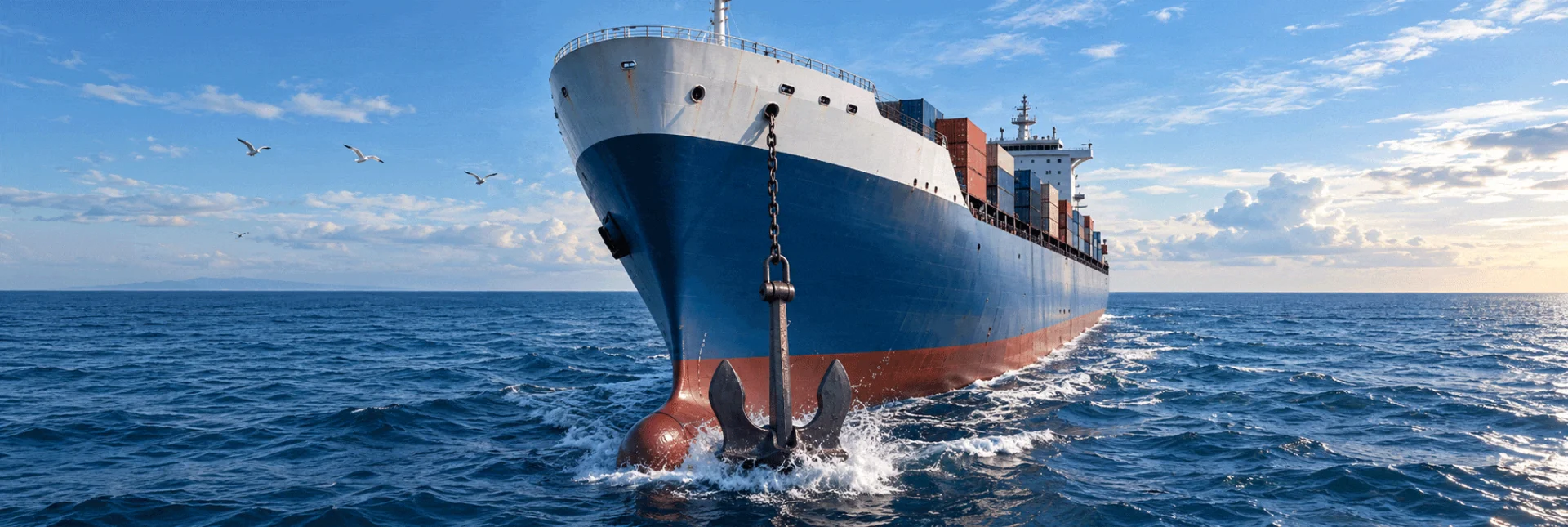
1. Preparation Before Anchoring
Before deployment, inspect the anchor body, flukes, hinge pins, connecting shackles and anchor chain for cracks, deformation, excessive wear or other visible damage.
Check that the hinged flukes move freely within their designed range. Confirm that the anchor-handling equipment is ready for operation and that the chain can be paid out without obstruction.
The anchoring plan should take into account:
Water depth and expected tidal variation
Seabed type and available seabed information
Wind, current and forecast sea conditions
Required anchor chain scope
Available swinging room and nearby obstructions
Vessel-specific anchoring procedures
The required chain scope should be determined according to the vessel's operating procedure and prevailing conditions rather than a fixed length for every anchoring operation.
2. Anchor Deployment
Reduce vessel speed and position the vessel according to the approved anchoring procedure before releasing the anchor.
Pay out the anchor chain in a controlled manner so that the anchor reaches the seabed without unnecessary impact. Continue releasing the required chain length to allow the anchor to orient itself and the flukes to move into their working position.
The Baldt Anchor's hinged fluke arrangement allows the flukes to pivot relative to the anchor body. As the chain is paid out and tension is gradually applied, the flukes can engage with the seabed, depending on the anchor design and bottom conditions.
Avoid releasing the anchor at excessive vessel speed or applying sudden loads to the chain. These conditions can place unnecessary stress on the hinge pins, fluke roots, connecting components and anchor-handling equipment.
3. Anchor Setting and Holding
After the anchor reaches the seabed, apply chain tension gradually in accordance with the vessel's anchoring procedure to assess whether the anchor has set.
The flukes must engage with the seabed to develop holding resistance. Successful setting depends on the seabed material, anchor orientation, chain scope, loading direction and the amount of movement available for the anchor to embed.
Baldt Anchor designs may differ in their fluke geometry and hinge arrangement. The actual engagement of the flukes should therefore be assessed according to the specific anchor design and operating conditions rather than assuming that both flukes will always penetrate the seabed simultaneously.
Sand, clay and some mud seabeds may provide suitable setting conditions, but performance varies with soil density, consistency and layering. Hard rock, exposed reef and seabeds containing large obstructions may prevent effective penetration.
Once anchoring is established, monitor the vessel's position, wind direction, current and tidal changes. Check the anchor chain's loading condition and watch for signs of dragging in accordance with the vessel's watchkeeping procedures.
4. Anchor Recovery
Before weighing anchor, the vessel should approach the anchor position gradually, following the approved recovery procedure, to reduce excessive tension on the anchor chain.
Retrieve the chain using the windlass while coordinating vessel movement with the chain-handling operation. Avoid using the windlass to pull the vessel toward the anchor against excessive chain tension.
As the anchor approaches the hawse pipe or anchor pocket, monitor its orientation and confirm that the flukes move into the intended stowed position. Prevent the anchor from striking the hull or becoming jammed in the recovery arrangement.
After recovery, remove accumulated mud, sand and debris, particularly around the hinge pins and other moving interfaces. Inspect the anchor for visible damage, unusual wear and coating deterioration before returning it to service.
5. Operating Limitations and Precautions
Incorrect operation can affect the structural condition and holding performance of a Baldt Anchor.
Excessive speed during deployment: Sudden impact and dynamic loading may damage the anchor structure, hinge pins or connecting components.
Insufficient chain scope: Inadequate chain deployment may prevent the anchor from setting properly and increase the risk of dragging.
Unsuitable seabed: Hard rock, large boulders and exposed reef may prevent the flukes from penetrating the seabed. Do not compensate by applying excessive chain tension.
Seized hinge components: Accumulated mud, corrosion or deformation may restrict fluke movement and interfere with setting or recovery.
Damaged anchor components: Anchors with cracks, bent flukes, deformed pins or other structural defects should be removed from service pending inspection and assessment.
Improper recovery: Pulling against excessive chain tension or allowing the anchor to strike the hull may damage the anchor, chain-handling equipment or vessel structure.
Following extended anchoring in muddy or sediment-rich seabeds, pay particular attention to the hinge area during recovery and inspection. Do not force seized components to move without first assessing the cause of the obstruction.
6. Maintenance, Handling and Storage
Routine inspection helps identify damage that may affect the anchor's operation.
After use, clean the anchor body and hinged areas to remove mud, sand and other deposits. Check the flukes, hinge pins, connecting points and welds or cast surfaces, as applicable, for cracks, deformation, excessive wear and corrosion.
Inspect protective coatings and repair damaged areas according to the specified coating system. For extended storage, keep the anchor in a suitable location with appropriate drainage and corrosion protection.
During lifting and handling, use the designated lifting points or an approved lifting arrangement. Confirm that the lifting equipment is suitable for the anchor's weight and that the anchor is adequately secured before moving it.
The anchor should be supported in a stable position during storage. Avoid uncontrolled impact, loading on vulnerable hinge components or arrangements that may deform the flukes.
7. Typical Applications
Baldt Anchors are used in vessel anchoring systems where the specified anchor design and approved anchoring arrangement are suitable for the application.
Typical applications may include:
Commercial vessels requiring conventional anchoring arrangements
Engineering and work vessels operating in ports or offshore areas
Vessel anchoring and replacement projects
Other marine applications where the anchor type is specified by the vessel design or project requirements
For offshore platforms and temporary mooring applications, confirm that the particular Baldt Anchor is designed and approved for the intended duty. A conventional vessel anchor should not automatically be treated as suitable for permanent mooring or offshore station-keeping.
8. Key Points for Buyers and Operators
When selecting and using a Baldt Anchor, confirm the anchor dimensions, weight, material specification, hinge arrangement, connecting components and applicable inspection requirements against the approved drawing and purchase specification.
The anchor should be compatible with the vessel's hawse pipe or anchor pocket, anchor chain and handling equipment. Where certification or classification approval is required, the applicable requirements should be agreed before manufacture and delivery.
Correct deployment, adequate chain scope, suitable seabed conditions and regular inspection are essential to reliable anchoring operation. Actual holding performance must be assessed against the specific anchor design and site conditions.
Application
Baldt Anchor is a conventional stockless anchor used mainly as a bow anchor on vessels designed for this type of anchoring arrangement. Its stockless construction allows the anchor to be stowed in a hawse pipe or anchor pocket, making it suitable for many commercial vessels.
Selection depends on the vessel's approved anchoring arrangement, required anchor weight, chain specifications and intended operating conditions. The anchor type alone does not determine its holding capacity or suitability for a particular seabed.
Bulk Carriers and General Cargo Vessels
Baldt Anchor can be specified for bulk carriers and general cargo vessels where a conventional stockless anchor is required. The anchor weight, shank dimensions and fluke arrangement should match the vessel's approved equipment specifications.
Oil Tankers and Other Tankers
For tankers, anchor selection should follow the vessel's approved anchoring system and applicable classification requirements. The anchor, chain, connecting shackles and handling equipment should be checked as a complete assembly.
Container Vessels
The stockless configuration allows the anchor to be accommodated in a suitable bow hawse pipe or anchor pocket. Overall dimensions, fluke movement and stowage clearance should be verified before ordering.
Engineering, Work and Research Vessels
Baldt Anchor may be used on engineering vessels, workboats and research vessels when specified by the vessel design. Selection should take account of the operating area, expected seabed conditions and the vessel's anchoring procedures.
Offshore and Temporary Anchoring Applications
Baldt Anchor may be considered for temporary anchoring of suitable floating equipment or work vessels when the anchor and complete anchoring system have been designed for the intended loads.
For offshore construction, floating platforms, buoy positioning or temporary mooring, the required holding capacity, environmental loads, water depth and seabed characteristics must be assessed before selection.
A conventional Baldt Anchor should not be treated as a universal solution for offshore station-keeping or permanent mooring. These applications may require a purpose-designed anchor and a project-specific mooring analysis.
Application:
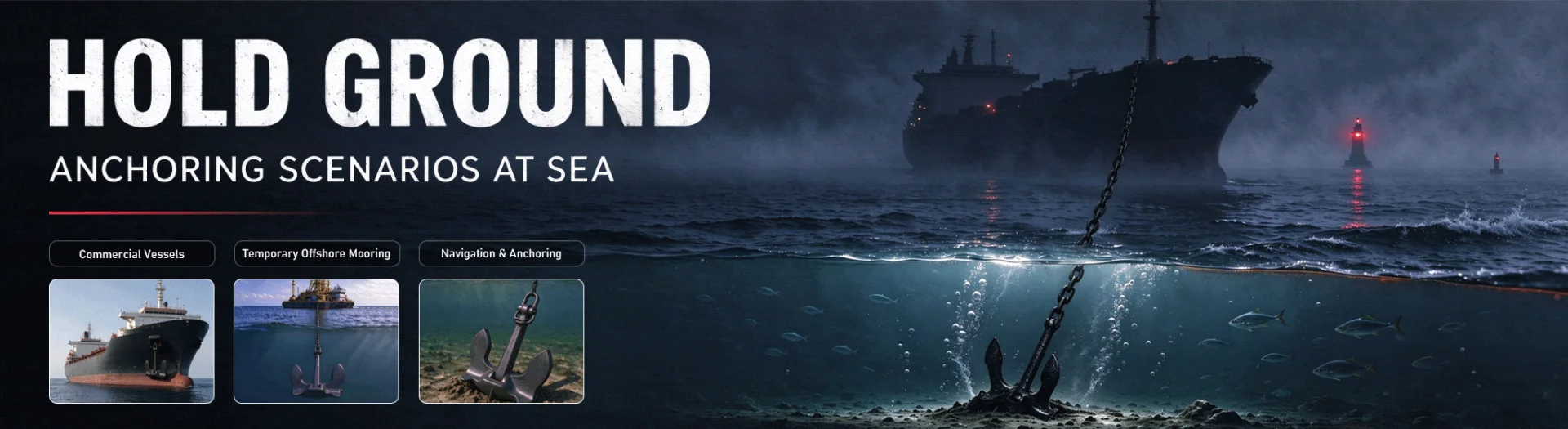
Seabed Conditions
Holding performance depends on the anchor design, penetration, seabed properties and loading direction.
Mud and soft clay: Penetration may be possible where the anchor geometry and seabed strength are suitable.
Silty and muddy sand: Performance depends on sediment density, layering and the anchor's ability to penetrate.
Sand: Holding capacity varies with grain size, density, seabed slope and embedment.
Gravel, rock and coral seabeds: Penetration may be limited, and the anchor may fail to develop the required holding capacity.
The actual holding capacity should be established from the applicable design data, recognized test results or project-specific assessment rather than assumed from the anchor type alone.
Offshore Navigation and Exposed Anchorage
For vessels operating offshore or anchoring in exposed waters, the anchor must be selected as part of the complete anchoring system.
Wind, waves, current, water depth, vessel displacement and the length and grade of anchor chain all affect anchoring performance. A Baldt Anchor should only be used where the approved equipment specification and operating limits are appropriate for the expected conditions.
Why Buyers Select a Baldt Anchor
Buyers may select a Baldt Anchor for the following practical reasons:
Stockless construction: Suitable for vessels that stow the anchor in a bow hawse pipe or anchor pocket.
Established vessel configuration: Appropriate where the original design or approved equipment list specifies a Baldt-type anchor.
Replacement compatibility: Can simplify replacement procurement when the existing anchor type, weight, dimensions and connection details are known.
Integration with shipboard equipment: Can be matched to the specified anchor chain, shackle, windlass and chain stopper.
Documented inspection requirements: Can be supplied against agreed drawings, material specifications, inspection requirements and classification documentation, subject to the actual order and certification scope.
The choice should be based on compatibility, specified performance and compliance requirements rather than the anchor name alone.
Classification and Inspection Requirements
For newbuilds, classed vessels and regulated marine projects, the anchor specification should identify the applicable classification society, manufacturing standard, material requirements and inspection scope.
Where required, the buyer should confirm whether the order includes material certificates, dimensional inspection, mechanical testing, proof testing, class survey or other agreed documentation. Classification approval and certification should not be assumed unless confirmed for the specific product and order.
Replacement and Retrofit Projects
For an existing vessel, replacement should normally be based on the original specification or an approved replacement drawing rather than visual similarity alone.
Before ordering, confirm:
Existing anchor type and nominal weight
Overall length, width and height
Shank and fluke dimensions
Hinge arrangement and pin diameter
Anchor shackle size and connection details
Anchor chain diameter and grade
Hawse pipe or anchor pocket clearance
Applicable classification society
Existing drawings, certificates and inspection requirements
Where the original drawing is unavailable, dimensional measurements and review by the vessel's technical department or responsible design authority may be necessary.
Application Limitations
Hard or Rocky Seabeds
Baldt Anchor may not develop adequate holding capacity on exposed rock, coral or coarse gravel where the flukes cannot penetrate or obtain a reliable purchase. For these conditions, the anchor type should be selected according to the actual seabed profile and verified holding requirements.
Very Shallow or Restricted Waters
Shallow water does not automatically make a Baldt Anchor unsuitable. However, restricted clearance, frequent wave-induced vessel movement, hard seabed or insufficient chain scope can affect setting and holding performance. Water depth, under-keel clearance and the available anchoring arrangement should be checked before use.
Frequent Dragging or Seabed Contact
A conventional anchor is designed to engage the seabed during anchoring, not to serve as a continuous-dragging component. Repeated dragging, impact or abrasive contact can wear the flukes, shank and hinge components. Anchors used in demanding service should be inspected for wear, deformation and damage in accordance with the applicable maintenance requirements.
Small Boats and Light-Duty Applications
A Baldt Anchor may be unnecessarily heavy or difficult to handle on a small vessel if its design does not require this anchor type. The anchor should be selected according to vessel size, displacement, equipment requirements and handling capacity rather than assuming that a larger anchor is always more suitable.
Permanent Mooring and Continuous Station-Keeping
A conventional Baldt Anchor should not automatically be used for permanent mooring, floating-platform station-keeping or other applications involving continuous environmental loads. These duties require an engineered anchoring or mooring system with verified holding capacity, load distribution and suitable components.
Final Selection Considerations
Before confirming an order, buyers should verify the anchor's intended duty, approved specification, required holding performance, seabed conditions, dimensional compatibility and certification scope. These checks help determine whether a conventional Baldt Anchor is suitable for the vessel or project.
How To Choose A Reliable Marine Anchor Supplier?
Supplier Evaluation for Baldt Anchor
When purchasing a Baldt Anchor, supplier evaluation should cover manufacturing capability, technical compliance, material traceability, inspection arrangements and delivery control. The requirements may vary depending on the anchor drawing, vessel specification, classification requirements and whether the order is for a new vessel or a replacement project.
Qingdao Richmax Imp. & Exp. Co., Ltd. supplies marine hardware, marine equipment and related industrial products for overseas customers. As an affiliated company of Hiking Group Global Industrial Limited, Richmax can coordinate manufacturing resources and related product supply according to project requirements. For Baldt Anchor orders, the focus is on confirming the technical specification, applicable manufacturing arrangements, inspection scope and delivery requirements before production.
Our Workshop:
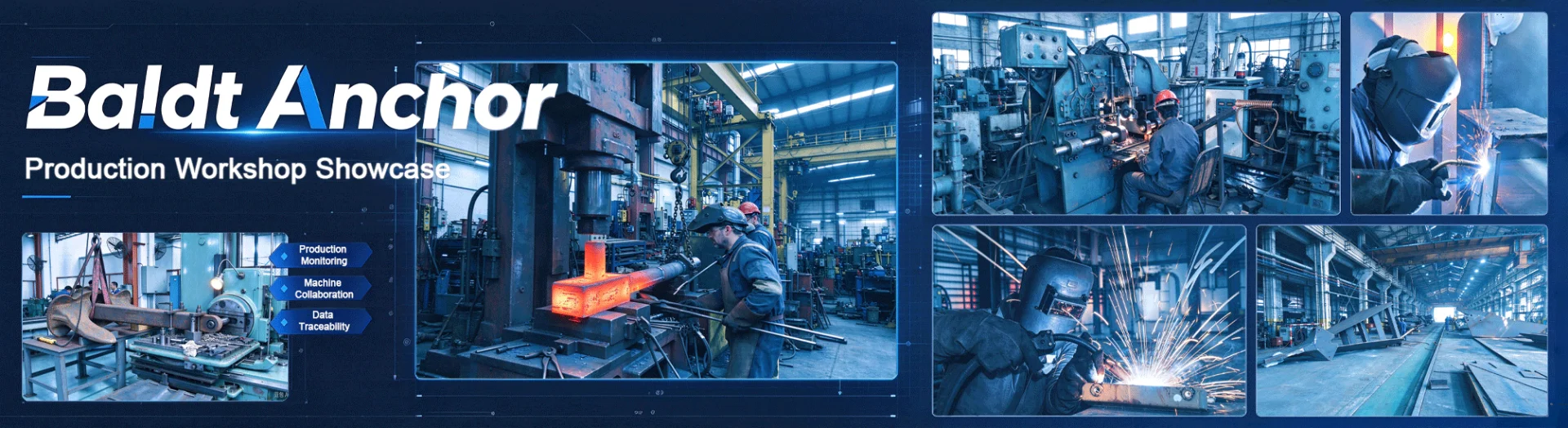
Manufacturing Facilities and Production Capability
Confirm whether the supplier manufactures the anchor in its own facilities or arranges production through subcontractors. If casting, machining, heat treatment and surface coating are handled by different facilities, the supplier should be able to explain how these processes are coordinated and inspected.
Relevant points include:
Experience in manufacturing Baldt Anchors and other conventional stockless anchors.
Availability of casting, machining and heat-treatment facilities.
Production capacity for the required anchor weight and order quantity.
Control of subcontracted processes, where applicable.
Ability to complete surface preparation and protective coating according to the purchase specification.
For larger shipyard projects, production capacity should be assessed against the actual delivery schedule rather than the supplier's stated annual output alone.
Richmax's approach: Through its industrial network and manufacturing-resource coordination, Richmax can arrange product supply according to the specified anchor design and order requirements. The actual manufacturing facilities, production route and process responsibilities should be confirmed for each order, particularly when casting, machining and heat treatment are carried out at different locations.
Classification Approval and Certification
For class-certified orders, confirm whether the manufacturing facility and the proposed inspection arrangements meet the requirements of the applicable classification society, such as DNV, Lloyd's Register (LR) or Bureau Veritas (BV).
The scope of approval should be checked against the actual product and manufacturing process. A supplier's general statement about classification experience does not, by itself, establish that a particular factory or anchor is approved.
Depending on the order, the supplier may need to provide:
Material certificates and heat-number traceability.
Mechanical test reports.
Dimensional inspection records.
NDT reports, where specified.
Proof-load test records or certificates.
Classification inspection or product certificates, where required.
The supplier should also be able to coordinate inspection with the attending surveyor or the buyer's appointed inspector. Certificate numbers, product details and material identification should correspond to the delivered anchor and its supporting records.
Richmax's approach: Certification and inspection requirements can be reviewed during order confirmation, including the required certificate type, inspection scope and documentation. Where classification attendance is required, the arrangements should be confirmed with the actual manufacturing facility and the relevant classification society before production. Certificate availability and approval scope should be verified for the specific order.
Technical Capability and Drawing Control
The supplier should understand the construction and dimensional requirements of Baldt Anchors and distinguish them from other stockless anchor designs, such as Hall-type anchors. Similar product names do not necessarily indicate interchangeable dimensions or performance.
Before production, confirm the following:
The applicable manufacturer, approved or classification drawing.
Anchor weight and principal dimensions.
Shank, fluke and hinge arrangement.
Pin dimensions and connection details.
Material grade and manufacturing method.
Surface protection requirements.
Applicable inspection and testing criteria.
For replacement projects, existing anchor dimensions, photographs and connection details may help establish the required configuration. However, they should be checked against the vessel's drawings or other approved technical information where available.
The supplier should also be able to check compatibility with the specified anchor chain, joining shackle and vessel's anchoring arrangement. Any proposed dimensional or material changes should be agreed before manufacture.
Richmax's approach: Richmax can coordinate technical confirmation for Baldt Anchors and related anchoring components, including anchor chains, joining shackles and other specified marine hardware. Drawing references, dimensions, material requirements and connection details should be established before the order is released for production. For replacement orders, the available vessel drawings and existing component dimensions provide a basis for checking the required configuration.
Material and Manufacturing Process Control
For cast-steel Baldt Anchors, material quality and casting control are important because the main structural components are produced from cast material.
The supplier should be able to explain its material identification and production procedures, including:
Incoming material verification and chemical analysis.
Steel melting, pouring and casting control.
Heat treatment according to the applicable specification.
Surface cleaning and casting-defect inspection.
Machining of specified holes, bearing surfaces and connection areas.
Assembly of the shank, flukes, pins and hinge components.
Where production is subcontracted, inspection responsibility and record retention should be clearly defined.
Heat-treatment records, material test results and relevant production records should be available when required by the purchase specification. Casting defects should be assessed using the applicable acceptance criteria rather than visual appearance alone.
Richmax's approach: Material grades, manufacturing methods and inspection requirements can be specified and confirmed with the responsible production facility before manufacture. Where required, material certificates, heat-treatment records and inspection reports should be collected and checked against the order specification. The applicable records and traceability arrangements should be agreed before production begins.
Our Manufacturing Process:

Quality Inspection and Testing
Inspection should be planned before production, with the scope agreed by the buyer, supplier and classification society or third-party inspector where applicable.
Depending on the approved drawing and purchase requirements, inspection may cover:
Visual inspection of casting surfaces, welds where applicable, and assembled components.
Dimensional checks of anchor weight, overall dimensions, shank, flukes, hinge and pin arrangements.
Material verification and mechanical testing.
Magnetic particle testing (MT) or ultrasonic testing (UT), where specified and appropriate.
Proof-load testing according to the applicable requirements.
Final inspection and verification of identification markings.
The supplier should retain the inspection results and make them available for review. A final visual inspection alone is not sufficient evidence of compliance when material testing, NDT or load testing is specified.
Historical Baldt Anchor specifications may contain defined proof-test requirements for particular anchor weights. The applicable test load and acceptance criteria should therefore be confirmed from the governing specification instead of applying a generic load to every order.
Richmax's approach: Inspection requirements can be coordinated according to the purchase specification, approved drawing and project inspection plan. Depending on the order, this may include dimensional verification, material documentation, NDT, mechanical testing, proof-load testing and third-party inspection. The actual tests, acceptance criteria and inspection records should be confirmed before production rather than assumed to be identical for every Baldt Anchor.
Production Schedule and Delivery Control
The supplier should provide a realistic production schedule covering material preparation, casting, heat treatment, machining, inspection, coating and shipment.
For project orders, confirm whether the supplier can accommodate the required quantity and inspection dates. If multiple factories or subcontractors are involved, responsibility for coordinating production and resolving delays should be clear.
Delivery arrangements may include:
Protective packaging suitable for the transport method.
Corrosion protection and coating protection during handling.
Marking and packing lists corresponding to the actual shipment.
Commercial invoices, certificates of origin and other agreed export documents.
Inspection access before dispatch.
For replacement anchors, confirm the finished weight, dimensions and connection details before shipment to reduce the risk of installation problems at the receiving vessel or shipyard.
Richmax's approach: With overseas trade experience, Richmax can coordinate order follow-up, inspection scheduling, export documentation, packing requirements and shipment arrangements. Delivery planning should account for manufacturing lead time, required inspections, coating, packaging and document preparation. For project orders, these milestones should be agreed in advance and monitored against the confirmed delivery schedule.
Commercial Terms and After-Sales Responsibility
The quotation should identify the anchor type, drawing reference, weight, material grade, coating, inspection scope, certification requirements, delivery time and included documents.
Price comparisons should be based on equivalent technical and inspection requirements. A lower quotation may reflect differences in material, testing, certification, coating or delivery terms, so these items should be checked before placing the order.
The purchase agreement should also clarify warranty terms, responsibility for nonconforming products, the procedure for handling inspection discrepancies and the records required for a quality claim.
For export orders, previous experience with shipping documents, third-party inspection and project coordination can help reduce communication and delivery problems. Where necessary, the buyer should arrange factory inspection or an independent inspection before shipment.
Richmax's approach: Richmax can coordinate commercial and technical requirements between overseas buyers and the responsible manufacturing facilities. The quotation and order confirmation should clearly identify the agreed specifications, inspection requirements, delivery terms and documentation. Any nonconformity should be assessed against the purchase agreement and relevant inspection records, with corrective actions and responsibilities agreed between the parties.
Questions to Ask Before Placing an Order
Before confirming a Baldt Anchor purchase, ask the supplier:
Which drawing and specification will govern production?
Is the anchor manufactured in-house or through subcontractors?
Which facilities handle casting, heat treatment, machining and coating?
What material grade and traceability records will be provided?
Which dimensions and manufacturing stages are inspected?
Are MT, UT, mechanical tests or proof-load tests required for this order?
What classification approvals and certificates are applicable?
Can the buyer or appointed surveyor inspect the product before shipment?
What is the confirmed production and delivery schedule?
Which documents, warranty terms and nonconformity procedures are included?
For Baldt Anchor enquiries, Richmax can work with buyers to clarify these requirements before quotation and order confirmation. This helps establish a clear basis for manufacturing, inspection, documentation and delivery, particularly for shipyard procurement, vessel maintenance and anchor replacement projects.
Supplier suitability should ultimately be assessed against the actual technical and contractual requirements, supported by relevant documents, inspection arrangements and production records rather than general claims about quality or manufacturing experience.
FAQ
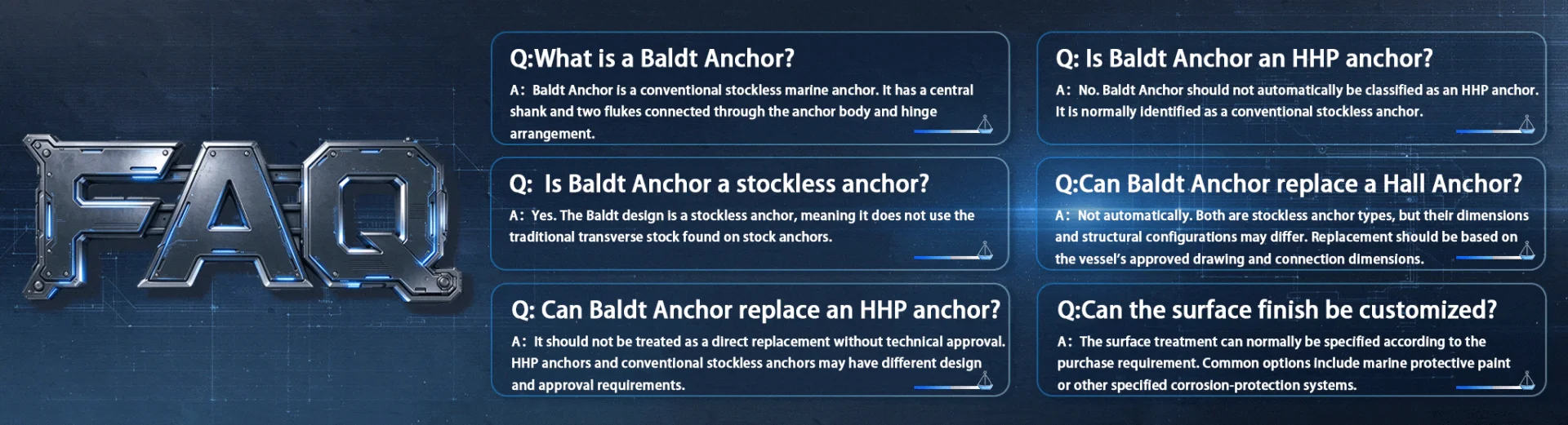
1. What is a Baldt Anchor?
Baldt Anchor is a conventional stockless marine anchor. It has a central shank and two flukes connected through the anchor body and hinge arrangement.
2. Is Baldt Anchor an HHP anchor?
No. Baldt Anchor should not automatically be classified as an HHP anchor. It is normally identified as a conventional stockless anchor. HHP designation should only be used when the specific anchor design has the applicable HHP approval or certification.
3. What is the main difference between Baldt Anchor and an HHP Anchor?
The anchor type, geometry, approved holding characteristics and classification basis are different. A Baldt Anchor should not be described as HHP simply because it has two flukes or develops seabed holding resistance.
4. Is Baldt Anchor a stockless anchor?
Yes. The Baldt design is a stockless anchor, meaning it does not use the traditional transverse stock found on stock anchors.
5. What are the main components of a Baldt Anchor?
The main components are generally the shank, crown, two flukes, hinge/pin arrangement and chain connection.
6. What material is normally used for Baldt Anchor?
Baldt Anchors are commonly manufactured from cast steel. The exact grade should be confirmed against the applicable standard, approved drawing and purchase specification. Some published specifications identify ZG200-400 cast steel, but this should not be assumed for every order.
7. Can Baldt Anchor be supplied with classification certification?
Yes, where required, inspection and certification can be arranged according to the specified classification society and project requirements. The required class should be confirmed before production.
8. Can Baldt Anchor be used as a bow anchor?
Yes. Baldt Anchor is commonly used as a bow or bower anchor on vessels with a suitable anchoring arrangement.
9. Can Baldt Anchor replace a Hall Anchor?
Not automatically. Both are stockless anchor types, but their dimensions and structural configurations may differ. Replacement should be based on the vessel's approved drawing and connection dimensions.
10. Can Baldt Anchor replace an HHP anchor?
It should not be treated as a direct replacement without technical approval. HHP anchors and conventional stockless anchors may have different design and approval requirements.
11. How is the correct Baldt Anchor size selected?
Selection should consider anchor weight, dimensions, chain size, vessel requirements, hawse pipe arrangement, classification requirements and the existing approved anchor specification.
12. What information should be provided for a replacement Baldt Anchor?
The most useful information includes the existing anchor drawing, anchor weight, overall dimensions, shank and fluke dimensions, pin dimensions, chain diameter, anchor shackle size and classification requirements.
13. Does anchor weight alone identify a Baldt Anchor?
No. Anchor weight is an important parameter, but different designs can have different dimensions at the same nominal weight.
14. What inspection is required for Baldt Anchor?
Depending on the order, inspection may include material verification, dimensional inspection, visual inspection, NDT, proof/load testing and classification inspection.
15. Can the surface finish be customized?
The surface treatment can normally be specified according to the purchase requirement. Common options include marine protective paint or other specified corrosion-protection systems.

 English
 Español
 Français
 Árabe
 Русский
 Português
 日本語
 한국어
 Dansk
 Nederlands
 Italiano
 Türkçe
 Deutsch
 Prancis
 ไทย
 Tiếng Việt
 हिंदी
 বাংলা
 中文