Structure
Marine mooring chain consists of interconnected steel links designed to transfer tensile loads through a continuous chain assembly. Its structural design affects load distribution, link articulation, connection compatibility and resistance to deformation, fatigue, wear and corrosion.
The chain configuration, dimensions and accessories should be selected according to the approved mooring system design, applicable standards and project requirements.
1. Chain Link Structure
Each chain link consists of a shaped steel body with defined cross-sectional dimensions and contact surfaces. Key dimensions include nominal diameter, inside and outside length, inside and outside width, and link pitch.
These dimensions determine the fit between adjacent links, their range of movement and compatibility with connecting equipment. Dimensional accuracy is therefore important for both assembly and load transfer.
Round-bar links are commonly used in marine mooring chains. Other cross-sectional profiles may be adopted where specified by the design. The finished link geometry must comply with the applicable drawings and dimensional requirements.
Stud Link Mooring Chain
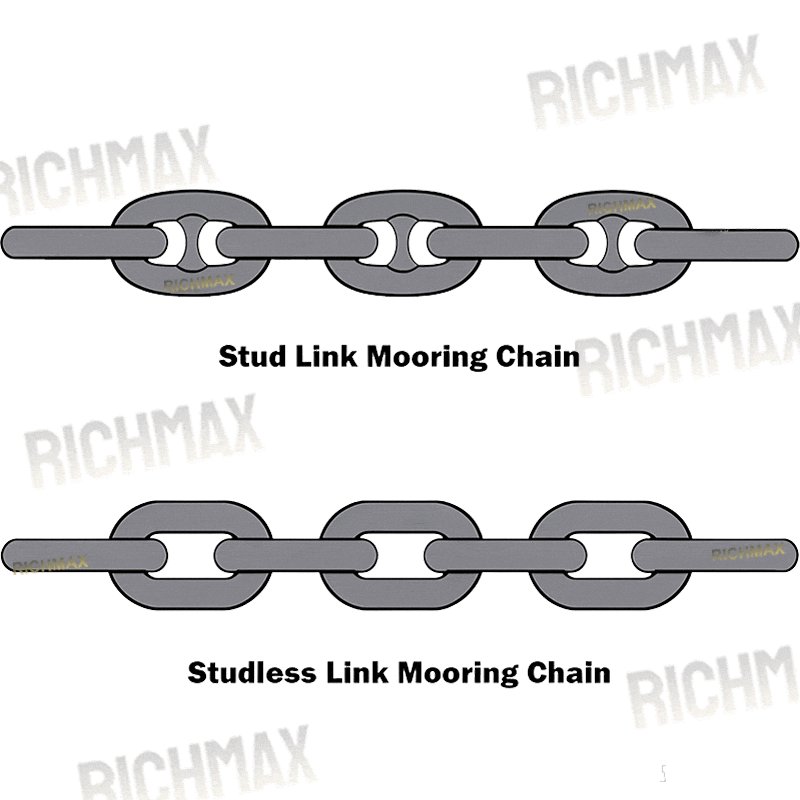
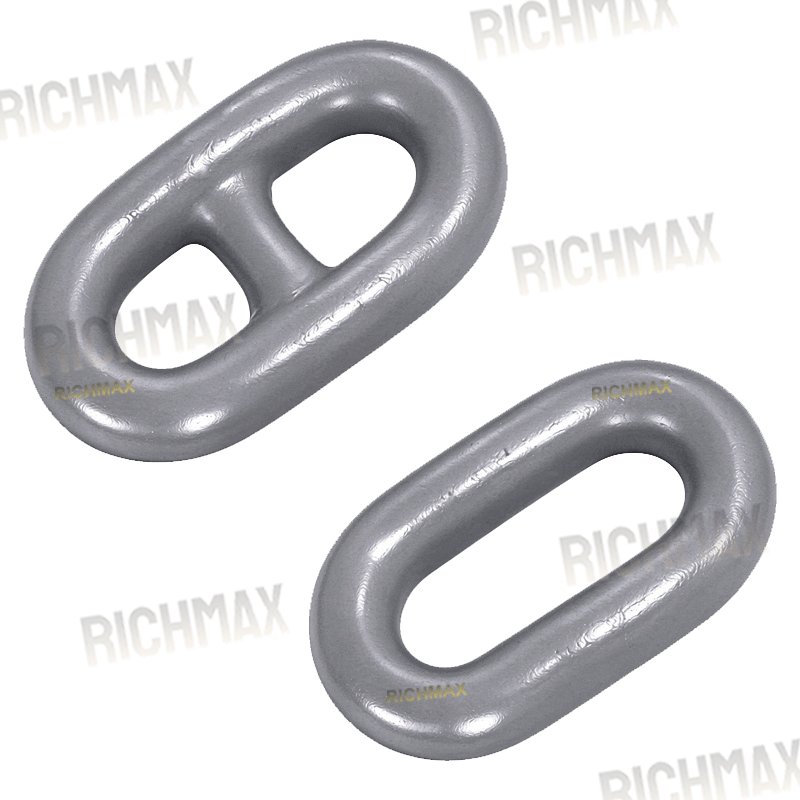
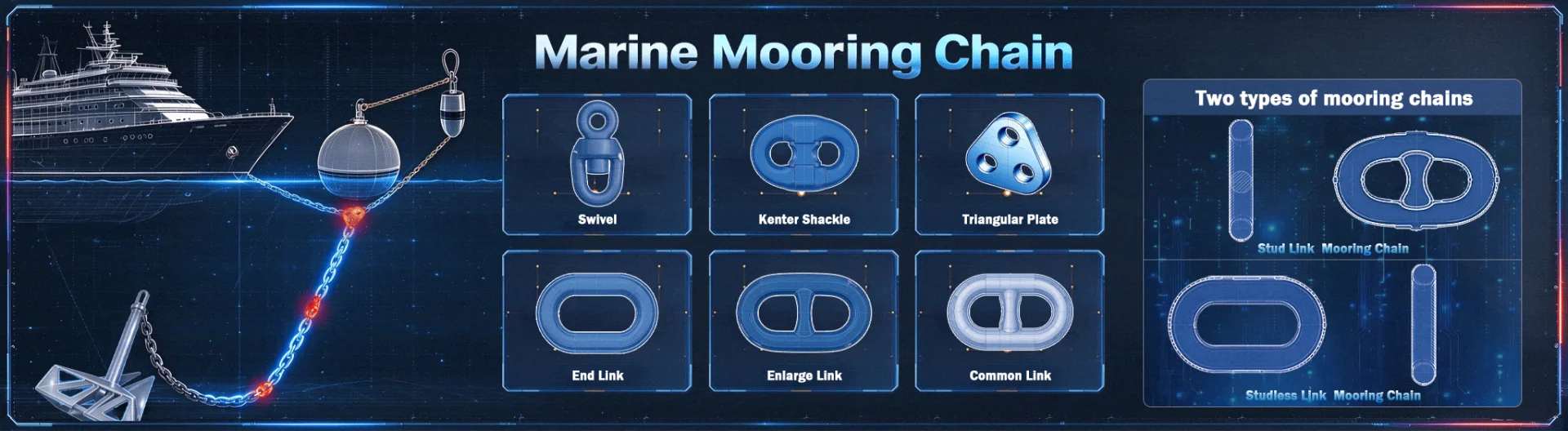
Stud link chain has a transverse stud fitted inside each link. The stud helps maintain the link's shape and limits deformation under loading. Its fit and retention are important to the structural integrity of the link.
Studless Mooring Chain
Studless chain has no transverse stud. Its link geometry and material properties must meet the specified strength and deformation-resistance requirements without internal stud support.
Both configurations are used in marine and offshore applications. Selection depends on the approved system design, mechanical requirements and operating conditions. They should not be treated as interchangeable based on nominal diameter alone.
2. Connections and Chain Accessories
A mooring chain assembly may include common links, enlarged links, end links, connecting shackles, end shackles and swivel assemblies.
These components connect chain sections and provide interfaces with other parts of the mooring system. Their dimensions, material grades, load ratings and connection geometry must match the specified assembly.
Welded chain links require controlled joint preparation, welding procedures and inspection. Weld quality, dimensional accuracy and any specified heat treatment affect the finished link's mechanical performance.
For long chain assemblies, section lengths, joining arrangements, transition components and end connections should be defined in the purchase specification. A component that fits dimensionally is not necessarily suitable for the required load.
3. Load-Bearing Design
Stress Distribution
The curved portions of a link provide transitions between straight sections and help transfer loads through the chain assembly. Controlled geometry and smooth transitions help limit unnecessary stress concentrations.
Actual stress distribution depends on link dimensions, material properties, contact conditions and loading direction. Cracks, sharp notches, unacceptable weld defects and dimensional deviations may increase local stress and require evaluation.
Deformation Resistance
The link body must withstand tensile loading and contact forces without unacceptable deformation. In stud link chain, the transverse stud provides additional internal support. Studless chain relies on its specified geometry and material properties to meet the required mechanical performance.
Neither configuration is immune to deformation under excessive loading, impact or unsuitable operating conditions.
Fatigue and Repeated Loading
Mooring chains may experience sustained tension, changing load directions and repeated movement during service. These conditions can contribute to fatigue damage, particularly where local stresses are elevated by contact wear, manufacturing defects or geometric discontinuities.
Chain design, material properties, manufacturing quality and inspection requirements should therefore be considered together.
4. Surface Details and Corrosion Protection
Weld preparation, surface transitions and contact areas require appropriate manufacturing control. Unacceptable undercuts, cracks, sharp notches and other surface defects may affect structural integrity.
Grinding, machining and weld repair should follow approved procedures and must not reduce the component below its specified dimensions.
Corrosion protection should suit the marine environment and project requirements. Where a corrosion allowance is specified, it must be distinguished from manufacturing tolerances and the minimum required load-bearing section. Coatings help protect the surface but do not eliminate the need to inspect for corrosion, wear and mechanical damage.
5. Assembly, Installation and Maintenance
Chain links and accessories should be assembled according to the approved mooring layout. Link type, dimensions, identification and connection details should be checked before installation.
Large-diameter chains can be difficult to transport, position and handle because of their weight and limited flexibility. Installation planning should account for lifting equipment, working space, chain length and connection arrangements.
Inspection should cover the link body, welded areas, stud condition where applicable, connecting components and contact surfaces. Depending on the specification, checks may include dimensional measurement, visual examination, corrosion assessment and nondestructive testing.
6. Structural Limitations and Potential Failure Risks
The service condition of a mooring chain can be affected by manufacturing defects, excessive loading, fatigue, wear and corrosion. Particular attention should be given to welded areas, link transition regions, stud retention points and surfaces subject to repeated contact.
Potential problems include link cracking, unacceptable deformation, loose or displaced studs, weld discontinuities and excessive section loss. Incorrect dimensions or unsuitable connecting components may also restrict link movement or cause abnormal contact.
These risks depend on the chain design, manufacturing quality and operating conditions. Studless chain should not automatically be considered less resistant to deformation than stud link chain; performance must be assessed against the specified design and mechanical requirements.
Inspection findings should be evaluated against applicable acceptance criteria before the chain is accepted or returned to service.
Material
Marine mooring chain requires steel with the strength, toughness and fatigue resistance specified for the intended mooring system. For offshore applications, material selection must consider the chain grade, heat treatment, service temperature, cyclic loading and applicable classification requirements.
1. Steel Grades and Material Selection
Offshore mooring chain grades include R3, R3S, R4, R4S and R5. Each grade has defined mechanical properties and manufacturing requirements under the applicable rules.
Higher grades generally provide higher specified strength, allowing the chain to meet demanding load requirements within the approved design. However, grade selection should also account for toughness, fatigue performance, manufacturing quality and
service conditions.
R3, R3S, R4, R4S and R5 chains may be specified for offshore mooring systems, including floating platforms and FPSO installations. The appropriate grade depends on the mooring design, environmental loads and project requirements, rather than the
application name alone.
2. Steel Cleanliness and Metallurgical Quality
Steel cleanliness affects the consistency and reliability of the finished chain. Controlled refining and steelmaking processes help limit sulfur, phosphorus and non-metallic inclusions that may affect toughness and fatigue performance.
Electroslag remelting (ESR) or other specified steelmaking processes may be used where required by the material specification. These processes should not be assumed for every mooring chain; the actual steelmaking route must be confirmed against the approved requirements.
Material verification may include chemical analysis, heat identification and mechanical testing. Traceability from the steel heat to the finished chain helps ensure that the material used in production corresponds to the specified grade.
3. Heat Treatment and Mechanical Properties
Quenching and tempering are used where specified to obtain the required combination of strength and toughness. Process control includes heating temperature, holding time, cooling conditions and tempering parameters.
Properly controlled heat treatment helps the chain meet the specified tensile properties and impact toughness. These properties are important when the chain is subjected to sustained tension, wave-induced cyclic loads and changes in operating temperature.
The finished material should meet the mechanical acceptance criteria of the applicable chain standard or classification rules. Heat-treatment records and test results should be traceable to the relevant production batch.
4. Strength, Toughness and Fatigue Resistance
Yield strength, tensile strength and impact toughness serve different purposes in mooring chain performance.
Yield strength: Determines the stress level at which permanent deformation begins under the specified test conditions.
Tensile strength: Indicates the maximum tensile stress reached during a tensile test.
Impact toughness: Measures resistance to fracture under specified impact-test conditions.
Fatigue resistance: Relates to the ability to withstand repeated loading over time and depends on material properties, chain geometry, surface condition, manufacturing quality and operating loads.
A high-strength steel grade does not automatically provide superior fatigue life in every application. The complete chain design, manufacturing process and loading conditions must be considered together.
5. Corrosion Protection and Service Life
Mooring chain steel remains susceptible to corrosion in seawater, including localized attack where protective coatings are damaged. The protection system should be selected according to the chain design, installation method and operating environment.
Depending on project requirements, surface protection may include approved paint systems or other specified treatments. Hot-dip galvanizing should only be used where permitted by the applicable chain specification and manufacturing procedure.
Cathodic protection may form part of the wider offshore corrosion-control system. Its compatibility with the chain material and other system components should be assessed during design. Surface protection can reduce corrosion exposure, but it does not
eliminate the need for inspection and condition monitoring.
6. Material Certification and Classification
Material and finished-chain acceptance should follow the applicable manufacturing standard, project specification and classification requirements.
Depending on the order, documentation may include:
Steel material certificates and chemical analysis.
Tensile and impact test results.
Heat-treatment records.
Finished-chain inspection and proof-test reports.
Classification certificates issued under the applicable approval and survey arrangements.
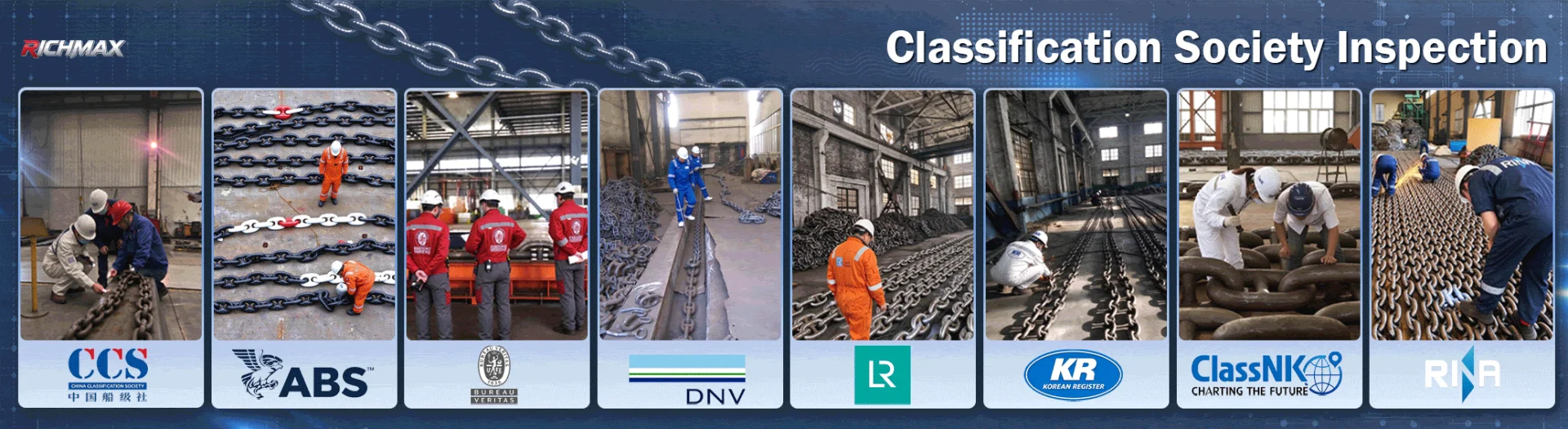
CCS, DNV and LR requirements may apply depending on the project and selected classification society. Certification availability and inspection scope should be confirmed before production.
A steel material certificate alone does not establish that the finished chain complies with the required grade. The material records, manufacturing history and finished-chain test results must be consistent with the specified requirements.
7. Material Limitations and Risks
Even correctly specified alloy steel has limitations in marine service. Material selection, manufacturing control and inspection all affect long-term reliability.
Corrosion and Section Loss
Damage to a protective coating can expose the steel to seawater. Localized corrosion and pitting may reduce the effective cross-section and create stress concentrations. Inspection should consider areas subject to wear, coating damage and restricted visibility.
Heat-Treatment Defects
Inadequate or inconsistent heat treatment can result in mechanical properties outside the specified limits. Insufficient toughness or non-uniform material properties may increase the risk of cracking under demanding service conditions. Compliance should be verified through process records and required testing.
Hydrogen Embrittlement
Hydrogen-related cracking is a potential concern under susceptible material and service conditions. Certain surface-treatment processes and poorly controlled cathodic protection conditions may increase the risk. Any acid pickling, coating or corrosion-control procedure should be assessed for compatibility with the chain material and applicable requirements.
Chemical Composition and Inclusions
Excessive impurities or unsuitable inclusion characteristics can impair toughness and fatigue performance. Chemical analysis and the required material-quality checks help verify compliance with the specified steel grade.
Incorrect Grade Selection
A lower-grade chain should not replace an R4 or R5 chain where the approved mooring design requires the higher grade. Substitution may affect the required load capacity and system safety. Any grade change must be reviewed and approved through the applicable engineering and procurement process.
Fatigue During Long-Term Service
Repeated wave-induced loading can contribute to fatigue damage over time. Fatigue performance depends on stress range, load cycles, chain geometry, surface condition and manufacturing quality. Cracks may not be visible during routine visual inspection, so inspection methods and intervals should follow the project maintenance plan and applicable requirements.
8. Material Selection for Offshore Mooring
When specifying marine mooring chain, confirm the required grade, steelmaking and heat-treatment requirements, mechanical test criteria, corrosion-protection system and certification scope before production.
The material should be assessed as part of the complete mooring system. Correct grade selection, controlled manufacturing, traceable testing and planned inspection are all necessary to maintain chain performance throughout its intended service life.
How to Use Marine Mooring Chain?
Marine mooring chain must meet the requirements of the mooring system in which it is installed. Chain selection, connection, operation and maintenance depend on the chain specification, installation arrangement and service conditions.
1. Pre-Installation Inspection
Before installation, check the chain grade, diameter, length, link type and required load capacity against the approved drawings and purchase specifications. For offshore mooring applications, confirm whether R3, R4 or R5 grade is required.
Inspect the links for cracks, deformation, excessive wear and corrosion. Check the dimensions and identification markings, and verify the material certificates and inspection records required by the project. Do not install chain with suspected defects before the necessary assessment has been completed.
2. Installation and Connection
Lay out the chain according to the approved mooring arrangement. Check that end links, joining shackles, connecting shackles and swivels match the specified dimensions and load requirements.
During installation, prevent the chain from twisting, kinking or becoming trapped against other equipment. Connections should fit correctly without forced alignment. For offshore mooring systems, chain length and catenary arrangement must follow the approved design.
Cutting, welding or modifying chain links is not permitted unless specifically covered by an approved engineering and manufacturing procedure.
3. Chain Deployment and Operation
Pay out and recover the chain at a controlled speed, following the equipment manufacturer's instructions. Avoid sudden pulling, impact loading or forcing a chain that has become jammed.
Monitor chain tension where required by the operating procedure. Loads must remain within the applicable design limits, taking account of the chain, connecting accessories and associated equipment. Changes in tide, wind, waves and vessel movement may affect mooring loads and should be considered during operation.
Stop the operation if the chain becomes trapped, connections show signs of damage, or operating conditions exceed the approved limits.
4. Routine Inspection and Maintenance
Inspect the chain at intervals specified by the maintenance plan and applicable requirements. Check for corrosion, worn link sections, deformation, cracks and damage to connecting components.
Remove marine growth and salt deposits when necessary to allow proper inspection. Measure link dimensions where wear is suspected or measurement is required by the inspection procedure. Non-destructive testing should be carried out when specified or when a defect requires further investigation.
Record inspection results, measured wear, repairs and replacement work. Repair damaged coatings where applicable, using the specified coating system.
5. Storage and Handling
Store unused chain in a designated area with suitable drainage and protection from avoidable corrosion and mechanical damage. Avoid placing the chain directly on soil or leaving it in standing water.
During lifting and transport, prevent links from striking hard surfaces or sharp objects. Keep identification markings legible and retain the relevant traceability documents.
6. Chain Replacement
Replace or remove from service any chain that fails the applicable inspection criteria. Cracks, unacceptable deformation and wear beyond the permitted limits require assessment before the chain can be considered for further use.
Replacement chain must match the approved grade, dimensions, link configuration and connection requirements. A chain of the same nominal diameter is not necessarily equivalent in strength or suitability.
Before reconnecting the system, check the replacement chain and accessories against the original specification or approved engineering revision. Rejected chain should be identified and kept separate from serviceable stock to prevent accidental reuse.
7. Common Mistakes to Avoid
Incorrect grade selection: Using a chain that does not meet the specified load and service requirements.
Mixing chain specifications: Connecting chains or accessories of different grades or dimensions without engineering approval.
Poor installation: Allowing links to twist, forcing misaligned connections or using incompatible fittings.
Impact loading: Pulling the chain suddenly or forcing it through a jammed connection.
Inadequate inspection: Overlooking cracks, corrosion, wear or damaged connecting components.
Poor storage: Leaving chain in standing water or exposing it to unnecessary impact and contamination.
Delayed replacement: Continuing to use chain that fails the applicable inspection or acceptance criteria.
The inspection scope, operating limits and replacement criteria should be established according to the chain specification, mooring system design and applicable requirements.
Application
Marine mooring chain is used in vessel mooring, offshore station-keeping and floating structure anchoring systems. Its application depends on the mooring arrangement, water depth, environmental loads, required service life and connection design.
Different applications may require different chain grades, link structures, dimensions and accessories. Offshore permanent mooring and general marine mooring should be specified separately according to their design and inspection requirements.
Marine and Offshore Applications:
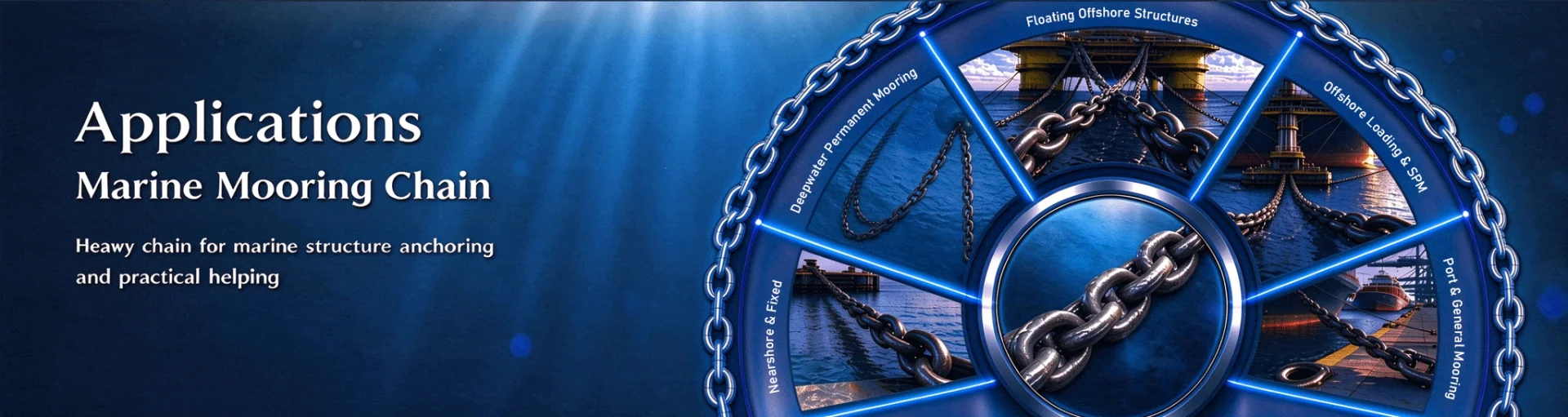
1. Nearshore and Fixed Mooring
Marine mooring chain is used in selected mooring arrangements for berthing pontoons, floating docks, work barges and other floating facilities in ports and sheltered coastal waters. It can connect floating structures to designated anchors or fixed mooring points while allowing for changes in water level and vessel movement.
Chain size and length should account for tidal range, water depth, wind, waves, current and seabed conditions. In areas with strong seabed movement or abrasive sediment, additional wear protection and periodic inspection may be necessary.
2. Floating Platforms and Offshore Structures
Floating platforms, buoys, floating solar installations and floating wind structures may use mooring chain as part of their station-keeping systems. The chain arrangement helps maintain the required position while accommodating movement caused by wind, waves and current.
The chain configuration depends on the structure's displacement, mooring layout, water depth and environmental loads. For floating wind and other offshore energy projects, chain grade, diameter, length and connection components should follow the approved mooring design.
3. Deepwater Permanent Mooring
Deepwater mooring systems for FPSOs, semi-submersible platforms and Spar platforms may incorporate high-grade offshore mooring chain. These systems are designed for long-term station-keeping under repeated wave, wind and current loading.
R3, R4 and R5 are established offshore mooring chain grade designations. The appropriate grade depends on the design loads, fatigue assessment, material requirements and project specifications. Higher grades should not be selected by grade number alone; the complete mooring system must be checked against the applicable design criteria.
Long-term service also requires consideration of corrosion, wear, fatigue, inspection access and replacement arrangements.
4. Temporary Mooring and Offshore Operations
Work vessels, construction barges, salvage vessels and mobile offshore units may use mooring chain for temporary positioning or operational station-keeping where the system design permits.
The chain specification should reflect the expected load, duration of use, vessel movement and environmental conditions. Temporary service does not remove the need to verify the chain's working limits, connections and condition before use.
A chain selected for temporary positioning should not automatically be treated as suitable for permanent offshore mooring.
5. Offshore Loading and Single Point Mooring Systems
Offshore loading installations and single point mooring (SPM) systems may incorporate chain sections for designated mooring functions. Depending on the arrangement, these may include connections between floating equipment, mooring components or anchoring assemblies.
The required chain grade, dimensions, joining components and wear protection depend on the chain's position in the system. Areas exposed to repeated movement or contact with adjacent components may require particular attention to wear and inspection.
Not all chain sections within an SPM system perform the same function or share the same specification.
6. Port Facilities and General Marine Mooring
General marine mooring chain may be specified for selected port facilities, floating docks, service vessels, marine buoys and other maritime installations. It provides a load-bearing connection where chain is required by the approved mooring arrangement.
Requirements vary with the installation and operating environment. General marine mooring chain should not automatically be specified to the same grade, certification or testing requirements as offshore permanent mooring chain. The applicable standard and acceptance criteria should be confirmed before ordering.
7. Special Floating and Restraint Applications
Mooring chain may also be incorporated into certain large aquaculture platforms, floating barriers and designated marine restraint systems. In these applications, the chain connects or restrains equipment according to the intended layout and load requirements.
For wreck restraint, submerged object securing or navigation obstruction systems, the chain must be selected for the actual load direction, environmental exposure, connection arrangement and consequences of failure. These uses require a project-specific assessment rather than direct substitution of a standard mooring chain assembly.
Application Limits and Operating Considerations
Marine mooring chain is designed for its specified mooring duty and should not be substituted for a certified lifting chain or lifting assembly. Mooring and lifting applications have different equipment requirements, operating conditions and inspection criteria.
Where a chain is required for lifting, the purchaser must specify a suitable lifting product with the appropriate rating, certification and traceability. A mooring chain's grade or breaking load alone does not establish its suitability for lifting.
In shallow waters with strong currents, mobile sediment or abrasive seabed conditions, repeated chain movement can cause localized wear. Reduced link cross-section may affect the chain's load-bearing capacity.
The mooring design should consider seabed contact, chain movement, inspection access and suitable wear protection. Chain dimensions and inspection intervals should be reviewed where abrasion is expected to be significant.
Marine steel chain is exposed to corrosion during service. Conditions involving elevated hydrogen sulfide, unusual chemical exposure or other aggressive environments require a specific material and corrosion assessment.
Material selection, coating or other protection measures should be based on the actual environment and applicable project requirements. A protective coating alone should not be assumed to resolve every corrosion mechanism, particularly where chain links experience continuous movement or coating damage.
Chain length and layout affect how loads are distributed within a mooring system. In a catenary arrangement, the suspended chain profile and its weight can contribute to the system's load response. Insufficient chain length or an unsuitable layout may increase tension and alter the loads transferred to connections and anchors.
A short-chain arrangement is not inherently unsuitable, but it must be assessed against the intended mooring configuration. Water depth, anchor position, required excursion, pretension and environmental loads should be considered together.
Permanent offshore mooring chain is designed for a specified service period and operating envelope. Actual condition can change because of corrosion, wear, fatigue, overload or damage to connecting components.
Inspection and replacement decisions should follow the project maintenance plan, applicable rules and the chain manufacturer's or system designer's requirements. The end of a design service period requires a formal engineering review; continued use should not be assumed acceptable without supporting assessment.
Selecting the Appropriate Mooring Chain
The chain grade should be selected from the system design, not from water depth or application name alone. Offshore projects may specify R3, R4 or R5 chain according to strength, toughness, fatigue performance and other requirements. General marine applications may use different specifications depending on the intended duty.
Before ordering, confirm:
Application: Permanent offshore mooring, temporary positioning or general marine mooring.
Operating conditions: Water depth, wind, waves, current, temperature and seabed characteristics.
Chain specification: Grade, nominal diameter, stud or studless construction, link dimensions and required length.
System compatibility: Joining shackles, connectors, fairleads, chain stoppers and anchor connections, as applicable.
Inspection and documentation: Applicable standard, material traceability, testing scope, classification requirements and acceptance criteria.
The final specification should match the approved mooring design and the requirements agreed between the purchaser, designer and relevant inspection body.
How to Choose Marine Mooring Chain?
Marine mooring chain should be selected according to the design loads, mooring arrangement, operating environment and applicable technical requirements. Chain grade, nominal diameter and link configuration must be considered together. A chain that meets the dimensional requirements may still be unsuitable if its mechanical properties, fatigue performance or certification do not meet the project specification.
1. Confirm the Mooring Loads and Operating Conditions
Start with the design requirements of the mooring system. The chain must withstand the specified loads under normal operating conditions and the relevant design environmental conditions.
For offshore applications, the assessment may include vessel or platform movement, wind, waves, currents, storm conditions and the expected service life. Temporary mooring and permanent mooring may have different design requirements, so the intended service should be stated clearly.
The required proof load and breaking load should be determined according to the applicable standard, chain grade and approved design. They should not be estimated from nominal diameter alone. For permanent mooring systems, fatigue performance and cyclic loading may also need to be considered.
2. Select the Chain Grade
Common offshore mooring chain grades include R3, R3S, R4, R4S and R5, subject to the applicable standard and classification requirements.
The appropriate grade depends on the design loads, required mechanical properties, fatigue requirements and project specifications. R3 or R3S may be specified for some mooring systems, while R4, R4S or R5 may be required for applications with more demanding design requirements, including certain deepwater developments and floating production units.
Water depth or application type alone does not determine the correct grade. The selected grade must comply with the approved mooring design and governing technical requirements. Using a higher grade does not automatically make a chain suitable if its dimensions, fatigue performance or other properties do not meet the system requirements.
The specified grade should remain consistent with the approved design. Different grades should not be substituted or mixed within a mooring leg without an engineering assessment and approval.
3. Choose the Chain Configuration and Dimensions
The choice between stud link and studless chain should follow the approved mooring system design. Their link geometry, mass characteristics and mechanical performance are different, and the two configurations should not be treated as interchangeable.
Confirm the following before ordering:
Nominal diameter and permitted dimensional tolerances.
Inside and outside link dimensions and link pitch.
Stud link or studless configuration.
Chain weight per unit length, where relevant to the design.
Total chain length and section arrangement.
Compatibility with chain stoppers, handling equipment and connecting accessories.
The chain dimensions must match the approved specification and the equipment used to handle and connect the chain. A nominal diameter match alone does not confirm compatibility.
4. Check the Compatibility of Connecting Components
The chain should be specified as part of the complete mooring assembly rather than as an isolated product. Connecting links, end links, enlarged links, joining shackles, swivels and other components must be suitable for the specified chain dimensions and system loads.
Check the connection geometry, rated or specified load capacity, material grade and certification requirements of each component. Particular attention should be given to interfaces between components supplied by different manufacturers.
Where chain sections or accessories are supplied separately, the purchaser should confirm that their specifications are compatible with the approved arrangement. An incompatible connection can become the limiting point of the assembly even when the chain itself meets its requirements.
5. Consider Corrosion, Wear and Environmental Conditions
The operating environment affects the selection, inspection and maintenance requirements of marine mooring chain. Relevant conditions may include seawater exposure, seabed contact, sediment abrasion, operating temperature and the presence of specific corrosive substances.
Where chain links are exposed to repeated contact with the seabed or other surfaces, wear allowance and inspection intervals should be considered in the system design. Low-temperature service may require specific impact toughness or material qualification. Environments containing hydrogen sulfide may require additional material and environmental compatibility assessments.
Corrosion protection should be selected according to the chain specification and intended service. Coatings, including hot-dip galvanizing where permitted, should not be assumed suitable for every offshore mooring chain. Any treatment must be compatible with the material, manufacturing process, applicable standard and project requirements.
6. Confirm Inspection, Testing and Certification
Before production, identify the required classification society and approval scope. Depending on the project, requirements may involve CCS, DNV, Lloyd's Register (LR) or another specified organization.
Confirm the applicable manufacturing standard, material traceability, inspection stages, mechanical testing, proof load and breaking load requirements. Additional testing or qualification may be required for particular grades, service conditions or offshore projects.
The documentation package may include material certificates, heat treatment records, test reports, dimensional inspection records, product identification and the required classification certificates. The exact documents depend on the order and governing requirements.
Certification should be verified against the actual product, grade, dimensions, manufacturer and order. A general factory certificate should not be treated as a substitute for project-specific classification or inspection requirements.
7. Evaluate Production and Delivery Requirements
For offshore projects, production planning and delivery arrangements should be confirmed before the purchase order is placed. Relevant factors include manufacturing capacity, production lead time, inspection scheduling, accessory availability and the time required for certificate review.
The purchaser should also confirm chain marking, section identification, packing, lifting arrangements and transport requirements. For long chain assemblies, the delivery configuration must be suitable for loading, transportation and site installation.
Where technical support is required, agree on the process for reviewing drawings, resolving specification questions and handling nonconformities. These arrangements help avoid delays caused by incomplete specifications, inspection issues or incompatible components.
Common Selection Issues to Avoid
Selecting by price alone
A lower quotation may reflect differences in grade, dimensions, testing scope, certification or delivery configuration. Compare offers against the same technical specification before making a purchasing decision. Reducing the chain grade or diameter without engineering approval may compromise the design requirements.
Using a grade that does not match the design
Do not assume that R3 is suitable for every nearshore application or that R4 or R5 is automatically required for every deepwater project. The correct grade must be established by the approved design and applicable rules.
Mixing incompatible chain sections or accessories
Components with similar nominal dimensions may have different tolerances, material properties or connection requirements. Confirm compatibility before assembly, particularly where chain and accessories come from different suppliers.
Underestimating environmental effects
Corrosion, abrasion, low temperature and chemical exposure can affect service performance. Confirm the environmental design basis and applicable material or protection requirements rather than selecting a coating or material treatment without technical review.
Accepting incomplete or unverified documentation
Check that certificates and test reports correspond to the supplied product and required inspection scope. Unverified or mismatched documents may cause technical approval and project acceptance problems.
Ignoring extreme environmental loads
Selection based only on normal operating conditions may not satisfy the design basis for severe storms or other specified extreme events. The chain and associated components must meet the loads established by the approved mooring analysis.
Information Required for an RFQ
For a technical quotation, provide the available information below:
Product type: Marine Mooring Chain or Offshore Mooring Chain.
Application and mooring arrangement.
Chain grade and governing standard.
Stud link or studless configuration.
Nominal diameter and dimensional requirements.
Total length and chain section arrangement.
Design load and specified testing requirements, where available.
Connecting components and accessory requirements.
Operating environment and any special material requirements.
Classification society, inspection scope and certificates.
Delivery destination and required delivery schedule.
If the full specification is not available, provide the approved drawing, existing chain details or project technical requirements for review. Final selection should be confirmed against the mooring system design and applicable approval requirements before production.
How to Choose a Reliable Marine Mooring Chain Supplier?
Marine mooring chain is a load-bearing component used in marine and offshore mooring systems. When selecting a supplier, buyers should look beyond price and delivery promises. The main considerations are manufacturing capability, applicable approvals, material traceability, testing arrangements, accessory compatibility and control of the complete delivery process.
For offshore projects, the supplier must be able to demonstrate that the proposed chain meets the specified grade, manufacturing requirements and inspection scope. For general maritime applications, the evaluation should also consider the intended service conditions, applicable standards and equipment compatibility.
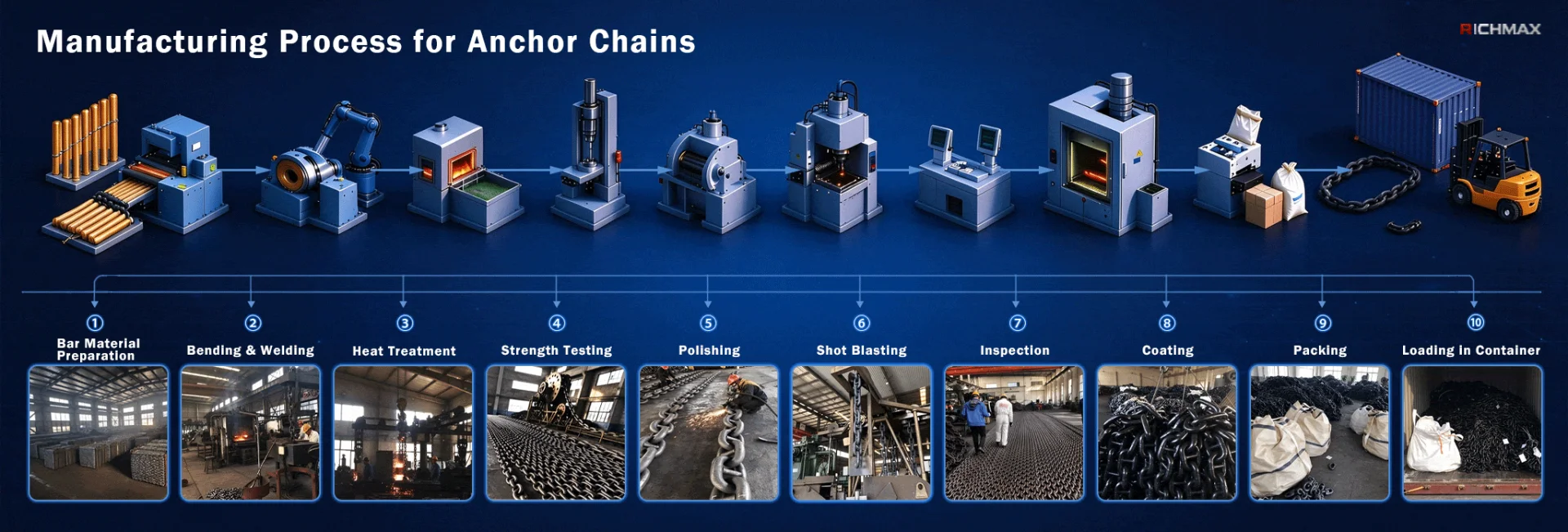
Our Manufacturing Process:
1. Verify Manufacturing Capability and Approvals
Start by identifying the actual manufacturing facility and confirming its experience with the required mooring chain type, grade, diameter and production volume.
For offshore mooring chain, check whether the manufacturer has the necessary production capability and valid factory or product approvals for the intended application. Where classification approval is required, confirm the certificate issuer, validity period, approved product scope and manufacturing location directly with the relevant classification society.
The production process may include steel preparation, link forming, welding, stud installation where applicable, heat treatment, mechanical testing and final inspection. The exact process depends on the chain design and governing manufacturing requirements.
A supplier with an established manufacturing facility should be able to explain which processes are completed in-house, which are subcontracted and how subcontracted work is controlled.
Warning signs include:
Certificates that are expired, unverifiable or issued for a different manufacturing facility.
Approval covering anchor chain but not the required mooring chain product.
A supplier claiming to be a manufacturer without being able to identify the production site or explain its manufacturing process.
No clear responsibility for subcontracted welding, heat treatment or testing.
A trading company is not automatically unsuitable. However, when production is outsourced, the buyer should establish who controls manufacturing, inspection, traceability and corrective action.
2. Check Material Traceability and Chain Grade
The specified chain grade must be supported by the relevant material records, manufacturing records and test results. For offshore mooring projects, commonly specified grades include R3, R3S, R4, R4S and R5, subject to the governing standard, classification rules and project specification.
Confirm that the supplier can provide the documentation required for the selected grade and that the delivered chain can be traced to the relevant production batch.
Depending on the applicable requirements, the document package may include:
Original material certificates and heat-number records.
Chemical composition and mechanical test results.
Heat-treatment records.
Dimensional inspection records.
Proof load and breaking load test reports.
Impact test results and non-destructive testing records, where required.
Final inspection and classification documentation, where applicable.
Pay particular attention to grade identification and dimensional tolerances. A higher grade should not be accepted on the strength of a product label alone. The applicable mechanical properties, test results and manufacturing records must support the specified grade.
Warning signs include inconsistent heat numbers, missing production records, unexplained changes in steel grade, chain dimensions outside the specified tolerances or test reports that cannot be linked to the delivered batch.
3. Review the Quality Control and Testing System
A suitable supplier should have a defined inspection and testing plan covering the manufacturing stages relevant to the order. Ask to review the inspection scope, acceptance criteria, testing responsibilities and records retained for each batch.
Depending on the chain design and applicable requirements, quality control may cover:
Incoming steel and material verification.
Link dimensions, surface condition and forming quality.
Welding and stud installation, where applicable.
Heat-treatment parameters and process records.
Hardness and mechanical property verification, where specified.
Proof load and breaking load testing.
Impact testing and UT or MT examination, where required.
Final marking, traceability and document review.
An in-house laboratory and testing equipment can improve process control and coordination, but their existence alone does not establish product conformity. Testing methods, equipment calibration, personnel competence and acceptance criteria also matter. External testing may be acceptable when it is permitted by the governing requirements and properly documented.
Confirm whether inspection is performed on a sample basis or on every item, where applicable. Do not assume that every test must be conducted on every chain link; the required inspection frequency depends on the applicable rules and approved inspection plan.
Warning signs include inspection limited to visual appearance, unexplained omissions from the specified test plan, incomplete calibration records or reports that cannot be verified with the issuing laboratory or inspection body.
4. Confirm Product Range and Accessory Compatibility
Check whether the supplier can provide the required chain configuration, grade, diameter, length and end arrangement. For projects involving several chain grades or non-standard dimensions, confirm the actual manufacturing range before placing the order.
Mooring chain may be supplied with connecting links, end links, shackles, swivels or other components. These accessories must be compatible with the chain dimensions, mechanical requirements and intended load path.
For a complete mooring assembly, clarify:
The specified grade and dimensions of each component.
Required working, proof and breaking load criteria, as applicable.
Applicable material and inspection documentation.
Dimensional compatibility between chain and connecting components.
Responsibility for final assembly checks and document coordination.
Where accessories are sourced from different manufacturers, the supplier should identify the source and explain how compatibility and quality records are checked.
Richmax can assist buyers in coordinating chain-related hardware and export orders across its established supplier network. The exact product range, available grades, manufacturing origin and certification scope should be confirmed against the project specification before quotation.
5. Evaluate Production Capacity and Delivery Control
Production capacity should be assessed against the actual order, not just the supplier's general claims. Confirm the available diameter range, order quantity, production lead time, inspection schedule and expected shipping date.
For large offshore projects, discuss whether the supplier can accommodate third-party inspection, client witnessing, classification inspection and agreed production hold points. Inspection arrangements should be confirmed before manufacturing begins.
Export delivery planning should cover:
Production milestones and inspection release dates.
Chain lengths, quantities, markings and accessory lists.
Packing and securing arrangements for sea transport.
Protection against handling damage and avoidable surface deterioration.
Loading plans and shipping documentation.
Procedures for communicating production changes or inspection findings.
Heavy chain products require suitable handling and securing arrangements. Packaging should be appropriate to the product dimensions, transport route and purchaser's requirements.
Warning signs include unrealistic lead times, refusal to agree on inspection arrangements, repeated unexplained schedule changes, inadequate transport protection or discrepancies between the delivered goods and the packing list.
6. Assess Technical Support and After-Sales Responsibility
Before placing an order, establish who will handle technical clarification, inspection findings, non-conformities and documentation discrepancies.
A capable supplier should be able to coordinate technical questions concerning chain grade, dimensions, accessories, inspection scope and applicable standards. For offshore projects, technical decisions should remain consistent with the approved design and the requirements of the responsible engineer or classification society.
The purchase agreement should define the process for:
Reviewing technical deviations before production.
Reporting and resolving non-conformities.
Correcting missing or inconsistent documentation.
Arranging replacement or other agreed remedies when necessary.
Responding to claims and coordinating corrective action.
Meeting agreed warranty terms and response timelines.
Relevant marine or offshore project references can help buyers assess experience, but references should be checked for relevance to the required chain type, grade and project scope.
Warning signs include unclear warranty terms, no named contact for technical issues, refusal to document corrective actions or an inability to explain how previous quality problems were resolved.
8. Why Consider Qingdao Richmax as a Supply Partner?
Qingdao Richmax Imp. & Exp. Co., Ltd. supplies marine hardware and marine equipment to international B2B buyers. For marine mooring chain enquiries, our role is to coordinate product requirements, manufacturing resources, quality documentation and export delivery according to the agreed order scope.
When evaluating a Richmax quotation, buyers can discuss the following points before order confirmation:
Product and specification coordination
We can work with buyers to clarify chain type, nominal diameter, grade, length, end connections and accessory requirements. This helps reduce specification gaps between the enquiry, quotation and final purchase order.
Manufacturing resource coordination
Through our established industrial and manufacturing network, we can coordinate with relevant production facilities according to the required product scope. The actual manufacturer, production location and responsibility for each manufacturing process should be confirmed for the specific order.
Quality and documentation review
We can coordinate the collection and review of applicable material certificates, inspection reports, traceability records and classification documents. The required documents and inspection arrangements should be agreed before production, with certificates issued by the appropriate manufacturer, laboratory or classification body.
Export and delivery management
Our export experience supports order communication, production follow-up, packing coordination and shipping documentation. For project orders, delivery milestones and inspection release requirements can be discussed and confirmed before production.
Technical communication and after-sales follow-up
We can coordinate technical clarification between the buyer and the relevant manufacturing facility, including questions about specifications, accessories, inspection findings and delivery documentation. Responsibilities for warranty, replacement and corrective action should be stated in the quotation or purchase agreement.
For buyers assessing a marine mooring chain supplier, the important point is to verify the actual manufacturing source, product conformity and document package for the proposed order. These details should be confirmed individually rather than inferred from a supplier's general marine hardware experience.
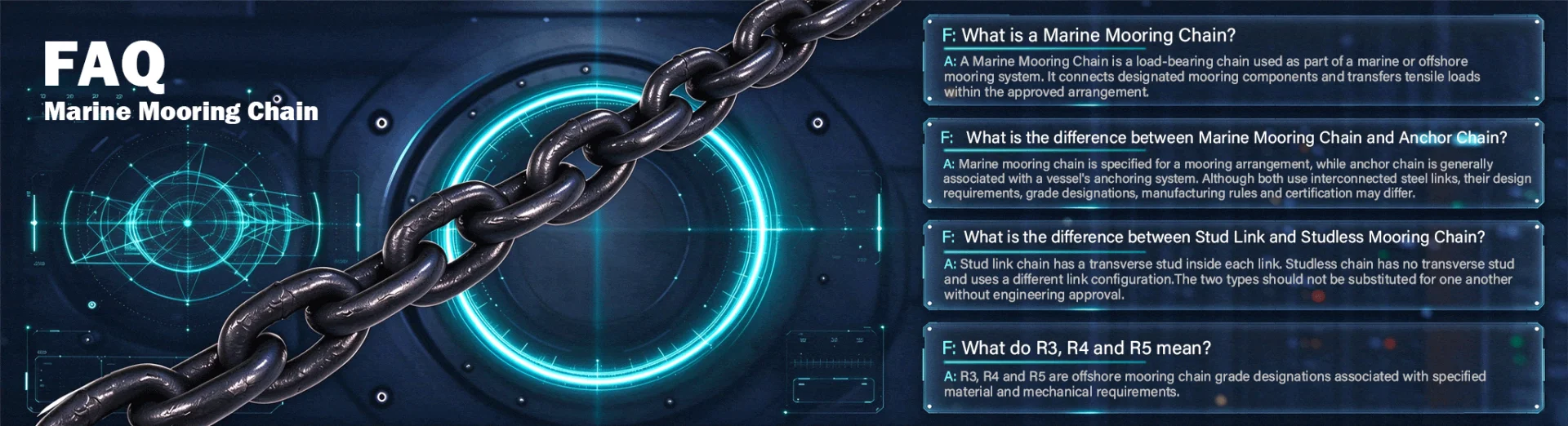
FAQ
1. What is a Marine Mooring Chain?
A Marine Mooring Chain is a load-bearing chain used as part of a marine or offshore mooring system. It connects designated mooring components and transfers tensile loads within the approved arrangement.
2. What is the difference between Marine Mooring Chain and Anchor Chain?
Marine mooring chain is specified for a mooring arrangement, while anchor chain is generally associated with a vessel's anchoring system.
Although both use interconnected steel links, their design requirements, grade designations, manufacturing rules and certification may differ. Offshore mooring chain should be specified according to the applicable offshore mooring requirements rather than automatically using anchor-chain specifications.
3. What is the difference between Stud Link and Studless Mooring Chain?
Stud link chain has a transverse stud inside each link. Studless chain has no transverse stud and uses a different link configuration.
The appropriate design depends on the approved mooring system, applicable requirements and intended service. The two types should not be substituted for one another without engineering approval.
4. What do R3, R4 and R5 mean?
R3, R4 and R5 are offshore mooring chain grade designations associated with specified material and mechanical requirements.
The applicable grade determines requirements for matters such as material properties and chain testing. The selected grade must match the approved system design and governing rules.
5. What is the difference between R3, R4 and R5 Mooring Chain?
The grades have different specified mechanical requirements. R4 and R5 generally have higher strength requirements than R3, but grade selection must consider the complete design, including loads, toughness, fatigue performance where applicable and certification.
The grades are not interchangeable simply because they share the same nominal diameter.
6. Is R5 Mooring Chain always better than R3 Mooring Chain?
No. R5 has more demanding strength requirements, but that does not mean it is automatically the correct choice for every mooring system.
The grade should be selected through the approved engineering design and applicable classification requirements.
7. What nominal diameters are available?
The available diameter range depends on the manufacturer's production capability, chain configuration, grade and applicable standard.
The buyer should provide the required diameter and dimensional specification so that manufacturing feasibility and compliance can be confirmed.
8. What materials are used for offshore mooring chain?
Offshore mooring chain is manufactured from steel meeting the material requirements for the specified grade.
Chemical composition, mechanical properties, toughness and heat treatment must comply with the applicable manufacturing rules. The exact steel specification should be confirmed from the order documentation.

 English
 Español
 Français
 Árabe
 Русский
 Português
 日本語
 한국어
 Dansk
 Nederlands
 Italiano
 Türkçe
 Deutsch
 Prancis
 ไทย
 Tiếng Việt
 हिंदी
 বাংলা
 中文