Structure
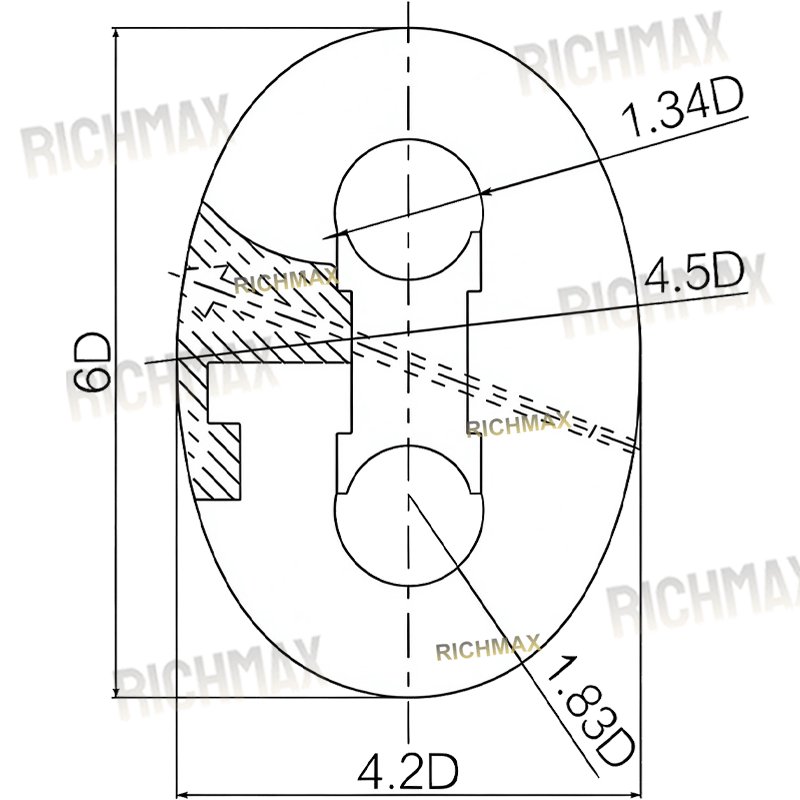
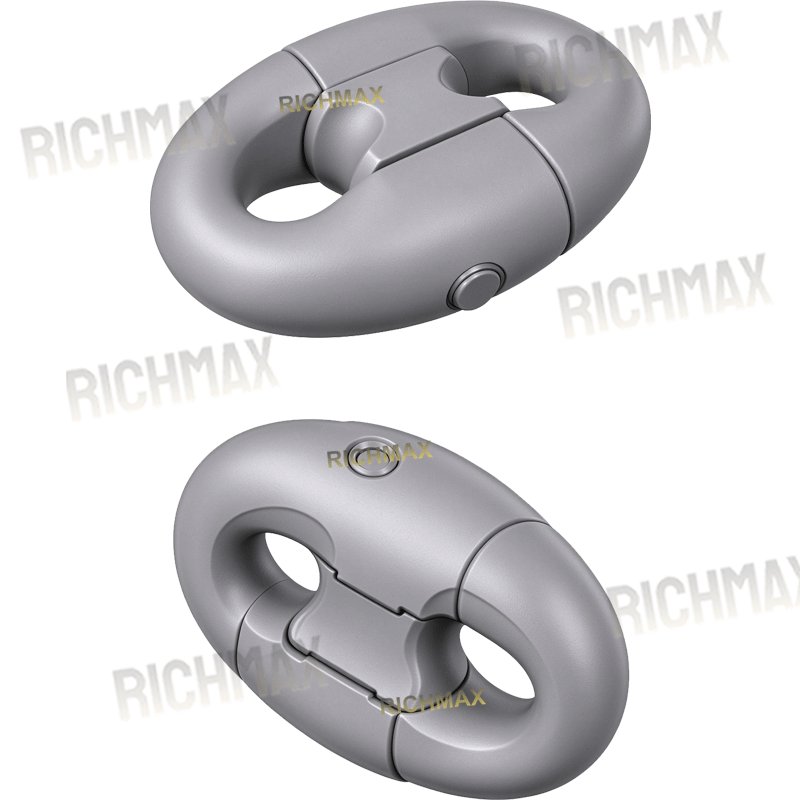
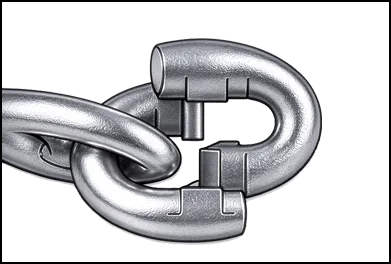
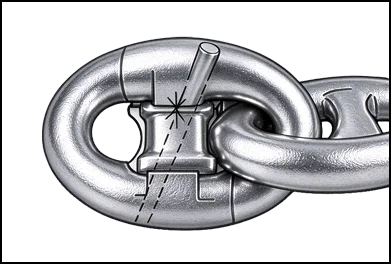
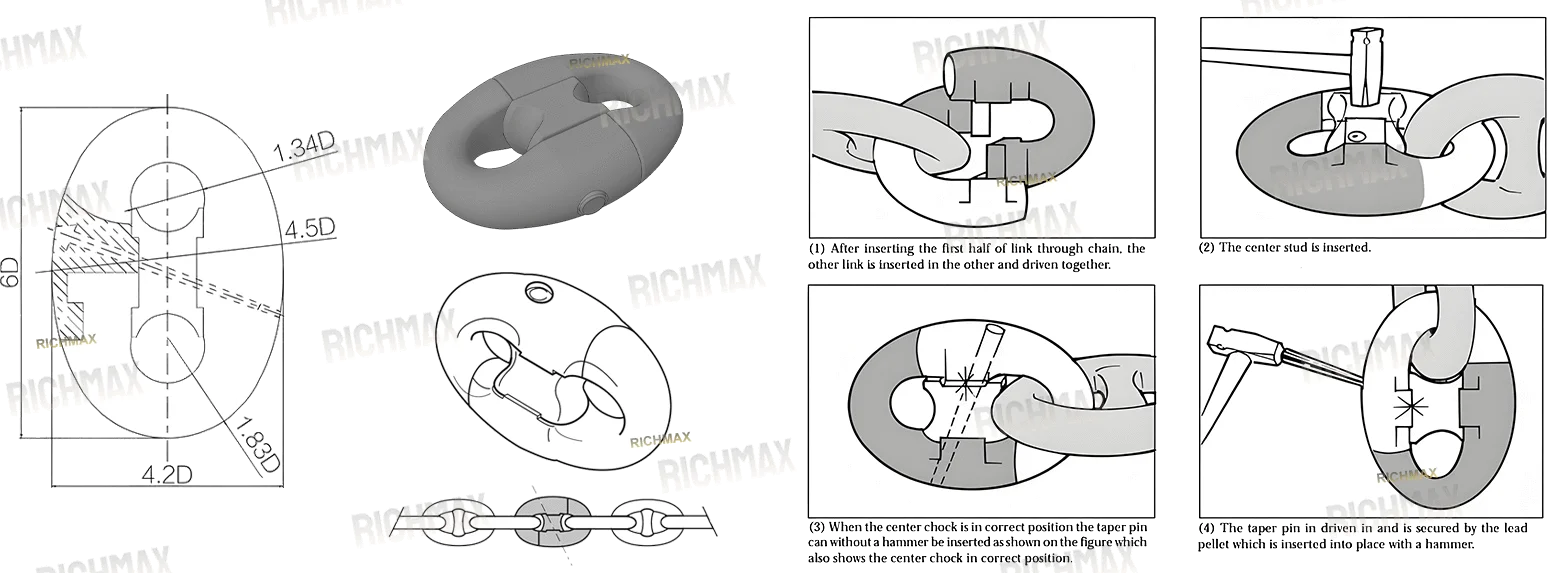
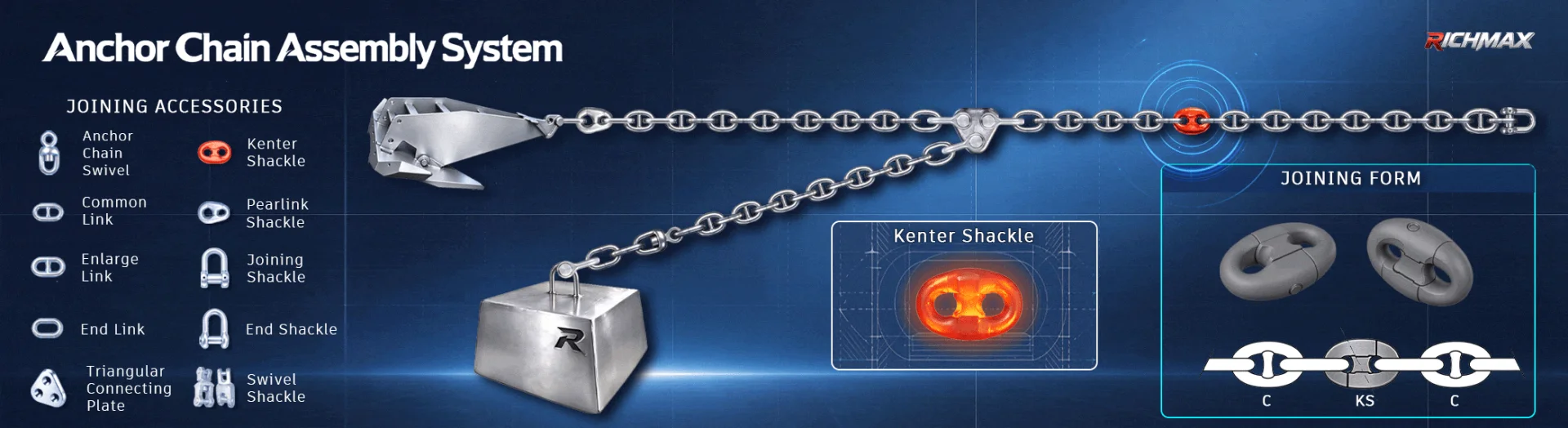
Kenter Shackle has a two-piece interlocking structure. The two body halves are fitted together and secured by locking components to form a complete connecting link.
Its dimensions and internal geometry are designed to match the corresponding stud link anchor chain.
1. Shackle Body
The shackle body consists of two separate interlocking halves.
Each half has a shaped connection section that fits into the other half during assembly.
When correctly fitted, the two halves form a closed chain link.
The body dimensions must match the specified anchor chain diameter and link geometry.
Important dimensions include:
Nominal chain diameter
Overall length
Outside width
Inside opening
Body cross-section
Locking pin dimensions
Dimensional accuracy is important because the shackle must fit the adjacent chain links without excessive clearance or interference.
2. Interlocking Connection
The two body halves have matching profiles that fit together during assembly.
The interlocking sections form the main connection between the two halves.
The mating surfaces should be free from damage, deformation and manufacturing defects that could affect assembly.
The connection geometry should follow the manufacturer's drawing and applicable manufacturing standard.
3. Locking Pins
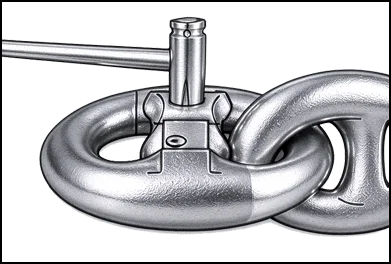
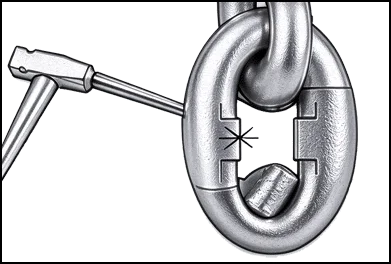
Locking pins secure the two body halves after they have been assembled.
The pins are fitted into the designated holes to prevent the body halves from separating.
Pin dimensions and fitting requirements depend on the shackle design.
The locking pins should be inspected for damage, deformation and correct fit before the shackle is placed into service.
4. Locking Plugs
Some Kenter Shackle designs use locking plugs or retainers to secure the locking pins.
These components prevent the pins from moving out of their designated positions.
The locking arrangement varies by manufacturer and product design.
The correct pin and retaining components should always be used as a complete set.
5. Internal Stud
The Kenter Shackle has an internal cross-section designed to maintain the required chain-link geometry.
The internal stud arrangement and body profile depend on the particular design.
The assembled shackle should provide the required clearance and compatibility with the adjacent stud link chain.
6. Assembled Configuration
After installation, the two body halves, locking pins and retainers form a complete connecting shackle.
The assembled dimensions should match the specified drawing.
The locking components should be correctly positioned, and the shackle should not show abnormal gaps, deformation or interference.
Material
Kenter Shackle is manufactured from steel specified according to the required chain grade, manufacturing standard and mechanical property requirements.
Material selection should match the anchor chain with which the shackle will be used.
The material grade should be confirmed from the product specification rather than determined from the nominal chain diameter alone.
1. Steel Grade
The required steel grade depends on the applicable chain grade and manufacturing standard.
For marine anchor chain applications, Kenter Shackle is commonly specified to match the mechanical requirements of the connected chain.
| Material requirements |
| Chemical composition | Yield strength | Tensile strength | Elongation |
| Reduction of area | Impact toughness | Hardness |
|
The required values should be confirmed against the applicable standard and purchase specification.
2. Material for Shackle Body
The two body halves should be manufactured from material suitable for the specified mechanical requirements.
Depending on the product design and manufacturing specification, the body may be produced through forging or another approved manufacturing process.
The manufacturing method should be confirmed through the supplier's technical documentation.
3. Locking Pin Material
Locking pins and retaining components should meet the material and dimensional requirements specified for the shackle design.
Their dimensions and mechanical properties should be suitable for the intended locking arrangement.
Locking components should not be replaced with unapproved pins or improvised retainers.
4. Heat Treatment
Heat treatment is carried out according to the specified material grade and manufacturing procedure.
The process is controlled to achieve the required mechanical properties.
Relevant production records may include:
5. Material Traceability
Material traceability should be maintained where required by the purchase specification or classification requirements.
Records may include:
Steel heat number
Material certificate
Chemical composition
Mechanical test results
Heat-treatment records
Manufacturing batch identification
The supplied documents should correspond to the actual components.
How to Use Kenter Shackle?
Kenter Shackle is used to connect two sections of stud link anchor chain.
The two body halves are assembled around the corresponding chain links and secured with locking components.
Correct installation is necessary to maintain the connection and avoid assembly defects.
1. Confirm Chain Compatibility
Before assembly, check the following information:
Anchor chain diameter
Chain grade
Chain link dimensions
Kenter Shackle type
Shackle dimensions
Applicable manufacturing standard
The shackle should be selected for the specific chain size and grade.
A shackle with the same nominal diameter is not necessarily interchangeable with another manufacturer's product.
2. Prepare the Components
Before installation, inspect the shackle body halves, locking pins and retaining components.
Check for:
Cracks
Deformation
Corrosion
Damaged mating surfaces
Worn locking holes
Bent or damaged pins
The components should be clean and free from foreign material that could interfere with assembly.
3. Assemble the Two Body Halves
Position the two shackle halves around the chain links to be connected.
Fit the interlocking sections together according to the manufacturer's assembly instructions.
Check that both halves are fully seated and that the assembled body matches the specified configuration.
Do not force the body halves together if the mating sections do not fit correctly.
4.4 Install Locking Pins
Fit the locking pins into their designated positions.
Make sure the pins are correctly seated and that the retaining components are installed as specified for the product design.
The locking arrangement should be checked before the connected chain is put into service.
4. Final Assembly Check
After assembly, inspect the complete Kenter Shackle.
Check:
Correct seating of both body halves
Locking pin position
Retaining component installation
Body alignment
Connection clearance
Visible deformation or damage
The assembled shackle should match the manufacturer's drawing and installation requirements.
5. Anchor Chain Operation
Once installed, the Kenter Shackle forms part of the connected anchor chain.
During anchor deployment and retrieval, the shackle passes through the vessel's chain-handling system as part of the chain assembly.
The shackle dimensions must be compatible with the windlass gypsy wheel and other chain-handling equipment.
The chain should be handled according to the vessel's anchoring procedure.
6. Disassembly
When a chain section needs to be separated, the Kenter Shackle can be dismantled according to the manufacturer's instructions.
The locking components are removed first, followed by separation of the two body halves.
The shackle should be cleaned and inspected before reuse.
Damaged or deformed components should not be returned to service without appropriate assessment.
Application
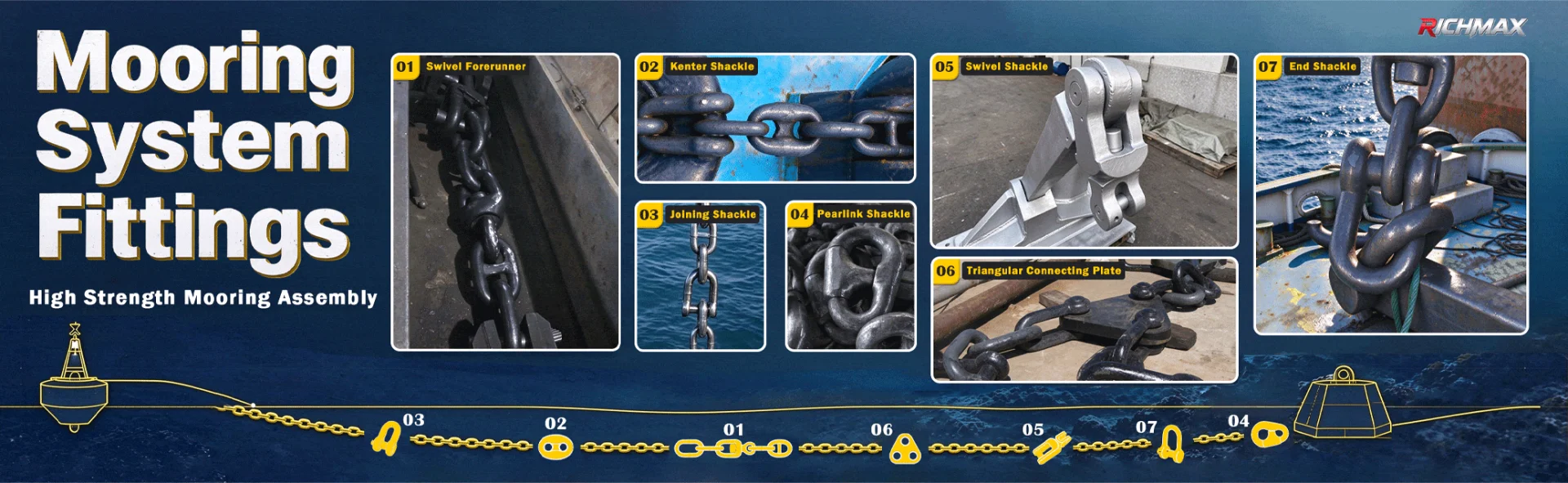
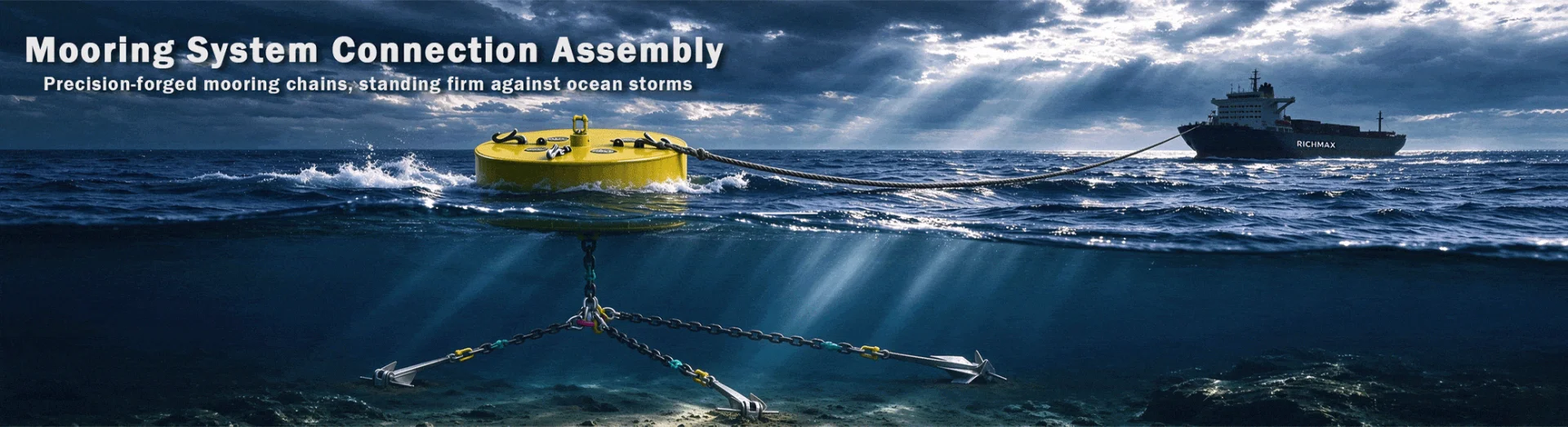
Kenter Shackle is used in marine anchor chain systems where detachable connections between chain sections are required.
1. Commercial Vessels
Used to connect stud link anchor chain sections in the anchoring systems of cargo ships, bulk carriers, container vessels and general cargo vessels.
2. Tankers
Used in tanker anchoring systems where the Kenter Shackle dimensions and grade match the specified anchor chain.
3. Offshore Support Vessels
Used in specified anchor chain arrangements for offshore support vessels.
The required chain grade, shackle dimensions and mechanical properties depend on the vessel's approved equipment specification.
4. Shipyards and Newbuilding Projects
Used during the installation and assembly of anchor chain systems for new vessels.
The shackle specification should correspond to the chain supplied for the project.
5. Anchor Chain Replacement
Used when replacing damaged chain sections or connecting new chain lengths to existing anchor chain.
Before replacement, the existing chain diameter, grade, link dimensions and shackle compatibility should be checked.
6. Marine Equipment Maintenance
Used during anchor chain inspection, maintenance and renewal operations where chain sections need to be disconnected and reconnected.
The shackle should be inspected before reuse, particularly the body mating surfaces and locking components.
How to Choose Kenter Shackle?
Selecting Kenter Shackle requires more than matching the nominal chain diameter.
The shackle must fit the chain link geometry and meet the mechanical requirements of the connected anchor chain.
1. Confirm Chain Diameter
Start by confirming the nominal diameter of the stud link anchor chain.
Common chain diameters vary according to vessel size and anchoring system requirements.
The Kenter Shackle size should match the specified chain diameter and corresponding dimensional standard.
2. Confirm Chain Grade
Confirm the chain grade, such as AM2 or AM3, where applicable under the specified manufacturing standard.
The shackle material and mechanical properties should meet the requirements for the connected chain.
Do not assume that a shackle is suitable for different chain grades simply because the nominal diameter is the same.
3. Check Chain Dimensions
Confirm the actual chain link dimensions.
Important measurements include:
Chain diameter
Inside link length
Outside link length
Inside link width
Outside link width
Link cross-section
These dimensions affect how the Kenter Shackle fits into the chain.
4. Confirm Shackle Dimensions
Check the Kenter Shackle drawing before ordering.
Relevant dimensions include:
Nominal size
Overall length
Overall width
Body cross-section
Internal opening
Locking pin dimensions
For replacement orders, the existing shackle should be measured and compared with the proposed replacement.
5. Confirm Manufacturing Standard
Specify the applicable manufacturing standard or classification requirements.
The standard should cover the required dimensions, material properties, manufacturing process and testing requirements.
Where a specific chain standard is used, confirm that the Kenter Shackle is compatible with that chain specification.
6. Confirm Load Requirements
The required proof load and breaking load should be confirmed according to the applicable standard and purchase specification.
These values should correspond to the shackle size and grade.
Do not use working load, proof load and breaking load as interchangeable values.
7. Confirm Certification
For classed vessels, identify the applicable classification society and required certification.
Confirm the required material certificates, inspection reports and load test documentation before placing the order.
How To Choose A Reliable Marine Anchor Chain Supplier?
Supplier Evaluation for Kenter Shackle
When sourcing Kenter Shackle, buyers need to check more than the quoted price. Chain compatibility, material grade, manufacturing process and inspection records all affect whether the supplied shackle can be used with the existing anchor chain.
At Richmax, Kenter Shackle orders are handled with reference to the buyer's chain specifications, product drawings and inspection requirements. Through our manufacturing resources and cooperation with multiple factories within the Hiking Group industrial system, we can coordinate the production and inspection of marine chain components.
1. Chain Compatibility
The Kenter Shackle must match the anchor chain in both size and mechanical grade.
Before quotation, Richmax checks the nominal chain diameter, chain grade (such as AM2 or AM3), applicable standard and connection dimensions. For replacement orders, existing product drawings or samples can be used to confirm the required dimensions.
This helps avoid ordering a shackle that has the correct nominal diameter but does not fit the actual chain links.
2. Product Drawing
A dimensional drawing is important for confirming the Kenter Shackle configuration before production.
The drawing should show the overall dimensions, internal opening, body cross-section, mating sections and locking pin arrangement.
Richmax reviews the supplied drawings and technical specifications during order confirmation. If the buyer provides an existing sample or dimensional requirements, these details can be used to clarify the replacement specification before production starts.
3. Manufacturing Process
The Kenter Shackle body and locking components require controlled manufacturing and dimensional accuracy.
Depending on the product design, manufacturing may involve:
Steel material preparation
Forging or specified forming process
Machining
Heat treatment
Surface treatment
Component assembly
Final inspection
Richmax works with manufacturing facilities within its industrial supply network, coordinating the relevant production processes according to the product specification.
For orders involving special dimensions, chain grades or inspection requirements, the manufacturing arrangement is confirmed before production.
4. Material Control
Material selection directly affects the mechanical properties of Kenter Shackle.
The buyer should confirm the steel grade, chemical composition and mechanical properties required for the connected anchor chain.
Richmax coordinates material requirements with the manufacturing facilities and checks the relevant material documentation. Where specified, material certificates and heat-number records are used to support material identification and traceability.
The material grade of the shackle body and locking components should be confirmed separately where their specifications differ.
5. Mechanical Testing
Kenter Shackle must meet the mechanical requirements specified for its size and grade.
Depending on the applicable standard and purchase specification, testing may include:
Tensile testing
Impact testing
Hardness testing
Proof load testing
Breaking load testing
Richmax confirms the required test items before production and arranges the corresponding inspection through the manufacturing facilities.
Test reports can be provided according to the agreed inspection scope. The test values and acceptance criteria should be consistent with the specified chain grade and manufacturing standard.
6. Dimensional and Assembly Inspection
Dimensional accuracy is particularly important for Kenter Shackle because the two body halves must fit together correctly.
Inspection should cover the body dimensions, internal opening, mating surfaces, locking holes and pin dimensions.
Richmax pays attention to the fit between the two body halves and the installation of the locking components during product inspection.
For replacement orders, the finished dimensions are checked against the confirmed drawing or agreed sample dimensions. This is particularly important when the shackle will be used with an existing anchor chain system.
7. Classification and Documentation
For vessels requiring classification inspection, the applicable classification society and certification requirements should be confirmed before production.
Depending on the order, the required documents may include:
Material certificates
Mechanical test reports
Heat-treatment records
Dimensional inspection reports
Proof load test reports
NDT reports
8. Classification certificates
Richmax coordinates the required inspection and documentation with the relevant manufacturing facilities and inspection parties.
The certification scope is confirmed against the purchase specification rather than assuming that every Kenter Shackle order requires the same documents.
For export orders, we also coordinate inspection arrangements, document preparation and shipment requirements with overseas buyers.
FAQ
1. What is a Kenter Shackle?
Kenter Shackle is a detachable connecting component used to join two sections of stud link anchor chain. It consists of two interlocking body halves secured by locking components.
2. What is the main function of Kenter Shackle?
Its main function is to connect anchor chain sections while allowing the chain to be assembled and dismantled when required.
3. What are the main components of a Kenter Shackle?
A typical Kenter Shackle consists of two interlocking body halves, locking pins and retaining components. The exact locking arrangement depends on the product design.
4. What is the difference between Kenter Shackle and D-Type Shackle?
Kenter Shackle uses a two-piece interlocking body and locking arrangement. D-Type Shackle generally uses a bow-shaped body with a removable pin.
They have different structures and connection applications and should not be treated as interchangeable.
5. Can Kenter Shackle connect different chain grades?
The compatibility must be checked against the applicable dimensions, material properties and manufacturing standards.
The nominal diameter alone is not sufficient to establish compatibility.
6. How is Kenter Shackle installed?
The two body halves are fitted around the corresponding chain links and assembled according to the manufacturer's instructions. Locking pins and retaining components are then installed to secure the assembly.
7. Can Kenter Shackle be reused?
It may be reused if it remains within the applicable dimensional, material and inspection acceptance criteria.
The body halves, mating surfaces and locking components should be inspected before reuse.
8. What happens if the locking pins are damaged?
Damaged or missing locking components should be replaced with the correct specified parts before the shackle is returned to service.
Improvised pins or retaining components should not be used.
9. What information is required for a quotation?
The main information includes chain diameter, chain grade, manufacturing standard, shackle dimensions, required load testing, classification requirements and quantity.
A product drawing or existing sample is helpful for replacement orders.
10. What certificates can be provided?
Depending on the order requirements, documentation may include material certificates, mechanical test reports, proof load test reports, NDT reports and classification certificates.

 English
 Español
 Français
 Árabe
 Русский
 Português
 日本語
 한국어
 Dansk
 Nederlands
 Italiano
 Türkçe
 Deutsch
 Prancis
 ไทย
 Tiếng Việt
 हिंदी
 বাংলা
 中文