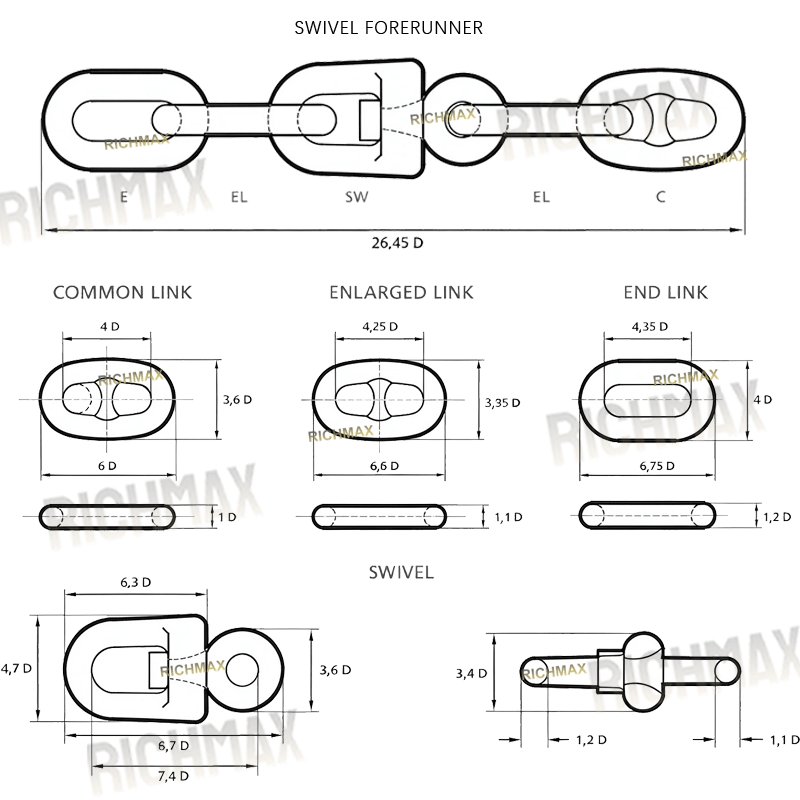
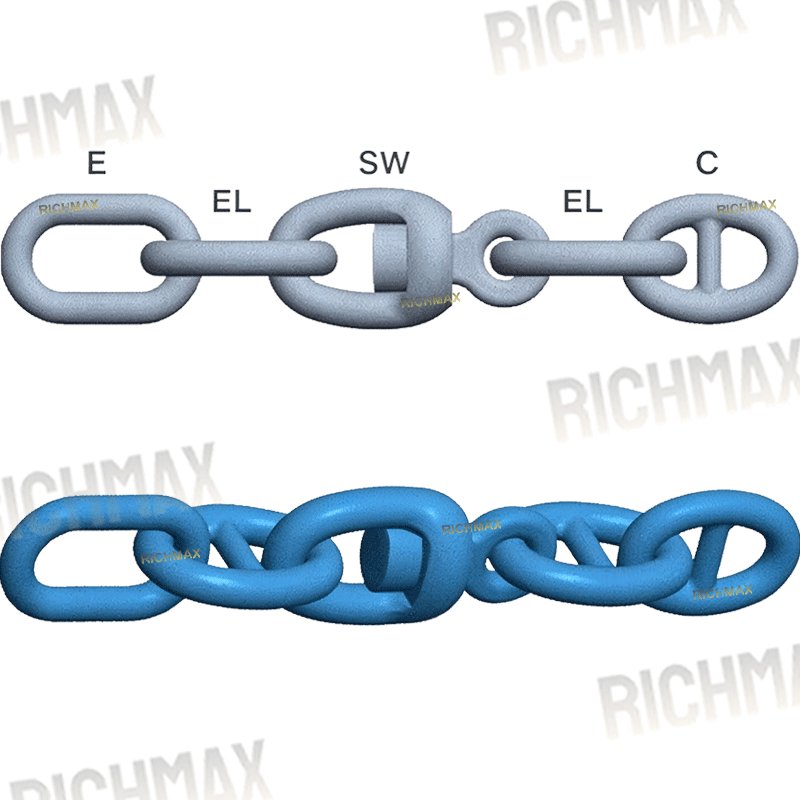
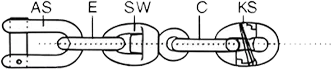
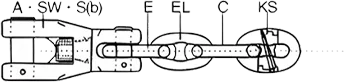
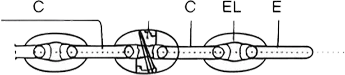
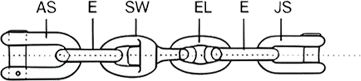
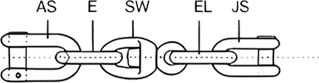
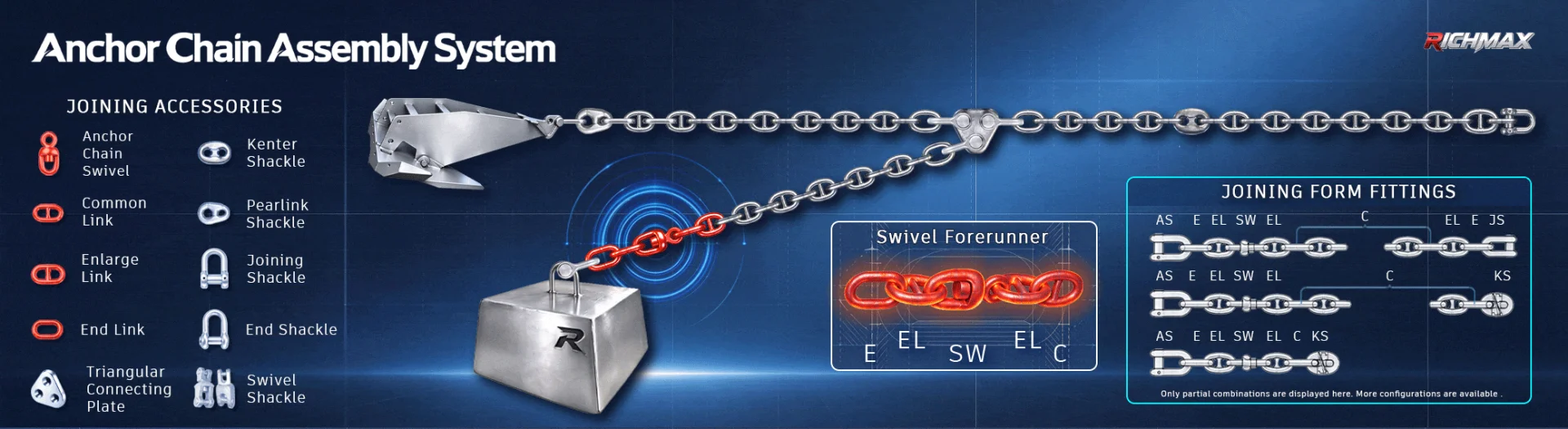
Swivel Forerunner / Swivel Piece include End Link, Enlarged Link, Swivel, Enlarged Link and Common Link, commonly used to connecting End Shackle and anchor chains.
Joining the stud link chain and the anchor, a 3-link or 4-link swivel forerunner is the most common swivel-connector in use today due to its optimal design.
The anchor-side of the swivel forerunner is open for fitting a "D" end shackle. The other side is a common link to fit a Kenter joining shackle. The swivel forerunner is produced to ISO 1704 standards.
Structure
Swivel Forerunner consists of chain links and a central swivel connected to form an anchor chain assembly.
Chain Links
The chain links connect the swivel with the anchor and main anchor chain.
Their dimensions determine the connection size and compatibility with adjacent components.
The main dimensions include:
Chain diameter
Inside link length
Outside link length
Inside link width
Outside link width
Central Swivel
The swivel is positioned between the chain sections.
It allows relative rotation between the connected components during anchoring operations.
The swivel body and connecting ends are manufactured according to the product design.
End Connections
The chain links at both ends connect the assembly with the anchor and main anchor chain.
The connection dimensions should match the anchor shackle, joining shackle or other connecting components used in the anchoring system.
Assembly
The chain links and swivel form a complete connecting assembly.
The number of links, swivel dimensions and overall length depend on the required configuration.
Material
The chain links and swivel are manufactured from steel specified for the required chain grade and component design.
Chain Links
The chain-link material is selected according to the specified grade and manufacturing standard.
Material requirements include chemical composition, tensile strength, yield strength and impact properties.
Swivel
The swivel material is specified according to its design and mechanical requirements.
The material grade and manufacturing process should be confirmed through the product drawing and material specification.
Heat Treatment
Heat treatment is applied where required by the material grade and manufacturing process.
The process is controlled to achieve the specified mechanical properties.
Surface Treatment
The surface treatment depends on the purchase specification.
The required coating or galvanizing method should be confirmed before production.
How to Use Swivel Forerunner?
Swivel Forerunner is installed between the anchor and anchor chain.
The central swivel allows relative rotation between the connected components during anchoring operations.
Selection
Before installation, confirm the chain diameter, chain grade, swivel dimensions and connection sizes.
The assembly should match the anchor and main anchor chain.
Installation
Connect the swivel forerunner to the anchor and anchor chain using the specified connecting components.
Check the chain links, swivel and connecting shackles before installation.
The assembly should be fitted according to the vessel's anchoring arrangement.
Anchor Deployment
Before releasing the anchor, inspect the swivel and connecting links.
During deployment, the anchor chain should be paid out according to the vessel's anchoring procedure.
The swivel forerunner should remain correctly connected throughout the operation.
Anchor Retrieval
During retrieval, check the assembly as it approaches the vessel's chain-handling equipment.
The swivel and connecting links should pass through the designated chain path without interference.
After retrieval, inspect the assembly for abnormal wear, deformation or damage.
Maintenance
Inspect the chain links, swivel body and connecting components during scheduled maintenance.
Check for corrosion, wear, cracks, deformation and abnormal swivel movement.
Cleaning, lubrication and further inspection should follow the manufacturer's instructions.
Applications
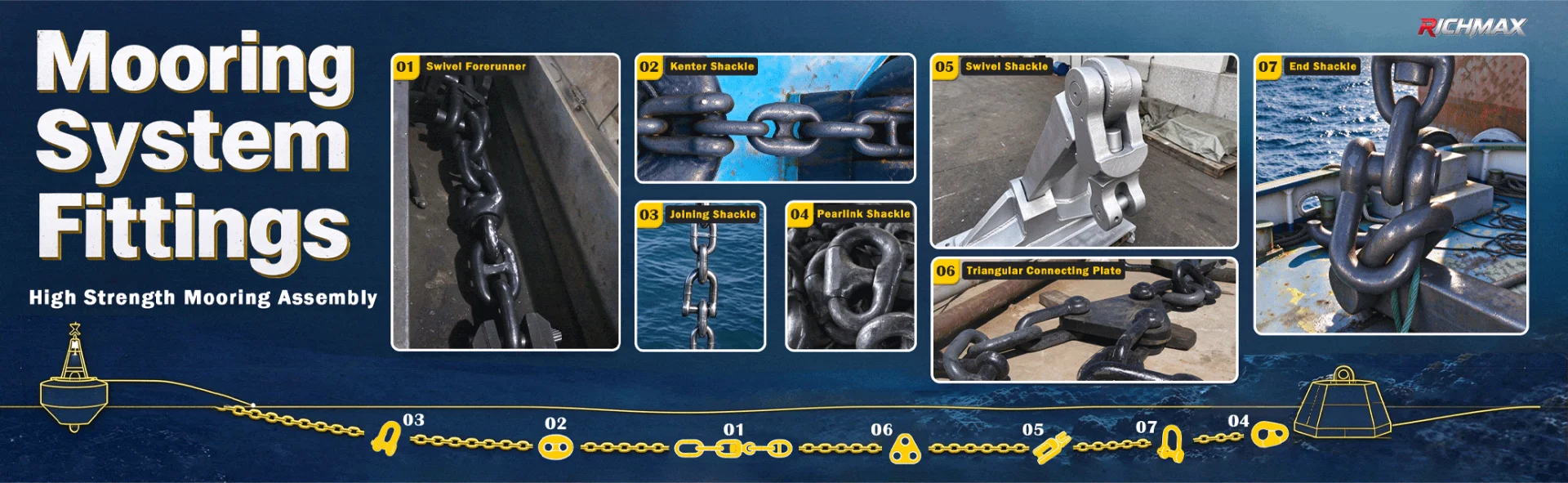
Swivel Forerunner is used in marine anchoring systems where a rotating connection is required between the anchor and anchor chain.
Commercial Vessels
Used in anchoring systems of cargo ships, bulk carriers, container vessels and other commercial vessels.
Tankers
Used in tanker anchoring arrangements where the assembly matches the vessel's anchor and chain specifications.
Offshore Support Vessels
Used where a swivel connection is specified in the vessel's anchoring arrangement.
The required configuration depends on the vessel's equipment and operating requirements.
Work Vessel
Used on work boats and service vessels equipped with compatible anchor chain systems.
Anchor Chain Replacement
Supplied for replacement of existing swivel forerunner assemblies.
The replacement should match the original chain diameter, link arrangement, swivel dimensions and connection requirements.
How to Choose Swivel Forerunner?
Chain Diameter
Confirm the nominal diameter of the main anchor chain.
The connecting links should match the chain dimensions and required connection arrangement.
Chain Grade
Specify the required chain grade and manufacturing standard.
The material and mechanical properties should correspond to the vessel's anchoring requirements.
Assembly Length
Confirm the overall length and number of chain links.
The measurement should follow the product drawing.
Swivel Dimensions
Check the swivel dimensions and connection openings.
The swivel should fit the connecting links and allow the required movement.
Anchor Connection
Confirm the anchor shank dimensions and connecting shackle.
The connection should match the existing anchor or approved anchoring arrangement.
Chain Connection
Confirm the chain-side connection and joining component.
The link dimensions and connecting shackle should fit the main anchor chain.
Inspection Requirements
Specify the required dimensional inspection, material certificates, load testing and classification documentation before ordering.
How To Choose A Relieable Supplier?
Supplier Evaluation for Swivel Forerunner
Product Drawing
The supplier should provide a drawing showing the chain links, central swivel, overall length and connection dimensions.
The drawing should match the quoted product.
Material
Confirm the material grade of the chain links and swivel.
Material certificates should correspond to the supplied components and required specification.
Manufacturing
Check the manufacturing process for the chain links and swivel.
The supplier should identify the processes used for forming, machining, heat treatment and assembly.
Inspection
Confirm how the supplier checks chain dimensions, swivel dimensions and assembly condition.
The inspection scope should match the purchase specification.
Load Testing
Confirm the required test load and applicable test standard.
The test report should identify the tested component or assembly.
Documentation
Confirm the required material certificates, inspection reports and classification documents before production.
FAQ
1. What is a Swivel Forerunner?
Swivel Forerunner is a connecting assembly installed between the anchor and anchor chain. It consists of chain links and a central swivel.
2. What does the swivel do?
The swivel allows relative rotation between connected components during anchoring operations.
3. What components are included?
The assembly shown consists of chain links and a central swivel. The exact configuration depends on the product drawing.
4. Can the assembly be customized?
Chain diameter, link arrangement, overall length, swivel dimensions and connection sizes can be specified according to the required anchoring arrangement.
5. What information is required for a quotation?
Provide the chain diameter, chain grade, assembly length, swivel dimensions, connection details, applicable standard and inspection requirements.
6. Can it be used for anchor chain replacement?
Yes. The replacement assembly should match the existing dimensions, connection arrangement and technical requirements.
7. What inspection is required?
Inspection may include dimensional checks, visual examination, material verification, swivel inspection and load testing.

 English
 Español
 Français
 Árabe
 Русский
 Português
 日本語
 한국어
 Dansk
 Nederlands
 Italiano
 Türkçe
 Deutsch
 Prancis
 ไทย
 Tiếng Việt
 हिंदी
 বাংলা
 中文