Structure
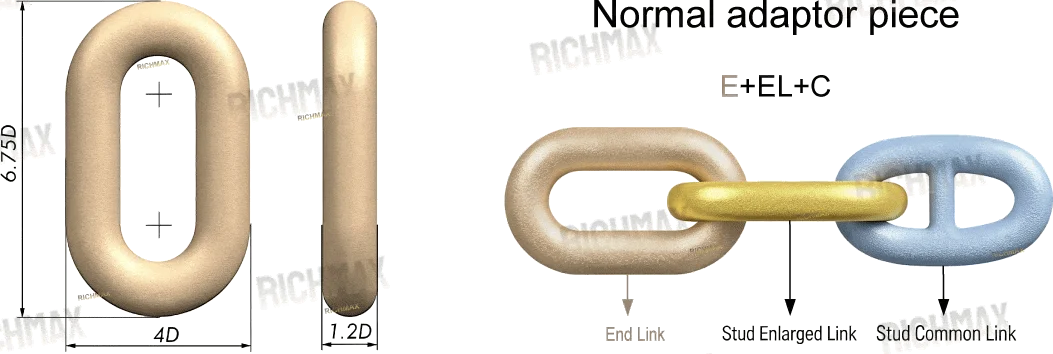
Anchor Chain End Link features an elongated oval configuration with a continuous closed steel body. Unlike a standard stud link, it does not contain a transverse stud across the middle of the link.
Its structural dimensions are designed around the requirements of the anchor chain connection arrangement. The overall length, width, cross-sectional diameter and internal opening determine how the End Link fits with the adjoining chain components.
Elongated Oval Body
The main body has an elongated oval profile, with rounded ends and relatively straight curved sections along the sides. This shape provides the internal clearance required for connecting components while maintaining the specified external dimensions.
The overall geometry must be controlled during manufacturing to avoid excessive dimensional variation or local deformation.
Circular Cross-Section
The link body has a circular cross-section. The nominal diameter is specified according to the applicable chain standard or approved technical drawing.
Consistent cross-sectional dimensions are important for maintaining the specified mechanical properties and ensuring proper contact with adjoining fittings.
Continuous Closed-Link Construction
The End Link forms a closed steel loop without a removable pin or transverse stud.
Its manufacturing process must ensure structural integrity throughout the link body. Depending on the approved design, the manufacturing route and process controls may differ.
Internal Opening
The internal opening is one of the main dimensional characteristics of the End Link.
Its internal length and width determine the available space for the connecting components. These dimensions must be compatible with the corresponding Joining Shackle, End Shackle or other specified fittings.
Insufficient clearance may cause interference during assembly, while excessive clearance may result in an unsuitable connection arrangement.
Surface Finish
The product shown has a black surface appearance. The actual finish may be specified according to the purchase order and corrosion protection requirements.
Surface treatment should not obscure cracks, unacceptable surface defects or other conditions requiring inspection.
Material
Anchor Chain End Link is a load-bearing component within a marine anchor chain assembly. Material selection must therefore be based on the required chain grade, mechanical properties, manufacturing process and applicable technical specifications.
The material should not be selected solely according to the nominal diameter or external appearance of the End Link.
Steel Grade
The steel grade should correspond to the specified anchor chain grade and approved manufacturing requirements.
For marine anchor chain applications, the material requirements differ between chain grades. The selected steel must meet the specified mechanical properties and any additional classification or project requirements.
Before production, the following information should be confirmed:
Required anchor chain grade.
Applicable manufacturing standard.
Material specification.
Required tensile and yield strength.
Elongation requirements.
Impact toughness requirements, where applicable.
Classification society or project-specific requirements.
Mechanical Properties
The mechanical properties of the steel directly affect the performance of the End Link under tensile loading.
Tensile Strength
Tensile strength indicates the maximum stress the material can withstand before fracture. It must meet the requirements specified for the corresponding chain grade.
Yield Strength
Yield strength represents the stress level at which permanent deformation begins. It is an important consideration for components subjected to tensile loads during anchoring operations.
Elongation
Elongation indicates the material's ability to deform before fracture. Adequate ductility is important for maintaining the required material performance.
Impact Toughness
Impact toughness evaluates the material's ability to absorb energy under impact loading. Where low-temperature service is specified, the required impact testing temperature and acceptance criteria should be confirmed.
Manufacturing Process
The manufacturing route depends on the approved product design and material specification.
Production may involve steel forming, forging, welding or other approved processes, depending on the design.
For welded construction, the following process controls may be required:
Qualified welding procedures.
Qualified welders, where applicable.
Welding consumable control.
Preheating and interpass temperature control.
Post-weld heat treatment, where specified.
Weld inspection and applicable NDT.
For forged or formed construction, dimensional control, forming temperature and material integrity should be considered throughout production.
The actual manufacturing process should be confirmed by the supplier rather than assumed from the finished product appearance.
Heat Treatment
Heat treatment requirements depend on the material grade and manufacturing procedure.
Where specified, heat treatment is used to obtain the required mechanical properties and control the effects of forming or welding.
Temperature, holding time and cooling conditions should be controlled according to the approved procedure. Relevant process records should be retained for inspection and traceability.
Material Traceability
Material traceability is important for marine chain components, particularly for classification-controlled orders.
The supplier should maintain records connecting the original steel material, heat number, production batch and final inspection results.
Material certificates should correspond to the actual production batch rather than being provided as unrelated general documents.
How To Use?
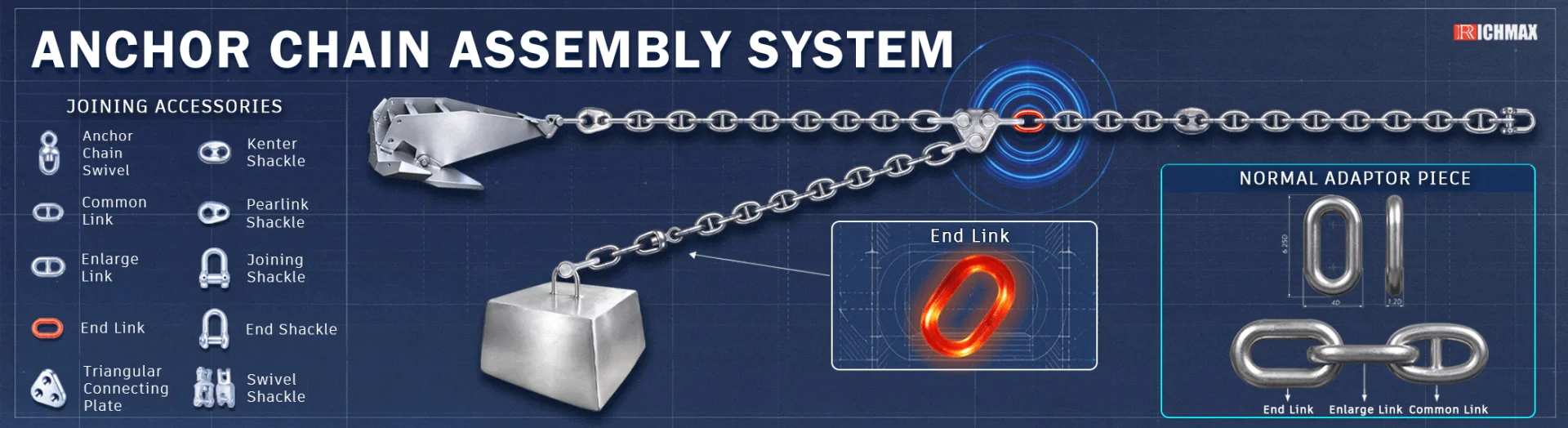
Anchor Chain End Link is installed at a designated connection position within an anchor chain assembly. Its function is to provide a closed-link connection point between specified chain components and connecting fittings.
The exact installation position depends on the anchoring system design and the connection arrangement specified for the vessel.
Connection Between Anchor Chain Components
End Links are used in specified chain connection arrangements where a larger, reinforced link is required instead of a standard Common Link.
The connecting configuration may involve a D-type Joining Shackle or another approved connection fitting, depending on the chain arrangement.
The dimensions of the End Link must correspond to the connecting component to ensure proper seating and sufficient clearance.
Connection with End Shackle
In an anchor-side chain arrangement, the End Link may be used as part of the connection between the outboard chain shot and the End Shackle.
The End Shackle then provides the connection to the anchor through the specified anchoring arrangement.
The two components have different functions:
Anchor Chain End Link: A closed chain link used at a designated chain-end connection position.
End Shackle: A separate connecting fitting used to connect the chain assembly to the anchor.
Their dimensions and connection arrangements should be confirmed against the approved assembly drawing.
Assembly Considerations
Before installation, check the compatibility of the End Link with all adjoining components.
Important considerations include:
Correct nominal chain diameter.
Matching chain grade.
Compatible internal opening dimensions.
Correct connecting shackle dimensions.
No interference between adjoining components.
Proper seating and contact between connecting parts.
Components should not be mixed solely because they have the same nominal diameter. Their actual dimensions and mechanical specifications must also be compatible.
Inspection Before Service
Before the anchor chain assembly is put into service, inspect the End Link for:
Visible cracks or unacceptable surface defects.
Permanent deformation.
Excessive wear.
Corrosion or material loss.
Abnormal contact marks.
Damage to connecting areas.
Any component showing unacceptable damage should be evaluated according to the vessel's maintenance procedures and applicable technical requirements.
Application
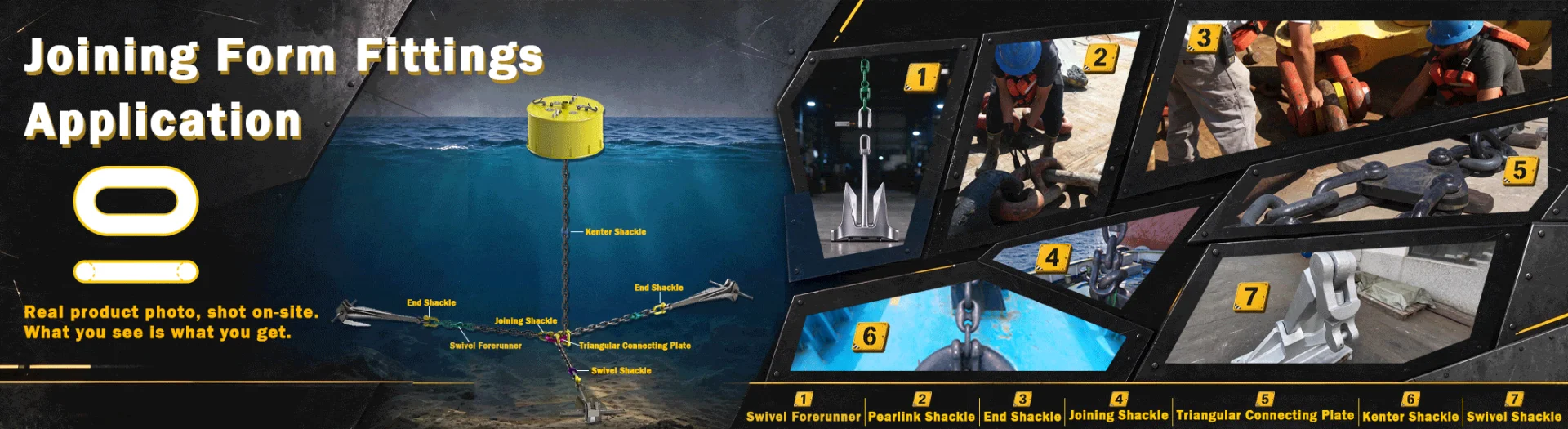
Anchor Chain End Link is mainly used in marine anchor chain assemblies where a designated end connection component is required.
Commercial Vessel Anchoring Systems
Used in anchor chain assemblies for commercial vessels, including:
Bulk carriers.
Container ships.
Oil tankers.
General cargo vessels.
Other merchant vessels.
The End Link forms part of the specified chain connection arrangement between the anchor chain and its associated fittings.
Shipbuilding and Newbuilding Projects
Supplied as part of anchor chain component packages for new vessels.
During vessel construction, the End Link dimensions and material grade must correspond to the approved anchor chain specification and anchoring system arrangement.
Anchor Chain Replacement
Used as a replacement component when an existing End Link requires renewal due to wear, deformation, corrosion or other damage.
For replacement orders, the original component dimensions, chain grade and connection arrangement should be checked before production.
Ship Repair and Marine Maintenance
Used by ship repair companies and marine maintenance contractors when repairing or renewing anchor chain assemblies.
Correct dimensional compatibility is important because replacement components must fit the existing chain system without modifying the approved connection arrangement.
Marine Equipment Distribution
Supplied to marine equipment distributors, ship chandlers and anchor chain component suppliers as part of their marine hardware product range.
Offshore and Marine Engineering
May be used in project-specific marine chain assemblies where the design specification requires this type of End Link.
For permanent offshore mooring applications, the applicable mooring chain standard and project requirements should be checked separately. Anchor chain components should not automatically be considered interchangeable with offshore mooring chain components.
How To Choose?
Selecting an Anchor Chain End Link requires checking the chain specification, material grade, dimensional requirements and connecting arrangement.
A correct nominal diameter alone is not sufficient to establish compatibility.
Confirm the Anchor Chain Diameter
Identify the nominal diameter of the adjoining Common Link or the specified reference chain component.
The End Link diameter and overall dimensions should be determined according to the applicable standard or approved technical drawing.
For standard stud-link anchor chain assemblies, ISO 1704 provides dimensional requirements for chain components, including End Links.
Do not calculate the final End Link dimensions using a general enlargement ratio without checking the applicable standard and drawing.
Confirm the Chain Grade
The chain grade determines the required material and mechanical properties.
Common anchor chain grades include Grade 1, Grade 2 and Grade 3, subject to the applicable standard and project specification.
The End Link must meet the requirements specified for the corresponding chain assembly.
A component manufactured for one grade should not automatically be used as a replacement for another grade.
Confirm the Applicable Standard
The purchase specification should clearly identify the required manufacturing standard.
For stud-link anchor chains, ISO 1704 is an important dimensional reference.
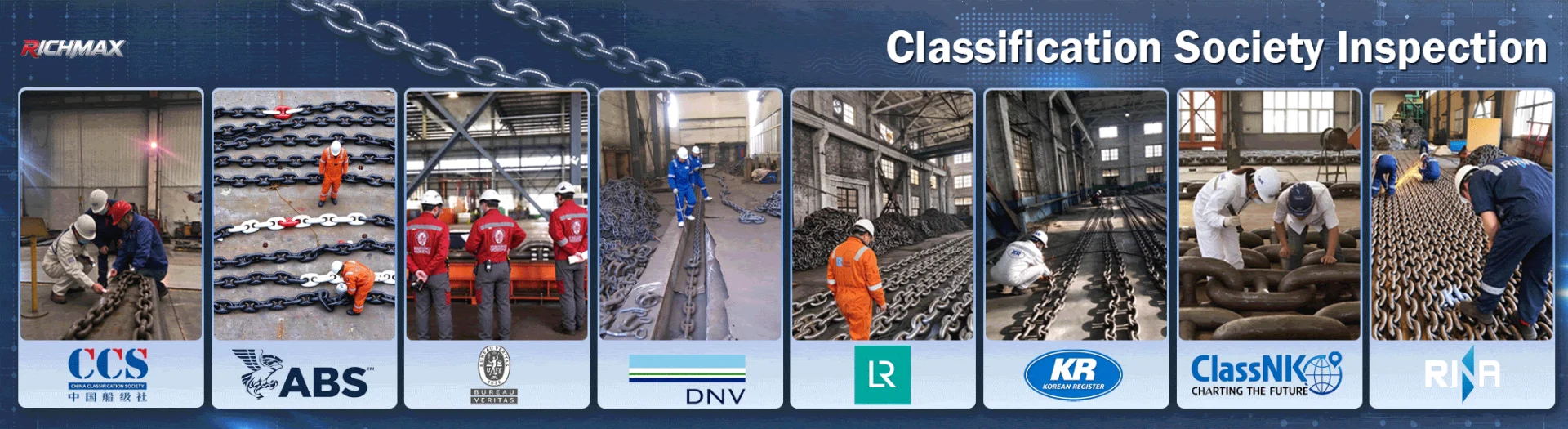
Additional requirements may be specified by classification societies such as ABS, DNV, Lloyd's Register, Bureau Veritas or CCS.
For non-standard products, the approved technical drawing and project specification should be used as the primary manufacturing reference.
Check Connecting Component Compatibility
The End Link must be suitable for its designated connection fitting.
Depending on the chain arrangement, this may include:
D-type Joining Shackle.
End Shackle.
Other specified chain connection fittings.
Check the internal opening, connecting fitting dimensions and contact geometry.
A mismatch may cause assembly interference, unsuitable contact conditions or incorrect component positioning.
Confirm Material and Inspection Requirements
Before ordering, clarify the required material grade, mechanical properties and inspection scope.
Depending on the order, the inspection package may include:
Material certificates.
Chemical composition reports.
Mechanical test reports.
Dimensional inspection reports.
Heat treatment records.
NDT reports, where applicable.
Proof load test records, where applicable.
Classification certificates, where required.
The actual inspection requirements should be agreed before production.
How To Choose A Reliable Supplier?
When purchasing Anchor Chain End Link, buyers should evaluate the supplier's understanding of anchor chain components, material control, manufacturing capability and dimensional inspection.
The following points are important for shipyards, shipowners, marine equipment distributors and procurement departments.
Understanding of Anchor Chain Components
A qualified supplier should understand the differences between Common Links, Enlarged Links, End Links and End Shackles.
They should be able to identify the correct product configuration according to the chain assembly drawing and applicable standard.
The supplier should also understand the connection relationship between the End Link and its adjoining fittings.
Material Selection and Traceability
The supplier should confirm the steel grade and material requirements before production.
For classified or project-controlled orders, material certificates and heat number records should be available.
Buyers should check whether the supplier can trace the material from incoming inspection through production to final delivery.
Manufacturing Process Control
Ask the supplier to explain the actual manufacturing route.
Depending on the approved design, relevant processes may include:
Raw material inspection.
Steel forming or forging.
Welding, where applicable.
Heat treatment.
Machining or dimensional correction.
Surface preparation and coating.
Final inspection.
It is also important to understand which production processes are completed in-house and which are subcontracted.
Dimensional Inspection Capability
The supplier should have suitable measuring equipment and procedures to verify the End Link dimensions.
Particular attention should be paid to:
Cross-sectional diameter.
Overall length.
Overall width.
Inside length.
Inside width.
Link profile and symmetry.
Inspection results should be recorded against the approved drawing or applicable standard.
Mechanical Testing and NDT
The supplier should be able to explain which mechanical tests and non-destructive testing methods are applicable to the product.
Depending on the manufacturing method and project requirements, inspection may include tensile testing, impact testing, hardness testing, MT or UT.
The testing scope and acceptance criteria should be agreed before production.
Quality Documentation
For marine anchor chain components, documentation should be consistent with the actual supplied product.
Depending on the order, relevant documents may include:
Material certificates.
Manufacturing records.
Dimensional inspection reports.
Mechanical test reports.
NDT reports.
Heat treatment records.
Final inspection reports.
Classification documentation, where required.
Export and Delivery Management
For international orders, the supplier should be able to coordinate technical confirmation, production scheduling, product identification, packaging and export documentation.
For replacement components, accurate dimensional confirmation before production and shipment is particularly important.
FAQ
1. What is an Anchor Chain End Link?
Anchor Chain End Link is a specialized closed-link component used at designated connection positions in marine anchor chain assemblies. It provides a connection point for specified anchor chain fittings and adjoining chain components.
2. What does an Anchor Chain End Link look like?
It generally features an elongated oval shape with a continuous closed body. The product shown has a circular cross-section and no transverse stud.
3. Does an Anchor Chain End Link have a stud?
The product shown is a studless design. It does not have the transverse crossbar found in a conventional stud-link anchor chain link.
4. What is the difference between an End Link and a Common Link?
A Common Link is the standard link used to form the main anchor chain length. An End Link has a different dimensional configuration and is designed for designated chain-end connection arrangements.
5. What is the difference between an End Link and an Enlarged Link?
Both are specialized chain components with dimensions different from a Common Link.
Their dimensions and positions within the chain assembly are different. The correct component should be identified according to the applicable chain standard and assembly drawing.
6. What is the difference between an End Link and an End Shackle?
An End Link is a continuous closed steel chain link without a removable pin. An End Shackle is a separate connecting fitting, normally incorporating a removable pin or another specified locking arrangement.
They perform different functions within the anchor chain assembly.
7. What material is used for Anchor Chain End Link?
The material depends on the required anchor chain grade and manufacturing specification. The steel must meet the specified mechanical properties, including tensile strength, yield strength, elongation and impact toughness where applicable.
8. What manufacturing methods are used?
The manufacturing method depends on the approved design. Forming, forging, welding and other approved processes may be used depending on the product specification.
The actual manufacturing route should be confirmed by the manufacturer.


 English
 Español
 Français
 Árabe
 Русский
 Português
 日本語
 한국어
 Dansk
 Nederlands
 Italiano
 Türkçe
 Deutsch
 Prancis
 ไทย
 Tiếng Việt
 हिंदी
 বাংলা
 中文