Structure
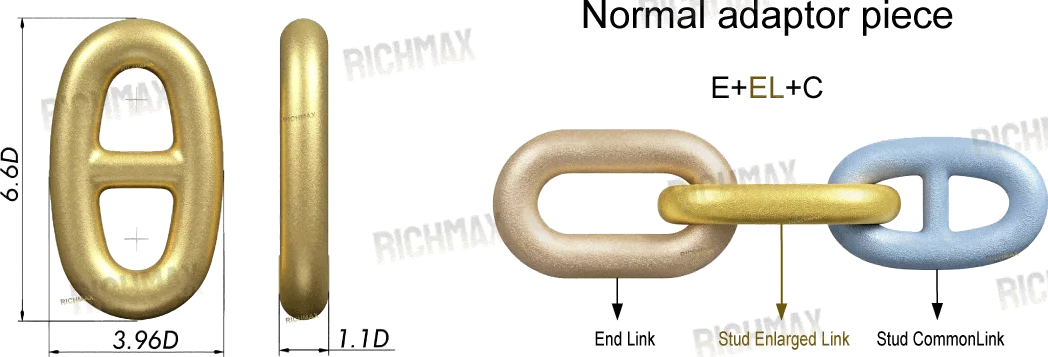
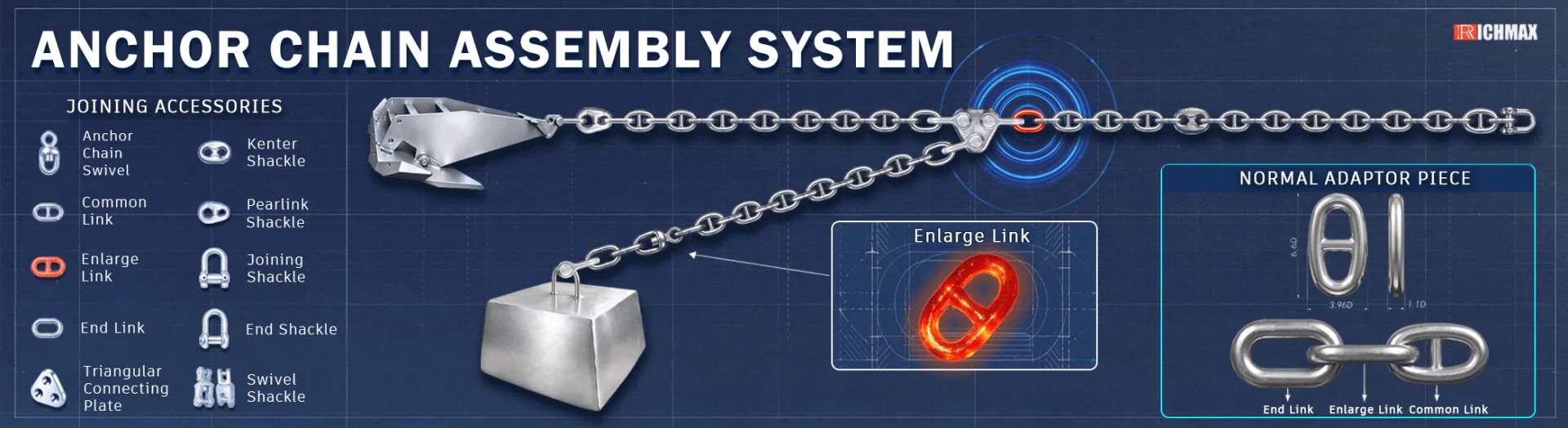
An Anchor Chain Enlarged Link is a specially proportioned link used within a stud link anchor chain assembly. Under ISO 1704, it is identified as a connecting component between a common link and an end link when D-type joining shackles are used, or between a common link and a swivel.
Its main structural feature is a larger cross-sectional diameter than that of a standard common link. The overall link profile follows the proportions specified for the enlarged link rather than simply increasing the dimensions of an ordinary chain link.
The main structural features include:
Enlarged Cross-Section
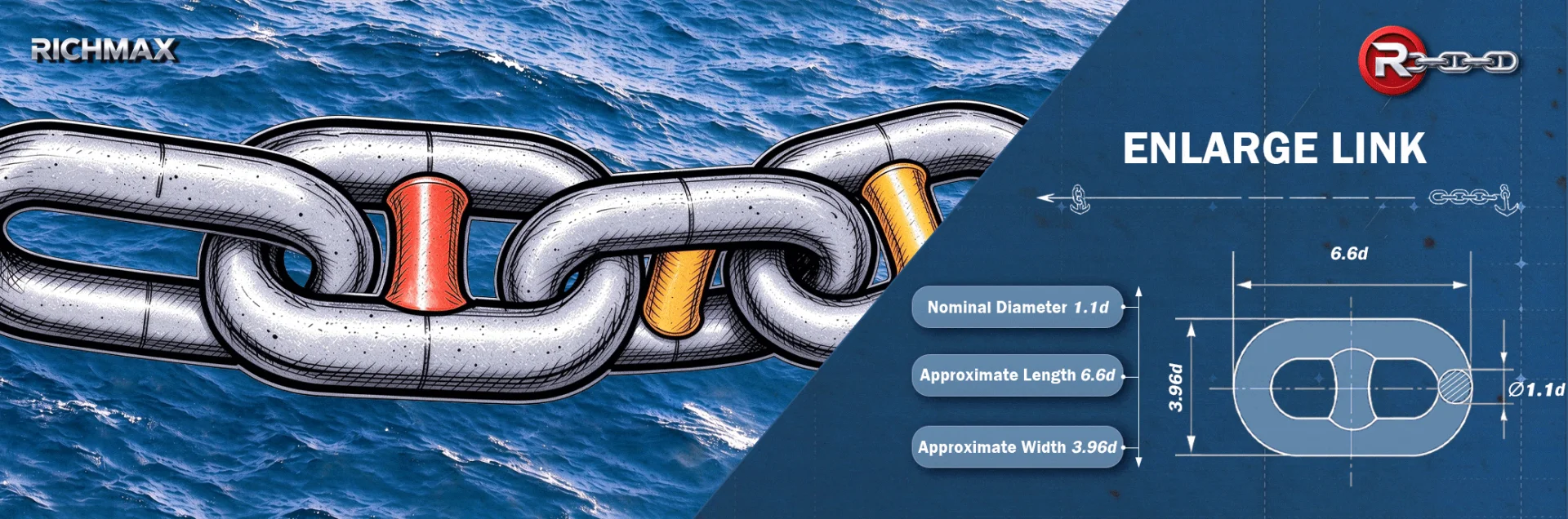
The enlarged link has a greater nominal diameter than the common link. This provides the specified geometry for the connecting position within the chain assembly.
Oval Link Profile
The link is formed into an oval configuration, with curved crowns and relatively straight side sections. The internal dimensions must allow the adjacent chain links and connecting fittings to seat and articulate correctly.
Crown and Side Sections
The crown sections and straight portions form the main load-bearing geometry. Their cross-sectional dimensions and bending profile must comply with the approved drawing and applicable manufacturing requirements.
Internal Clearance
The inside length and width must provide sufficient clearance for the adjoining links or connecting components. Insufficient clearance can restrict link movement, while excessive clearance may result in an incorrect fit.
Stud Configuration
For stud-link anchor chain applications, the enlarged link is manufactured with the stud configuration specified by the applicable chain design. The stud and link body must be compatible with the required assembly and manufacturing standard.
Material
Anchor Chain Enlarged Links are manufactured from steel selected according to the required anchor chain grade, mechanical properties and applicable classification requirements.
The material must be suitable for the forming, welding and heat-treatment processes specified in the approved manufacturing procedure.
Material selection should consider the following factors:
Steel Grade
The steel grade must correspond to the specified anchor chain grade and approved manufacturing requirements. Depending on the chain system, applicable requirements may involve Grade 2 or Grade 3 anchor chain materials.
For offshore mooring applications, higher-grade mooring chain materials may be specified under separate standards and project requirements. These should not automatically be treated as equivalent to conventional ship anchor chain grades.
Mechanical Properties
The material must meet the specified requirements for:
Yield strength
Tensile strength
Elongation
Impact toughness, where required
These properties should be verified against the applicable chain grade and classification requirements rather than assumed from the material designation alone.
Heat Treatment
Heat treatment is an important manufacturing process for controlling the mechanical properties of the enlarged link.
Depending on the material and manufacturing process, normalizing, quenching and tempering may be specified.
The actual process must follow the approved heat-treatment procedure, including temperature control, holding time and cooling conditions.
Material Traceability
Each production batch should have identifiable material records.
Heat numbers, material certificates and production records should be maintained so that the finished component can be traced back to its original steel material.
How To Use?
Installation in an Anchor Chain Assembly
An Anchor Chain Enlarged Link is installed at a designated position within the anchor chain assembly. Its position depends on the chain arrangement and the type of connecting fittings specified in the system design.
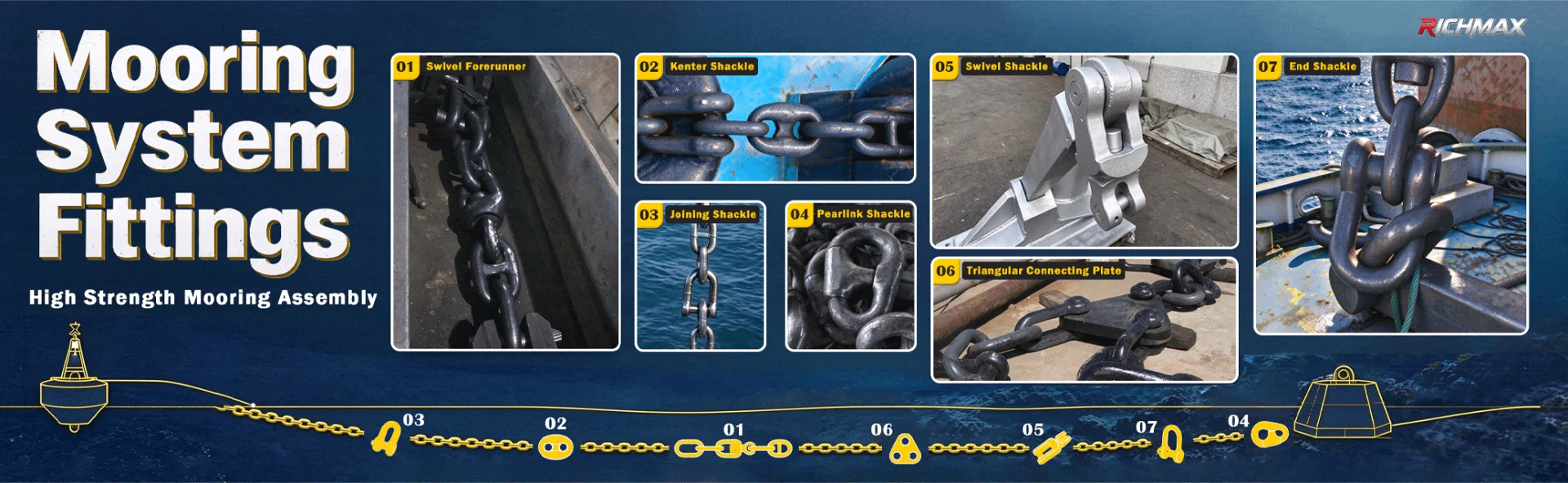
For a conventional stud link anchor chain using D-type joining shackles, the enlarged link may be positioned between a common link and an end link. It may also be used between a common link and a swivel in an arrangement designed for that connection.
The following points should be considered during assembly:
Confirm the Installation Position
Identify the required position of the enlarged link from the anchor chain assembly drawing. Do not replace a common link or end link with an enlarged link without checking the approved arrangement.
Check Dimensional Compatibility
Confirm the enlarged link dimensions against the adjoining common link, end link, joining shackle or swivel.
Particular attention should be given to the internal opening, cross-sectional diameter and connecting geometry.
Check the Connecting Components
The enlarged link must be compatible with the specified joining shackle or swivel. The connecting component must be designed to accommodate the actual link dimensions.
Confirm Assembly Condition
Before the chain assembly is accepted, the link arrangement should be checked for proper seating, alignment and freedom of movement.
Follow Approved Inspection Requirements
Installation and acceptance should follow the vessel's applicable procedures, approved drawings and classification requirements.
Application
Marine Anchor Chain Systems
Anchor Chain Enlarged Links are mainly used in stud link anchor chain assemblies where a larger link profile is required at designated connecting positions.
Typical applications include:
Ship Anchor Chain Cables
Used in conventional ship anchor chain assemblies for commercial vessels, including bulk carriers, container ships, tankers and general cargo vessels.
Chain Shot Connections
Used in specified chain-shot connection arrangements where an enlarged link is required between the common link and associated end connection components.
Swivel Connections
Applied in anchor chain arrangements where a swivel is connected through an enlarged link to accommodate the specified connection geometry.
Anchor Chain Replacement
Supplied as replacement components for existing anchor chain systems. Dimensional compatibility with the original chain cable and connecting fittings must be confirmed before ordering.
Marine Equipment Manufacturing
Used by anchor chain manufacturers, shipyards and marine equipment suppliers as part of the production or maintenance of compatible anchor chain assemblies.
Ship Repair and Maintenance
Used when replacing damaged, worn or otherwise unserviceable enlarged links, subject to the approved repair or replacement requirements of the vessel.
How To Choose?
Key Factors When Selecting an Anchor Chain Enlarged Link
Selecting an Anchor Chain Enlarged Link requires more than matching the nominal chain diameter. The link must be compatible with the chain grade, connecting components, dimensional requirements and intended installation position.
Confirm the Nominal Chain Diameter
The nominal diameter of the common link is the starting reference for selecting an enlarged link.
The actual dimensions should be checked against the applicable standard table and approved drawing.
Confirm the Anchor Chain Grade
The enlarged link must match the mechanical requirements of the associated anchor chain.
Common considerations include:
Grade 2 anchor chain
Grade 3 anchor chain
Other grades specified by the applicable standard or project
The material and heat-treatment requirements should be confirmed before production.
Check the Connecting Components
Identify which components will be connected to the enlarged link.
These may include:
Common Link
End Link
D-Type Joining Shackle
Anchor Chain Swivel
The internal opening and external profile must accommodate the adjoining components without restricting their intended movement.
Verify Critical Dimensions
All dimensions should be taken from the applicable standard or approved product drawing.
Confirm Manufacturing and Certification Requirements
For shipbuilding and replacement projects, confirm whether the order requires:
Manufacturer's material certificate
Mechanical property test reports
Proof load test records, where specified
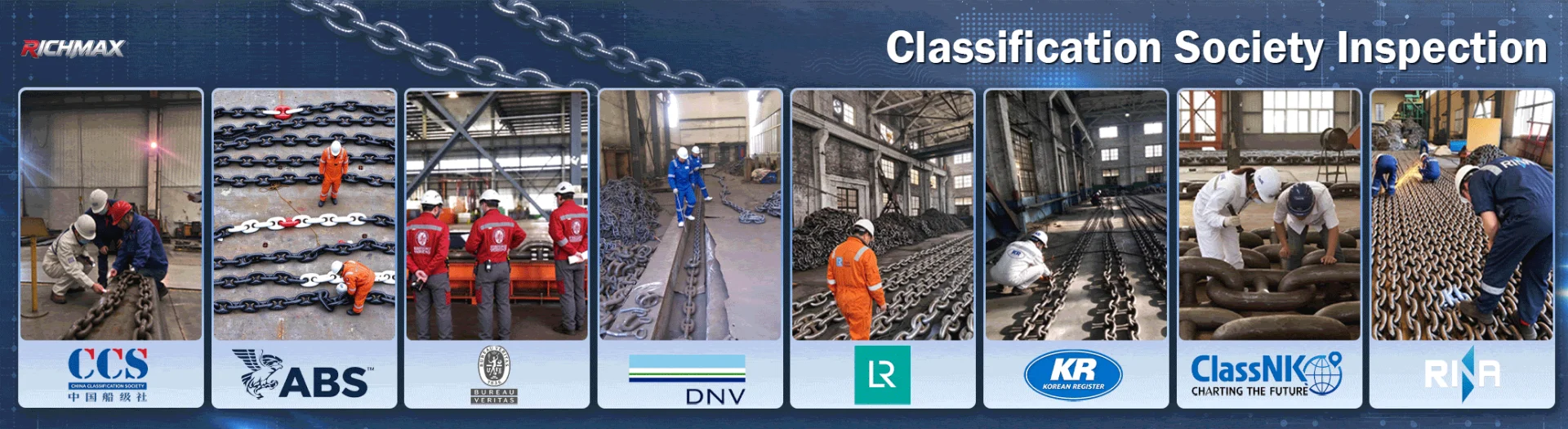
Classification society inspection
Dimensional inspection report
Product marking and traceability
Certification requirements depend on the project specification and applicable classification rules.

How To Choose A Reliable Supplier?
Supplier Evaluation for Anchor Chain Enlarged Link
When purchasing Anchor Chain Enlarged Links, buyers should evaluate the supplier's ability to control dimensions, material properties and manufacturing processes. These factors directly affect compatibility with the existing anchor chain assembly.
Understanding of Anchor Chain Standards
The supplier should understand the dimensional requirements of ISO 1704 and the relevant classification society rules.
The quotation should clearly identify the applicable standard, nominal chain size and enlarged link dimensions.
A supplier should also distinguish between enlarged links, end links and common links rather than treating them as interchangeable components.
Material Control and Traceability
The supplier should be able to provide information about the steel material used in production.
Material certificates should identify the steel grade, chemical composition and mechanical properties where required.
Heat numbers and production records should be maintained to establish traceability between raw material and finished products.
Manufacturing Process Control
Ask the supplier about its manufacturing processes, including:
Steel material preparation
Link forming
Welding and stud installation, where applicable
Heat treatment
Surface finishing
Final dimensional inspection
The manufacturing process should follow an established procedure appropriate for the specified chain grade.
Dimensional Inspection Capability
The supplier should have the equipment and inspection procedures needed to measure critical link dimensions.
Particular attention should be given to the enlarged diameter, overall length, overall width and internal clearance.
Dimensional inspection should be based on the applicable drawing and standard, not simply visual comparison with a sample.
Mechanical Testing and Quality Records
Depending on the order requirements, the supplier should be able to provide relevant test documentation, such as:
Chemical composition analysis
Tensile test results
Impact test results, where required
Hardness test results, where specified
Proof load test records, where applicable
Non-destructive testing reports, where required
For classification-controlled orders, the inspection and testing arrangements should be confirmed before production.
Export and Order Documentation
For international marine equipment procurement, the supplier should also be able to handle:
Technical drawings and dimensional confirmation
Commercial and packing documentation
Material and inspection records
Classification documentation, where required
Shipment and delivery coordination
These records are important for shipyard purchasing departments, shipowners and marine equipment distributors.
FAQ
1. What is an Anchor Chain Enlarged Link?
An Anchor Chain Enlarged Link is a specially dimensioned component used in stud link anchor chain assemblies. It has a larger cross-sectional diameter than a common link and is used at designated connecting positions within the chain system.
2. What is the difference between an Enlarged Link and a Common Link?
The main difference is the cross-sectional diameter and the intended position within the chain assembly.
Under ISO 1704, the enlarged link has a nominal diameter 10% greater than the common link. Its dimensions are specified separately to provide the required connection geometry.
3. What is the difference between an Enlarged Link and an End Link?
An enlarged link and an end link have different dimensional proportions and connection functions.
The enlarged link is generally used between a common link and an end link in D-type joining shackle arrangements, or between a common link and a swivel.
The end link is designed for specific chain-end connections, including connections involving an end shackle.
4. Is an Enlarged Link used in studless anchor chains?
The enlarged link discussed here follows the conventional stud link anchor chain arrangement covered by ISO 1704.
Studless chain systems may have different component configurations and dimensional requirements. Compatibility should be confirmed against the applicable chain design and standard.
5. What is the dimensional relationship between an Enlarged Link and a Common Link?
According to ISO 1704:2022, the nominal diameter of the enlarged link is 1.1 times the nominal diameter of the common link.
Other dimensions, including overall length, width and internal opening, should be taken from the relevant standard table.
6. Which materials are used for Anchor Chain Enlarged Links?
Steel materials are selected according to the required anchor chain grade and manufacturing specification.
The material must satisfy the specified chemical composition and mechanical properties, including tensile strength, yield strength and impact toughness where applicable.
7. Can an Enlarged Link be supplied according to customer drawings?
Yes. Enlarged links can be manufactured according to approved drawings and specified technical requirements, subject to manufacturing feasibility.
Customers should provide the chain diameter, grade, dimensional drawing and connecting component information.
8. Does an Enlarged Link require heat treatment?
Heat treatment requirements depend on the steel grade, manufacturing method and applicable standard.



 English
 Español
 Français
 Árabe
 Русский
 Português
 日本語
 한국어
 Dansk
 Nederlands
 Italiano
 Türkçe
 Deutsch
 Prancis
 ไทย
 Tiếng Việt
 हिंदी
 বাংলা
 中文