Structure
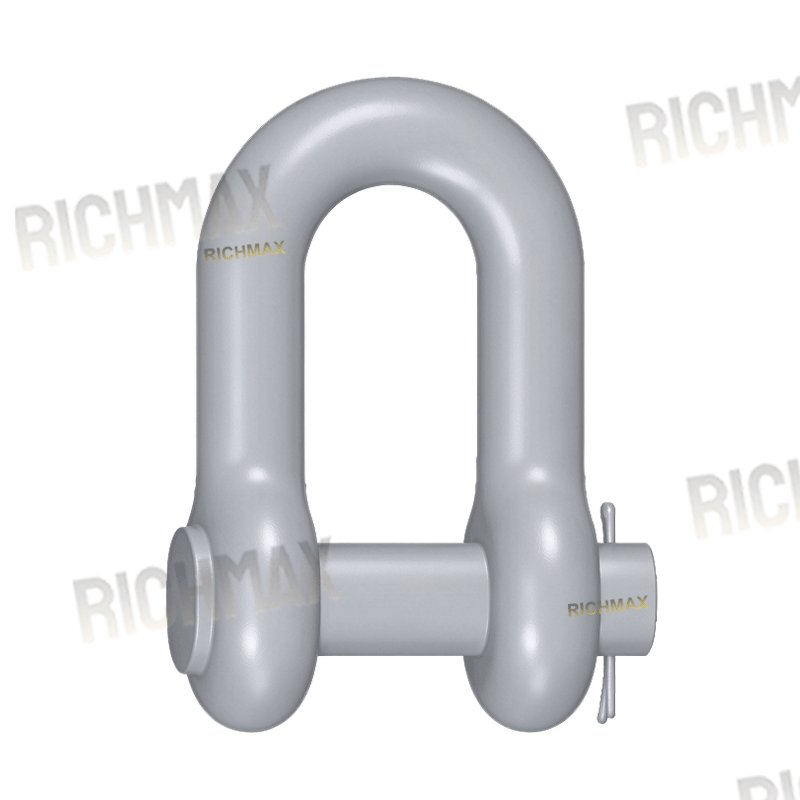
A Forelock Anchor Shackle generally consists of the following main components:
Shackle Body
The shackle body is the main load-bearing component. Its shape and cross-section are designed to accommodate the connecting chain links and transfer loads through the connection.
The body dimensions, internal clearance and contact surfaces must be compatible with the chain or fittings being connected. Incorrect dimensions may cause interference, poor seating or uneven contact during operation.
Shackle Pin
The pin passes through the holes in the shackle body and secures the connected components in position.
Its diameter, length, fitting clearance and retaining arrangement are important dimensional requirements. The pin must be compatible with the shackle body and should not be replaced with an unapproved alternative.
Forelock Locking Arrangement
The forelock is the retaining component associated with the pin assembly. Its function is to prevent unintended pin displacement during normal service.
The locking arrangement must be correctly fitted and inspected before the shackle is put into operation. Its configuration and installation requirements depend on the specific shackle design.
Connecting Section
The internal opening and bearing surfaces provide the contact area for the connected chain links or fittings.
The opening width, internal radius and body thickness should be checked against the mating components to avoid excessive local contact or dimensional interference.
Structural Considerations
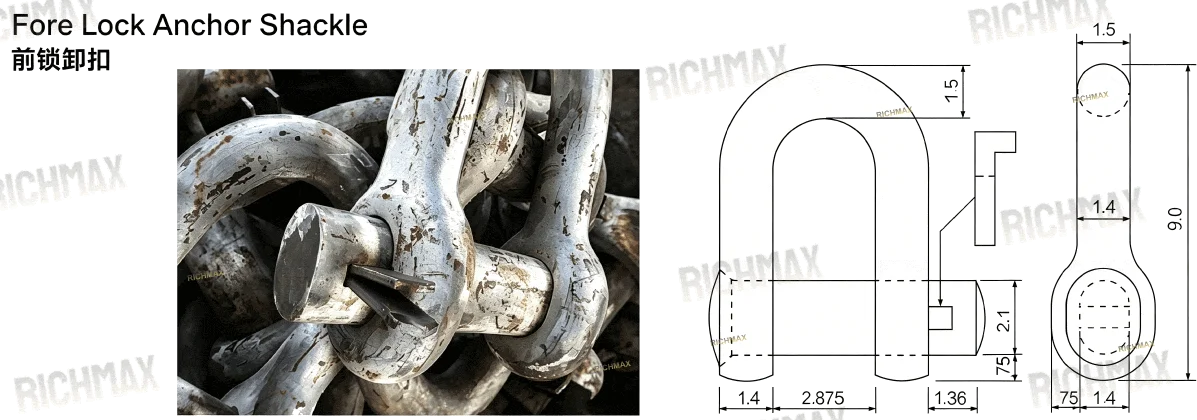
For marine applications, the following dimensions should be confirmed before ordering:
Nominal shackle size
Body width and thickness
Internal opening dimensions
Pin diameter and length
Pin retaining arrangement
Overall length and width
Compatible anchor chain diameter
These dimensions should be verified against the approved drawing rather than relying on nominal size alone.
Material
The material used for a Forelock Anchor Shackle depends on its design, required mechanical properties, manufacturing standard and intended service conditions.
For marine anchor chain connections, material selection should consider tensile strength, yield strength, impact toughness and resistance to deformation under the specified loading conditions.
1. Forged Steel
Forged steel is commonly used for heavy-duty marine shackles.
The forging process forms the main body under controlled temperature and deformation conditions. Depending on the manufacturing process, forging can provide suitable mechanical properties and a consistent load-bearing structure.
2. Cast Steel
Cast steel may be used for certain shackle designs where the approved manufacturing specification permits cast construction.
Casting quality, internal soundness, heat treatment and mechanical testing should be considered when evaluating cast steel components.
3. Heat-Treated Steel
Heat treatment is an important part of manufacturing when required by the material grade and product specification.
Depending on the specified material, processes may include normalizing, quenching and tempering. The actual treatment procedure should be based on the approved material requirements.
Material Requirements
When purchasing Forelock Anchor Shackles, buyers should confirm:
Steel grade and material specification
Required tensile and yield strength
Impact toughness requirements, where applicable
Heat treatment condition
Material test certificate requirements
Heat number and material traceability
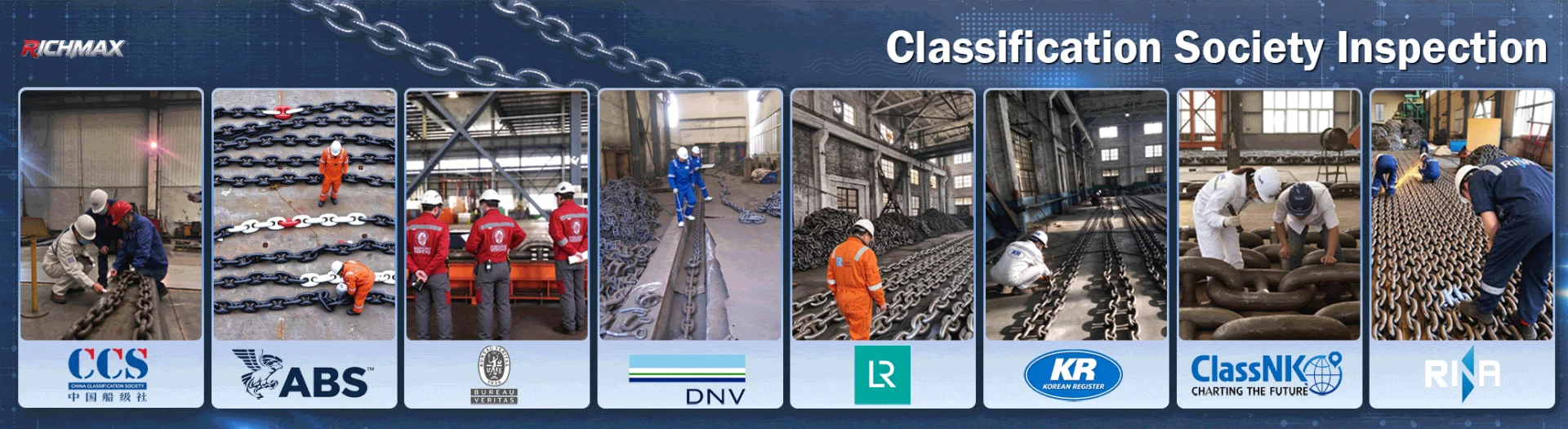
Classification society or project approval requirements
Material grades should not be assumed from the product name or nominal size. They must be confirmed against the drawing, applicable standard and purchase specification.
How To Use?
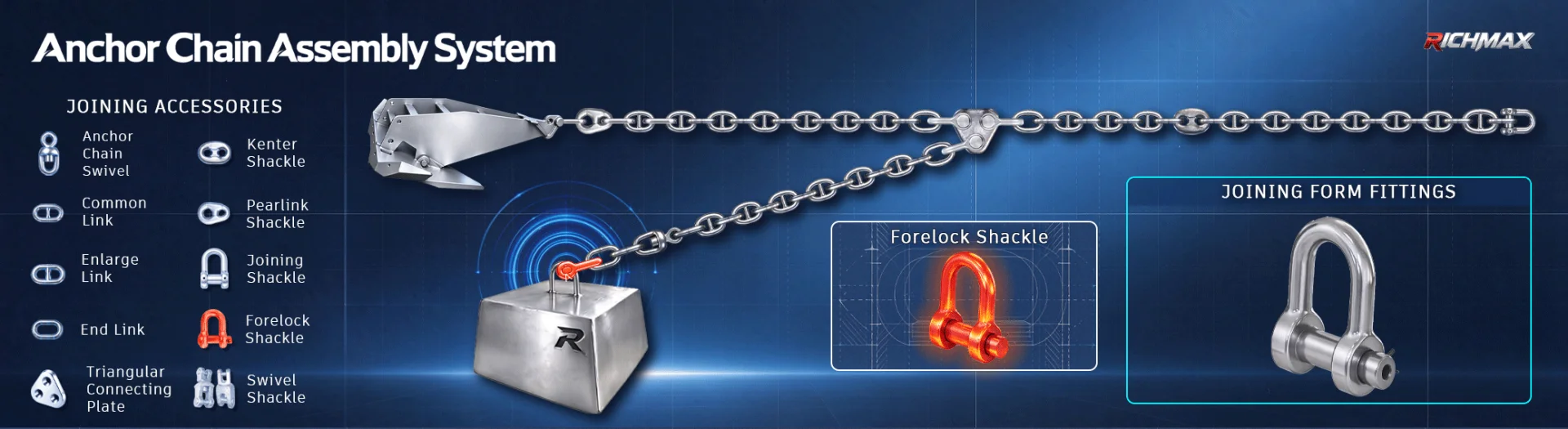
Forelock Anchor Shackle is used to establish a detachable connection between compatible components in a marine anchoring arrangement.
It may be incorporated into an anchor chain assembly where the connection design requires this type of shackle.
Step 1 – Confirm Component Compatibility
Before installation, check that the shackle size matches the anchor chain diameter and the dimensions of the connected components.
The shackle body opening, pin diameter and contact surfaces should correspond to the approved assembly drawing.
Step 2 – Inspect the Shackle Components
Check the body, pin and forelock arrangement for visible damage, deformation, corrosion or other conditions that may affect assembly.
The pin and retaining components should be the correct parts supplied for the specific shackle design.
Step 3 – Assembly
Connect the components in accordance with the manufacturer's assembly drawing and installation instructions.
The pin should be fully seated, and the forelock arrangement should be correctly installed according to the product design.
Step 4 – Final Inspection
After assembly, check the pin seating, retaining arrangement and connection clearances.
Confirm that the connected components can articulate as intended and that there is no obvious interference or abnormal contact.
Step 5 – Periodic Inspection
During service, inspect the shackle for wear, corrosion, deformation and changes in the pin-retaining arrangement.
Any component showing signs of damage or deterioration should be evaluated before further use.
Application
Forelock Anchor Shackle is primarily used in marine anchoring systems and compatible chain connection arrangements.
1. Commercial Vessels
Used in anchor chain assemblies for cargo ships, bulk carriers, tankers, container ships and other commercial vessels.
The shackle dimensions and mechanical properties should correspond to the vessel's approved anchoring arrangement.
2. Shipbuilding and Ship Repair
Used by shipyards and marine repair contractors when assembling, replacing or maintaining anchor chain components.
Dimensional compatibility with the existing chain and connecting fittings is particularly important during replacement work.
3. Marine Engineering Projects
May be specified for marine engineering equipment and chain connection assemblies where the design requires a detachable shackle connection.
The project specification should define the required material, dimensions and mechanical properties.
4. Anchor Chain Assembly
Used as a connecting fitting between compatible anchor chain components or other specified chain accessories.
The connection configuration must be confirmed against the complete anchoring system design.
5. Marine Equipment Distribution
Supplied to marine equipment distributors, ship chandlers and anchor chain suppliers for vessel maintenance, shipbuilding and marine equipment procurement.
How To Choose?
Selecting a Forelock Anchor Shackle requires more than matching the nominal shackle size. Buyers should verify the connection dimensions, material requirements and compatibility with the existing anchor chain system.
1. Confirm the Shackle Type
First, confirm that the required product is a Forelock Anchor Shackle.
Different marine shackles may have similar external shapes but different pin structures, locking arrangements and dimensional requirements.
The quotation should clearly identify the shackle type and applicable drawing or standard.
2. Confirm Anchor Chain Diameter
The shackle must be compatible with the nominal diameter of the anchor chain.
However, matching the chain diameter alone is not sufficient.
The buyer should also check:
Chain link dimensions
Shackle internal opening
Body width
Pin diameter
Connection clearance
These details help ensure that the shackle fits the connected components correctly.
3. Check Material Grade and Mechanical Properties
Material selection should follow the technical requirements of the anchoring system.
Confirm the required steel grade, tensile strength, yield strength and impact properties where specified.
For classification projects, material requirements should be consistent with the applicable classification rules and approved documentation.
4. Verify Dimensions Against the Drawing
A dimensioned drawing should be used to confirm the shackle geometry before production.
Important dimensions include:
Overall length
Overall width
Body thickness
Internal opening
Pin diameter
Pin length
Locking arrangement dimensions
This is particularly important for replacement orders, where the new shackle must fit existing chain components.
5. Confirm Manufacturing and Testing Requirements
Before placing an order, specify the required manufacturing process and inspection scope.
Depending on the project, requirements may include:
Material inspection
Heat treatment records
Dimensional inspection
Mechanical property testing
Non-destructive testing
Proof load testing
Classification inspection
Not every order requires the same inspection scope. The final requirements should follow the purchase specification and agreed inspection plan.
How To Choose A Reliable Marine Anchor Shackle Supplier?
When purchasing Forelock Anchor Shackles, buyers should evaluate the supplier's ability to control material quality, manufacturing dimensions, pin assembly and inspection documentation.
1. Manufacturing Capability
The supplier should be able to explain whether the shackle is manufactured by forging or casting and identify the relevant production processes.
For customized orders, the supplier should be able to review drawings and confirm whether the requested dimensions can be manufactured.
2. Material Traceability
Material identification should be maintained throughout the manufacturing process.
For projects requiring material certificates, the supplier should be able to provide documentation corresponding to the actual material used.
Heat number identification and material records are important for verifying the origin and properties of the steel.
3. Dimensional Control
A reliable supplier should have inspection procedures for the main body, pin and retaining components.
Particular attention should be given to the internal opening, pin diameter, body dimensions and assembly clearance.
These dimensions directly affect whether the shackle can be installed correctly with the intended chain components.
4. Heat Treatment and Mechanical Testing
Where heat treatment is required, the supplier should be able to provide relevant process records.
Mechanical testing should be carried out according to the specified material standard and product requirements.
The supplier should clearly distinguish between standard factory inspection and additional third-party inspection.
5. Quality Documentation
Depending on the order requirements, relevant documents may include:
Material Test Certificate
Dimensional Inspection Report
Mechanical Test Report
Heat Treatment Record
NDT Report, where required
Proof Load Test Report, where required
Classification Certificate, where applicable
The documentation should correspond to the actual product batch and agreed inspection requirements.
6. Export and Delivery Management
For international orders, the supplier should confirm the production schedule, inspection arrangements, packaging method and shipping documentation.
For heavy marine fittings, packaging should prevent damage to machined surfaces, pins and locking components during transportation.
FAQ
1. What is a Forelock Anchor Shackle?
A Forelock Anchor Shackle is a marine chain connecting fitting consisting of a shackle body, removable pin and forelock retaining arrangement. It is used to connect compatible components in specified anchor chain assemblies.
2. What is the function of the forelock?
The forelock is part of the pin-retaining arrangement. Its purpose is to help prevent unintended displacement of the installed pin during normal service.
3. What is the difference between a Forelock Anchor Shackle and a Kenter Shackle?
They have different structural designs.
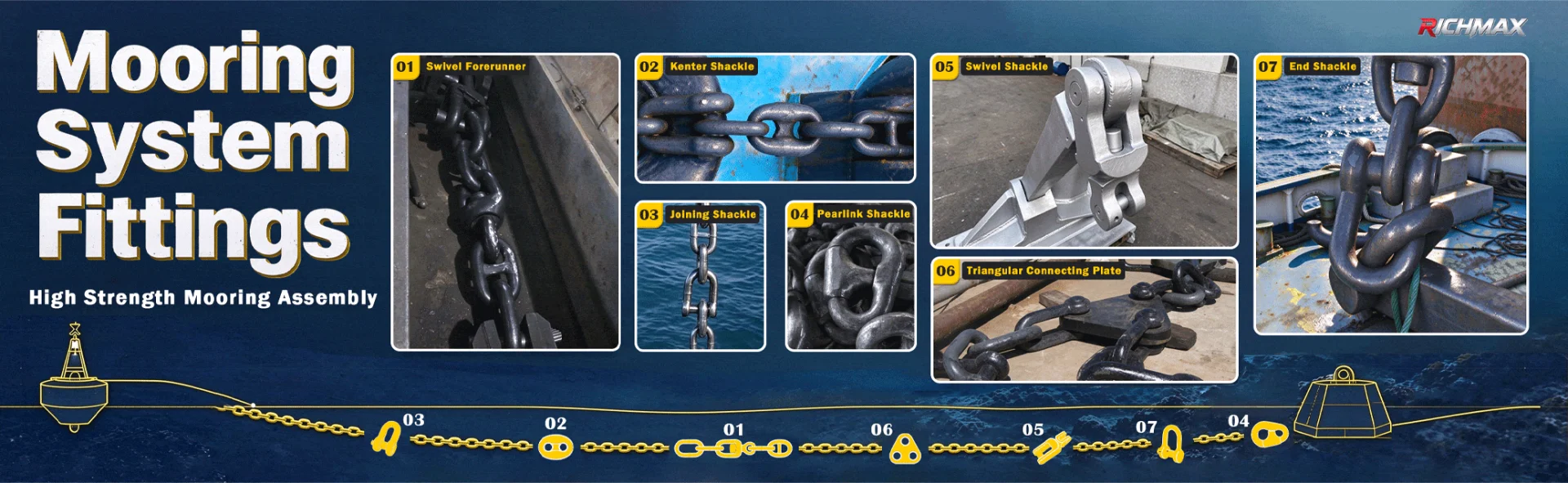
A Kenter Shackle uses a multi-part connecting arrangement with a detachable central connection structure. A Forelock Anchor Shackle uses a shackle body and removable pin with a forelock retaining arrangement.
Their dimensions and connection configurations are different, so they should not be treated as interchangeable without checking the approved design.
4. Is a Forelock Anchor Shackle suitable for all anchor chains?
No. The shackle must match the anchor chain dimensions and the specified connection arrangement.
The nominal chain diameter alone does not establish compatibility.
5. What materials are used for Forelock Anchor Shackles?
Depending on the design and specification, they may be manufactured from forged steel or cast steel.
The actual material grade should be confirmed through the product drawing and purchase specification.
6. Can Forelock Anchor Shackles be customized?
Yes. Customized dimensions and material requirements can be considered according to the customer's drawings, technical specifications and manufacturing feasibility.
7. What inspection is required for Forelock Anchor Shackles?
Inspection may include visual examination, dimensional inspection, material verification, mechanical testing and non-destructive testing.
Proof load testing and classification inspection may also be required depending on the applicable standard and purchase specification.
8. Does a Forelock Anchor Shackle require a classification certificate?
Not every order has the same classification requirements.
For vessels or projects under classification supervision, the buyer should specify the applicable classification society and required approval documents when placing the order.
9. How should the correct shackle size be selected?
The selection should be based on the anchor chain diameter, connecting component dimensions, internal opening, pin diameter and approved assembly drawing.
For replacement orders, comparing the existing shackle drawing and actual dimensions is recommended.
10. Can the pin be replaced separately?
This depends on the product design and manufacturer's requirements.
Replacement pins and retaining components should match the original design in material, dimensions and mechanical properties. Unapproved substitutes should not be used.

 English
 Español
 Français
 Árabe
 Русский
 Português
 日本語
 한국어
 Dansk
 Nederlands
 Italiano
 Türkçe
 Deutsch
 Prancis
 ไทย
 Tiếng Việt
 हिंदी
 বাংলা
 中文