Structure
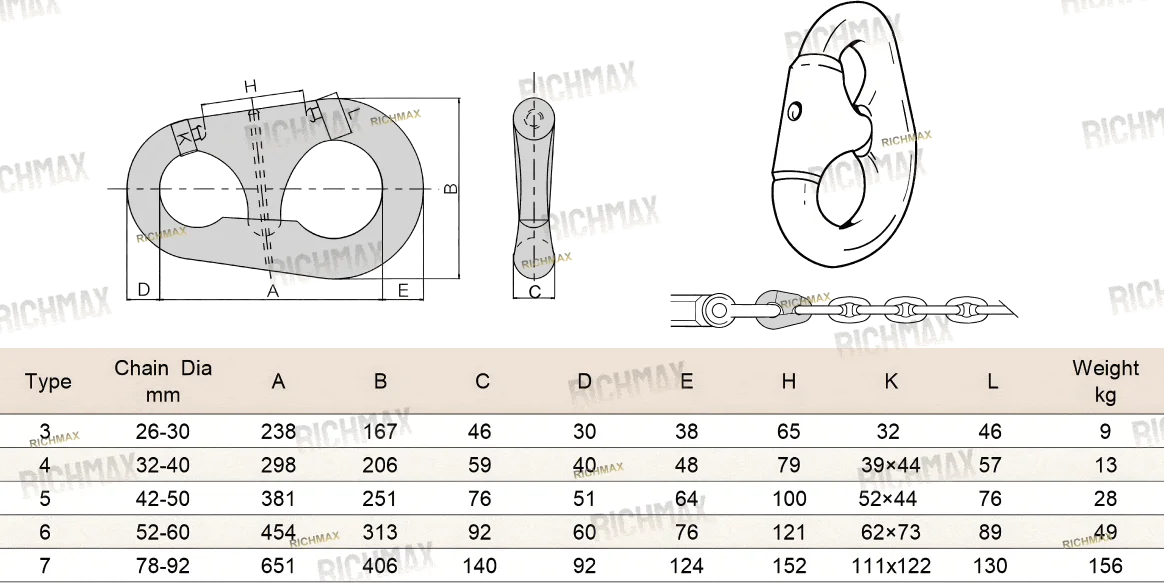
Pear Shaped Connecting Link is characterized by its pear-shaped external profile and two openings with different internal dimensions. The upper section is relatively narrow, while the lower section forms a wider opening. Both openings are integrated into one continuous connecting body.
The main structural feature is the difference in opening geometry between the upper and lower sections. This configuration distinguishes the product from conventional shackles and standard chain connecting links.
The overall structure can be divided into the following areas.
Upper Opening
The upper opening is located at the narrower end of the pear-shaped body. Its internal diameter, opening profile and surrounding material section are defined by the product drawing.
The opening geometry is an important dimensional characteristic because it determines the physical configuration of the component. The internal profile should be consistent with the specified drawing, without unacceptable deformation or surface irregularities.
Lower Opening
The lower opening forms the wider section of the connecting link. Compared with the upper opening, it has a different internal geometry and a larger surrounding body profile.
The dimensions of this opening should be clearly identified in the technical drawing. Inspection should consider its internal dimensions, shape consistency and relationship with the overall body geometry.
Central Connecting Section
The central section connects the upper and lower openings and forms part of the main load-bearing body.
Its cross-sectional dimensions, material continuity and surface condition are important manufacturing characteristics.
Particular attention should be given to the transition between the two openings. Dimensional deviations or unacceptable manufacturing defects in this area may affect product conformity.
Outer Body Profile
The external contour follows a pear-shaped configuration, with a narrower upper section and a wider lower section.
The curved transitions between the two sections should be consistent with the approved drawing. The external profile should be checked for dimensional consistency and visible manufacturing defects.
Integrated Body Construction
Unlike conventional bow shackles and D-type shackles, Pear Shaped Connecting Link does not use a conventional removable pin as its primary structural connection.
Its two openings are formed within one connecting body. The actual manufacturing method, however, should be confirmed from the product specification rather than assumed from its appearance.
Dimensional Requirements
The principal dimensions generally include:
Overall length.
Maximum external width.
Upper opening dimensions.
Lower opening dimensions.
Body cross-sectional dimensions.
External profile dimensions.
Critical transition dimensions.
These dimensions should be defined in the approved product drawing, together with the applicable manufacturing tolerances.
Material
Material selection is an important part of Pear Shaped Connecting Link manufacturing. The specified steel grade should correspond to the product design, required mechanical properties, manufacturing process and intended service environment.
For marine and industrial applications, material requirements should be established before production. The material should not be selected solely according to its nominal strength or external appearance.
Carbon Steel
Carbon steel may be specified for connecting links requiring defined mechanical properties and manufacturing characteristics.
The actual material grade depends on the applicable product specification and customer requirements.
During production, material control should cover chemical composition, mechanical properties and the relevant manufacturing requirements.
Alloy Steel
Alloy steel may be specified where particular mechanical properties or heat treatment requirements are established by the product design.
The alloy composition and heat treatment process should correspond to the specified material grade.
Where applicable, mechanical testing and material documentation should be used to verify conformity with the purchase specification.
Material Chemical Composition
Chemical composition is one of the basic factors used to verify raw material conformity.
Depending on the specified material grade, the inspection may cover:
Carbon content.
Manganese content.
Silicon content.
Sulfur content.
Phosphorus content.
Specified alloying elements.
The acceptance limits should follow the applicable material standard or purchase specification.
Mechanical Properties
Mechanical properties should be verified according to the specified material grade and product requirements.
Relevant test items may include:
Tensile strength.
Yield strength.
Elongation.
Reduction of area.
Impact properties, where required.
Hardness, where specified.
The applicable test methods and acceptance criteria should be agreed before production.
Material Traceability
Material traceability is particularly important for marine equipment and industrial connecting components.
Where required, each production batch should have corresponding material identification and documentation.
Typical records include:
Material grade identification.
Heat number.
Material test certificate.
Chemical composition results.
Mechanical property test results.
Incoming material inspection records.
These records help establish the relationship between the supplied material and the finished product.
How To Use?
Product Integration and Technical Requirements
Pear Shaped Connecting Link is a specialized connecting component intended for designated marine and industrial connection assemblies.
Its distinctive feature is the combination of two differently sized openings within one integrated body. The product geometry should correspond to the connection arrangement specified in the approved equipment design.
The product should not be treated as interchangeable with a conventional shackle, Kenter joining shackle or other chain connector simply because their external dimensions appear similar.
Before incorporating the component into an assembly, the responsible engineering personnel should verify:
Product Identification
Confirm the product designation, drawing number, dimensions and material specification against the relevant technical documentation.
Dimensional Compatibility
The dimensions and opening geometry must correspond to the approved connection design. Visual similarity alone is not sufficient to establish compatibility.
Technical Approval
The component should be accepted only after its material, manufacturing specification and documented performance requirements have been reviewed by qualified personnel.
Inspection Documentation
The relevant material certificates, dimensional inspection records and applicable testing documents should be available according to the purchase and project requirements.
All installation and operational arrangements must follow the approved engineering design and the instructions of qualified equipment personnel.
Application
Pear Shaped Connecting Link is designed for specialized connection arrangements in marine and industrial equipment systems.
Its pear-shaped body and dual-opening configuration distinguish it from conventional single-opening connecting components.
Depending on the approved product design, potential application categories may include:
Marine Chain Assemblies
Pear Shaped Connecting Link may be specified as a connecting component within particular marine chain assemblies.
For these applications, product dimensions, material requirements and manufacturing specifications should correspond to the approved chain system documentation.
Anchor Chain Accessories
Certain anchor chain arrangements may require specialized connecting components with different opening dimensions.
Pear Shaped Connecting Link may be considered where this particular geometry is specified by the equipment designer.
Its suitability should be confirmed against the relevant chain assembly drawings and technical requirements.
Shipbuilding and Marine Equipment
In shipbuilding and marine equipment projects, connecting components are generally selected according to the design of the complete equipment system.
Pear Shaped Connecting Link may be included where its configuration and material requirements are specified in the relevant engineering documentation.
Offshore and Marine Engineering Projects
Offshore and marine engineering projects may involve specialized chain and connection components with defined dimensional and material requirements.
For such projects, the product specification should identify the required material grade, manufacturing standard, inspection scope and applicable approval requirements.
Industrial Chain Connection Systems
Pear Shaped Connecting Link may also be specified for particular industrial chain connection assemblies.
The actual application depends on the equipment design and documented technical requirements.
The product should not be assigned a general lifting or mooring application without confirming its approved design, ratings and applicable certification.
How To Choose?
When purchasing Pear Shaped Connecting Link, buyers should establish the complete technical specification before requesting quotations or placing production orders.
Because the product has two openings with different geometries, dimensional information should be clearly identified in the product drawing.
Confirm the Product Type
First, confirm that the required component is Pear Shaped Connecting Link.
It should be distinguished from other connecting components, including:
Kenter Joining Shackle.
End Shackle.
Connecting Link.
Bow Shackle.
D-Type Shackle.
Different connecting components have different body configurations and manufacturing requirements.
The product name, drawing reference and purchase description should remain consistent throughout the procurement process.
Confirm the Overall Dimensions
The overall dimensions should be provided in a technical drawing.
Important dimensions generally include:
Overall length.
Maximum external width.
Upper opening dimensions.
Lower opening dimensions.
Body cross-section.
External body profile.
Critical transition dimensions.
Dimensional tolerances should also be identified, especially for the two internal openings.
Confirm the Material Grade
The required steel grade should be specified according to the product design and applicable technical standard.
Buyers should clarify whether material certificates, chemical composition records and mechanical property test results are required.
For projects with traceability requirements, material identification should be included in the purchase specification.
Confirm the Manufacturing Method
The manufacturing method should be confirmed according to the approved product design.
Possible production routes may involve forging, casting or other specified manufacturing processes.
The manufacturing method should not be assumed based on the external shape of the finished product.
Buyers should request confirmation of the production process and relevant quality control arrangements.
Confirm Heat Treatment Requirements
Where heat treatment is required, the applicable process and acceptance requirements should be identified.
The supplier should maintain relevant production records and provide test documentation where required by the order specification.
Confirm Inspection Requirements
Inspection requirements should be agreed before production.
Depending on the product specification, inspection may include:
Raw material verification.
Dimensional inspection.
Visual examination.
Mechanical property testing.
Hardness testing.
Non-destructive testing, where applicable.
The inspection methods and acceptance criteria should correspond to the applicable standard and purchase requirements.
Confirm Surface Treatment
The required surface finish should be determined according to the material, manufacturing process and service environment.
Buyers should specify whether the product requires a particular protective coating, surface treatment or other finishing process.
The treatment requirements should be confirmed before production to avoid differences between the quotation and final delivery.
How To Choose A Reliable Pear Shaped Connecting Link Supplier?
When sourcing Pear Shaped Connecting Link, buyers should evaluate more than the quoted unit price.
The supplier's ability to understand the product drawing, control the manufacturing process, maintain material traceability and provide inspection documentation is important for procurement quality.
Technical Drawing Review
A qualified supplier should be able to review the customer's technical drawing and identify the principal product dimensions.
Particular attention should be given to:
Upper and lower opening dimensions.
Overall body dimensions.
Cross-sectional dimensions.
Dimensional tolerances.
Material specification.
Manufacturing requirements.
Any unclear dimensions or technical differences should be resolved before production begins.
Material Procurement and Traceability
The supplier should have a defined material procurement and verification process.
For orders requiring material traceability, the supplier should be able to provide relevant material certificates and heat number records.
Material documentation should correspond to the actual production batch rather than unrelated sample certificates.
6.3 Manufacturing Capability
The supplier should have a clear understanding of the manufacturing method required for the product.
Depending on the approved design, production may involve casting, forging, machining, heat treatment and surface finishing.
Buyers should confirm which processes are completed in-house and which are handled by qualified subcontractors.
This helps establish responsibility for each production stage.
Dimensional Inspection Capability
The two different opening geometries make dimensional inspection an important part of Pear Shaped Connecting Link production.
The supplier should have suitable measuring equipment and inspection procedures for checking the internal openings, overall dimensions and body profile.
Inspection results should be recorded against the approved drawing.
Quality Control and Testing
The supplier should maintain inspection procedures covering raw materials, production processes and finished products.
Where specified, the supplier should be able to arrange mechanical testing, hardness testing and applicable non-destructive testing.
The inspection scope should be based on the actual product requirements rather than applying the same testing package to every order.
Production Records and Documentation
For industrial and marine procurement, production records help establish product conformity and traceability.
Depending on the purchase agreement, documentation may include:
Raw material certificates.
Heat treatment records.
Dimensional inspection reports.
Mechanical test reports.
NDT reports, where applicable.
Final inspection records.
6.7 Export Experience and Order Management
For overseas buyers, the supplier should also be able to manage technical communication, production follow-up, inspection coordination and export documentation.
Product identification, quantities, packing requirements and shipping marks should be consistent with the purchase order.
Clear communication between the buyer and supplier helps reduce misunderstandings during production and delivery.
FAQ
1. What is a Pear Shaped Connecting Link?
Pear Shaped Connecting Link is a specialized connecting component with a pear-shaped body and two openings of different sizes. It is designed for designated marine and industrial connection assemblies.
2. Why is it called Pear Shaped Connecting Link?
The name describes its external appearance. The upper section is narrower, while the lower section is wider, giving the component its characteristic pear-shaped profile.
3. What is the main structural feature of Pear Shaped Connecting Link?
Its main structural feature is the combination of two differently sized openings within one integrated connecting body. This distinguishes it from conventional single-opening shackles.
4. What is the difference between Pear Shaped Connecting Link and Kenter Joining Shackle?
They have different body configurations and connection designs. Pear Shaped Connecting Link features a pear-shaped body with two differently sized openings, while Kenter Joining Shackle has a detachable joining construction. They should not be considered interchangeable without engineering confirmation.
5. What materials are used for Pear Shaped Connecting Link?
Material selection depends on the product design and purchase specification. Carbon steel and alloy steel may be specified according to the required mechanical properties and manufacturing standards.
6. Is Pear Shaped Connecting Link available in different sizes?
Yes. Different dimensions may be available according to the manufacturer's production range or customer drawings. The opening dimensions, body cross-section and overall profile should be confirmed before ordering.
7. Can Pear Shaped Connecting Link be manufactured according to customer drawings?
Custom manufacturing may be available depending on the production process and technical requirements. Customers should provide detailed drawings and material specifications for technical review.
8. What manufacturing methods are used?
The manufacturing method depends on the approved product design. Possible methods include forging, casting or other specified production processes. The actual manufacturing route should be confirmed with the supplier.
9. Does Pear Shaped Connecting Link require heat treatment?
Heat treatment requirements depend on the material grade, manufacturing process and applicable product specification. The process and acceptance criteria should be established before production.
10. What surface treatments are available?
Surface treatment options depend on the material and intended service environment. Specific coating or finishing requirements should be included in the purchase specification.


 English
 Español
 Français
 Árabe
 Русский
 Português
 日本語
 한국어
 Dansk
 Nederlands
 Italiano
 Türkçe
 Deutsch
 Prancis
 ไทย
 Tiếng Việt
 हिंदी
 বাংলা
 中文