Structure
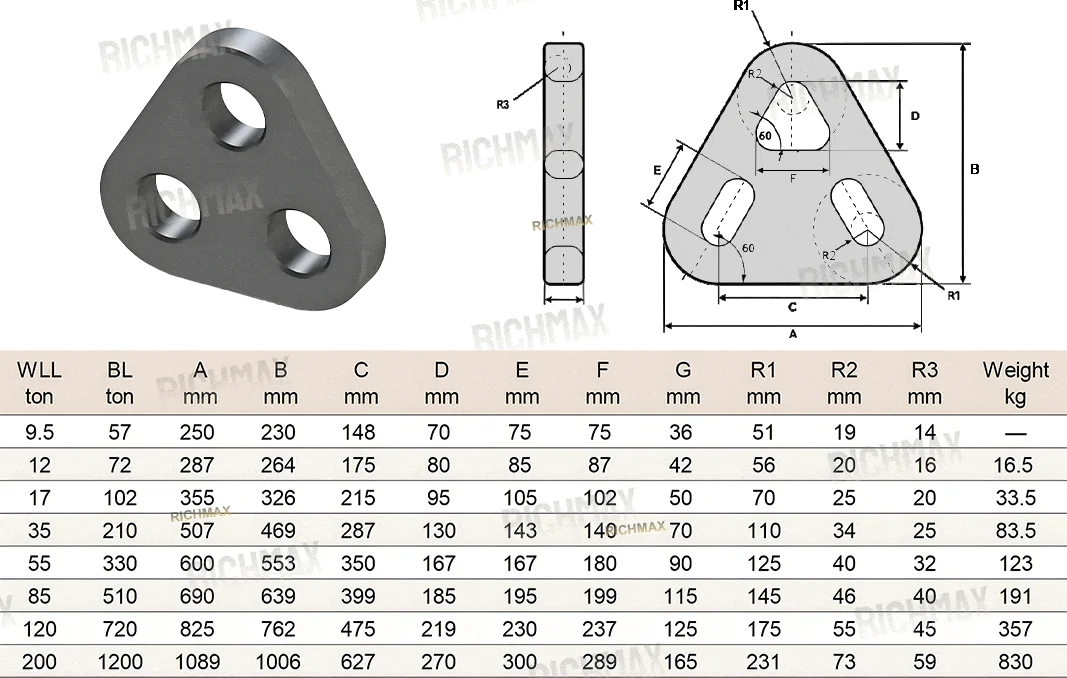
A Triangular Connecting Plate is generally manufactured as a solid steel component with three connection holes arranged in a triangular configuration. Depending on the design, the plate may have an equilateral, symmetrical or customized shape.
The triangular structure provides a centralized connection point for several chain legs, wire ropes or other compatible connecting components. It is commonly referred to as a Tri-Plate, Delta Plate or Triangle Plate in marine and rigging applications.
Main Structural Components
Plate Body
The main body is the load-bearing section of the connecting plate. Its overall dimensions, thickness and geometry are determined by the specified design and mechanical requirements.
Connection Holes
The holes provide connection positions for shackles, pins or other compatible fittings. Their diameter, center distance and positioning must correspond to the connecting hardware specified in the assembly drawing.
Hole Edge and Bearing Area
The material surrounding each hole transfers force between the connecting pin and the plate body. Hole geometry, edge distance and local material thickness are important design considerations.
Rounded Corners and Edges
The external corners and machined edges may be rounded or chamfered to remove sharp edges. This is particularly relevant when the plate is used with wire ropes, synthetic ropes or other flexible components.
Plate Thickness
Thickness is determined by the design load, material properties, connection geometry and required mechanical performance. It should not be selected independently of the other structural dimensions.
Common Structural Configurations
Three-Hole Triangle Plate: Three connection holes arranged in a triangular configuration, commonly used as a multi-point connection fitting.
Two-Hole Triangle Plate: A two-point configuration used for specific connection arrangements.
Customized Tri-Plate: Special hole positions, dimensions, thicknesses or additional connection features manufactured according to project drawings.
The number and arrangement of holes should be confirmed from the actual product drawing rather than inferred from the product name.
Material
Material selection directly affects the mechanical properties, manufacturing process and service suitability of a Triangular Connecting Plate.
For marine and offshore applications, the material should be selected according to the specified working environment, design requirements and applicable product standards.
High-Strength Steel
High-strength steel is commonly used for heavy-duty triangular connecting plates.
Its mechanical properties make it suitable for structural connection components where tensile strength, yield strength and toughness are specified requirements.
The actual steel grade should be identified in the approved drawing or purchase specification. High-strength steel should not be treated as a single material grade because different grades have different mechanical properties and processing requirements.
Alloy Steel
Alloy steel may be specified for connecting plates requiring particular strength and toughness characteristics.
Depending on the selected grade, manufacturing may involve controlled forging, heat treatment and machining. The final mechanical properties should be verified through material documentation and the agreed inspection requirements.
Material Traceability
For project-based marine procurement, material documentation may include:
Material grade and applicable specification.
Heat number and material identification.
Chemical composition.
Mechanical properties.
Material test certificate, where required.
Heat treatment records, where applicable.
Material traceability helps establish a documented relationship between the supplied plate and its original material batch.
How To Use Triangular Connecting Plate?
A Triangular Connecting Plate serves as a connection interface within a multi-point marine or industrial assembly.
Its primary function is to provide several connection positions within one component, allowing compatible connecting hardware to form part of a designed chain, rope or rigging arrangement.
Connection with Marine Hardware
Depending on the approved assembly design, a triangular connecting plate may be associated with:
Anchor chain and connecting shackles.
Mooring chain accessories.
Wire rope assemblies.
Towing connections.
Multi-leg rigging assemblies.
Connection Arrangement
The number of connection points, hole positions and compatible connecting components are determined by the assembly design.
A triangular configuration does not automatically guarantee equal force distribution between all connected legs. Actual force distribution depends on the complete system design and operating conditions.
Component Compatibility
The plate and its associated hardware should be treated as one engineered connection assembly.
Compatibility requirements include the specified hole dimensions, pin configuration, connection geometry and mechanical ratings. The complete assembly must be reviewed and approved by the responsible engineering or technical personnel.
Technical Documentation
Before a product is accepted for a marine or offshore project, the relevant technical documentation should identify the product configuration, material specification, dimensional requirements and applicable load rating.
Installation and operational arrangements should follow the approved project documentation and instructions from qualified personnel.
Application Of Triangular Connecting Plate
Triangular Connecting Plates are used in marine, offshore and industrial connection systems where multiple connection points are required.
Marine Mooring Systems
In marine mooring systems, triangular connecting plates may form part of an assembly involving mooring chains, shackles and other connection fittings.
Their multi-hole configuration provides a common connection interface for different components within the specified mooring arrangement.
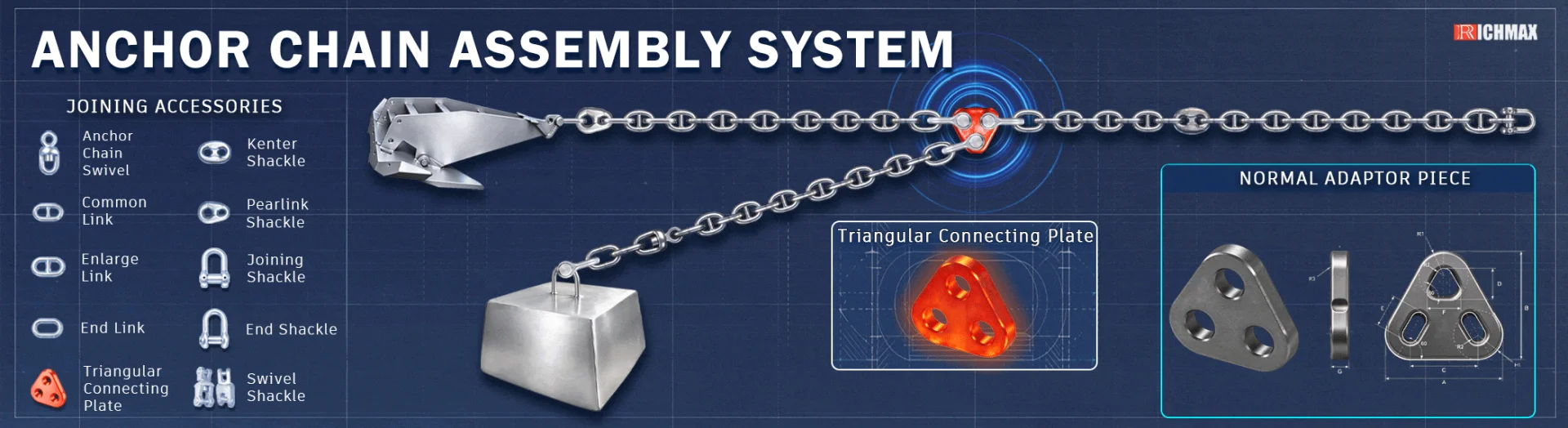
Anchor Chain Systems
Triangular plates can be incorporated into certain anchor-chain connection arrangements where several chain components or connection points need to be brought together.
The plate configuration and connecting hardware must correspond to the approved anchoring system design.
Offshore Engineering
Offshore engineering projects may require specially designed connecting plates for permanent or temporary marine connection systems.
Depending on project requirements, these components may be manufactured with specified material grades, dimensional tolerances and inspection documentation.
Towing and Bridle Assemblies
In marine towing systems, a Triangular Connecting Plate may serve as a common connection component for towing lines or chain bridles.
The plate geometry provides separate connection positions within the assembly, while the actual load distribution remains dependent on the complete towing arrangement.
Industrial Rigging Systems
Triangular plates are also found in industrial rigging assemblies where multiple wire ropes, chains or other connecting elements form part of a designed system.
Different industries may use different plate configurations and rating requirements, so marine, offshore and general lifting products should not automatically be considered interchangeable.
How To Choose Triangular Connecting Plate?
Selecting a Triangular Connecting Plate requires more than matching its external dimensions. The plate must correspond to the intended connection arrangement, material requirements and specified mechanical performance.
The following points are important during technical procurement.
Confirm the Application
First, identify the intended application:
Marine mooring system.
Anchor chain connection.
Offshore mooring arrangement.
Marine towing and bridle assembly.
Industrial rigging connection.
Different applications may require different plate configurations, material grades and documentation.
Confirm the Required Load Rating
The specified Working Load Limit (WLL) or other applicable load rating should be confirmed from the approved product design and technical documentation.
It is important to distinguish between WLL, proof load and Minimum Breaking Load (MBL). These values describe different mechanical requirements and should not be used interchangeably.
The rating should apply to the actual product configuration and intended assembly, not simply to a similarly sized triangular plate.
Check the Dimensional Requirements
The following dimensions should be confirmed against the technical drawing:
| Dimension | Description |
| Overall Length | Maximum length of the plate |
| Overall Width | Maximum width of the plate |
| Plate Thickness | Thickness of the main plate body |
| Hole Diameter | Diameter of each connection opening |
| Hole Center Distance | Distance between the centers of connection holes |
| Edge Distance | Distance from the hole center to the external plate edge |
| Corner Radius | Radius of the rounded external corners |
These dimensions affect the compatibility between the plate and the associated connecting hardware.
Select the Appropriate Material
Material selection should consider:
Required tensile and yield strength.
Impact toughness requirements, where specified.
Operating temperature.
Marine corrosion exposure.
Manufacturing and heat treatment requirements.
Applicable classification or project specifications.
For offshore projects, the specified material grade and traceability requirements should be established before production.
Confirm Surface Treatment
Common surface treatments include:
The coating system should be selected according to the service environment and project requirements.
Review Manufacturing and Inspection Requirements
Before placing an order, confirm the required manufacturing process, dimensional tolerances, inspection scope and certification requirements.
For classified marine or offshore projects, the inspection plan should be agreed upon before production rather than determined only after manufacturing is completed.
How To Choose A Reliable Triangular Connecting Plate Supplier?
When purchasing Triangular Connecting Plates for marine and offshore applications, buyers should evaluate the supplier's ability to control material quality, manufacturing dimensions and product inspection.
A supplier's ability to provide consistent technical documentation is also important for project procurement and product traceability.
Material Control and Traceability
The supplier should be able to identify the material grade used for each production batch.
For products manufactured from high-strength or alloy steel, buyers should confirm whether material certificates and heat number records are available.
Material documentation should correspond to the actual supplied product rather than a general material certificate unrelated to the production batch.
Manufacturing Capability
Ask the supplier to explain its manufacturing process.
Depending on the product design, production may involve forging, heat treatment, machining and surface treatment.
For forged connecting plates, the supplier should be able to explain how forging quality, heat treatment and final machining are controlled.
Dimensional Control
A reliable manufacturer should have the inspection capability to verify:
Overall plate dimensions.
Plate thickness.
Hole diameter and position.
Hole center distance.
Edge distance.
External profile and corner radius.
Surface condition.
Dimensional records should be available when required by the purchase specification.
Mechanical Testing and Inspection
The supplier should understand the difference between material testing, product proof testing and other mechanical inspection requirements.
Depending on the order, inspection may include tensile testing, impact testing, hardness testing, proof load testing and non-destructive testing.
Not every order requires an identical inspection scope. The applicable requirements should be established according to the product design, standard and project specification.
Classification and Certification
For marine and offshore procurement, buyers may require documentation or inspection involving classification societies such as:
BV (Bureau Veritas)
ABS (American Bureau of Shipping)
LR (Lloyd's Register)
DNV
CCS (China Classification Society)
The buyer should confirm whether the supplier's approval, product certification and inspection arrangements cover the specific product and order.
The availability of a classification certificate should not be assumed solely because a supplier manufactures marine hardware.
Production and Delivery Management
For project orders, manufacturing consistency and delivery control are important.
The supplier should be able to provide information about production progress, inspection arrangements, surface treatment, product identification and export packaging.
For large or customized orders, drawing approval and inspection arrangements should be completed before mass production.
FAQ
1. What is a Triangular Connecting Plate?
A Triangular Connecting Plate is a multi-point connection component with a triangular body and multiple connection holes. It is used in marine, mooring, towing and industrial rigging assemblies to connect compatible components within a designed system.
2. What are other names for a Triangular Connecting Plate?
It is also commonly known as a Triangle Plate, Tri-Plate, Delta Plate or Monkey Plate. The exact terminology may vary between manufacturers and applications.
3. What is the main function of a Triangular Connecting Plate?
Its main function is to provide a common connection interface for multiple components. It allows different chain, rope or rigging elements to be incorporated into one connection arrangement.
4. What materials are used to manufacture Triangular Connecting Plates?
Common material options include high-strength steel, alloy steel and stainless steel. The actual material grade depends on the product design, mechanical requirements and operating environment.
5. Are Triangular Connecting Plates manufactured by forging?
Many heavy-duty marine models are manufactured by forging. However, manufacturing methods can vary depending on product dimensions, structural design and technical requirements.
6. What surface treatments are available?
Common finishes include black painting, hot-dip galvanizing and specified marine protective coating systems. The appropriate finish depends on the corrosion exposure and project requirements.
7. Can Triangular Connecting Plates be customized?
Yes. Customized products can be manufactured according to approved drawings and specifications. Customization may include overall dimensions, plate thickness, hole diameter, hole arrangement, material grade and surface treatment.
8. What is the difference between a Triangular Connecting Plate and a Joining Shackle?
A Joining Shackle is generally designed to connect two compatible chain ends or components, while a Triangular Connecting Plate provides multiple connection positions within one assembly.
They serve different connection purposes and are not interchangeable.
9. What is the difference between a Triangular Connecting Plate and a Pear Shaped Connecting Link?
A Pear Shaped Connecting Link has a pear-shaped body designed around a specific connection configuration. A Triangular Connecting Plate uses a plate structure with multiple connection holes.
Their dimensions, connection arrangements and mechanical ratings differ according to the respective designs.
10. Is a Triangular Connecting Plate suitable for offshore applications?
It can be used in offshore connection systems when the product design, material properties, mechanical rating and certification meet the relevant project requirements.



 English
 Español
 Français
 Árabe
 Русский
 Português
 日本語
 한국어
 Dansk
 Nederlands
 Italiano
 Türkçe
 Deutsch
 Prancis
 ไทย
 Tiếng Việt
 हिंदी
 বাংলা
 中文